
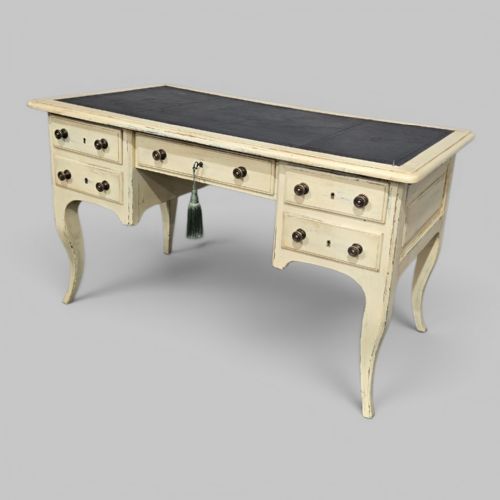
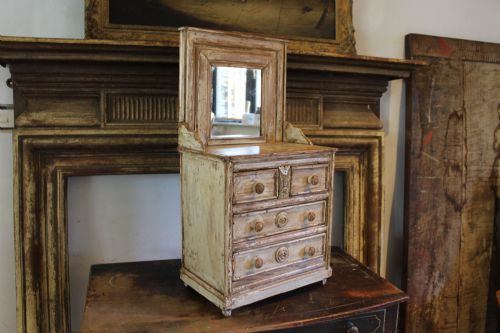


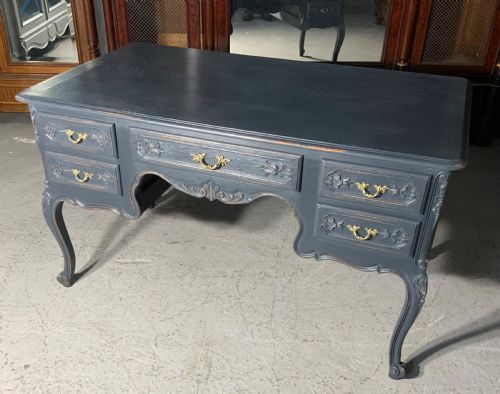


Painted French Bureau
A painted french bureau brings refined continental workspace style into a room, offering hidden compartments alongside decorated surfaces.
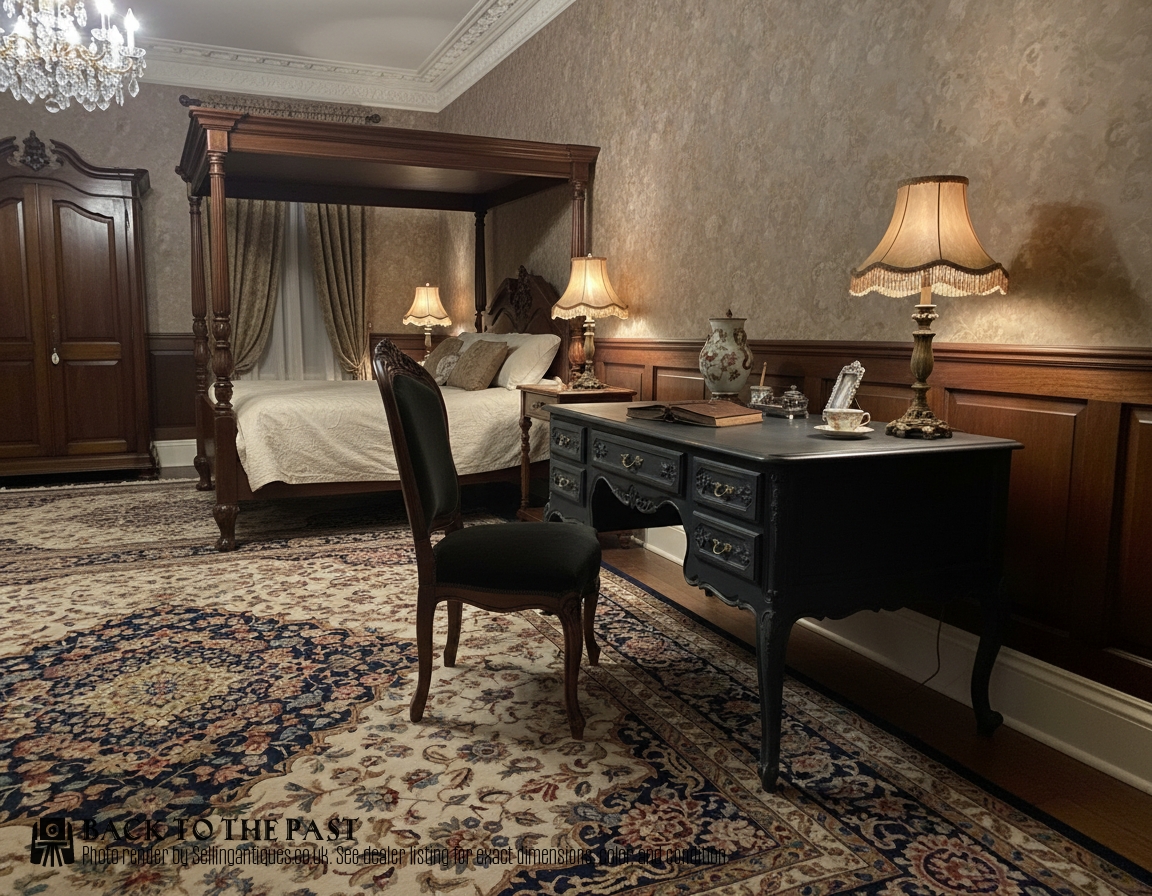
Painted French Bureau
A painted french bureau covers writing cabinets, kneehole desks, cylinder escritosires, and secretaires spanning the nineteenth and early twentieth centuries. These pieces combine practical storage with decorative painted finishes, often drawing on Louis XV and Louis XVI revival aesthetics.
The most common examples encountered here are nineteenth century creations featuring painted wood, lacquer, or vernis martin panels alongside kingwood, oak, or mahogany carcases. Miniature apprentice chests of drawers and desks also appear among the larger writing cabinets.
Regional variations extend from French provincial forms to Dutch bombe commodes and chinoiserie decoration. Buyers select these desks for their sloping fall fronts, superstructure galleries, and decorative motifs that suit period and eclectic interiors alike.
How they were made
Construction relies on timber carcases of pine, oak, or mahogany, frequently veneered with kingwood and finished with hand-applied paint, lacquer, or vernis martin panels. Artisans built fall fronts and cylinder mechanisms to conceal fitted pigeonholes and secret drawers.
Metalwork played a structural and decorative role, with ormolu mounts, brass accents, and iron hardware fitted to corners, handles, and escutcheons. Carved wooden details and inset marble tops completed the construction of high-status writing cabinets.
Listings feature pieces spanning the nineteenth and early twentieth centuries, utilising materials including ormolu, kingwood, painted wood, and lacquer.
What varies in quality
The sophistication of the painted or lacquered decoration dictates much of the distinction between pieces, particularly where hand-painted vernis martin scenes or floral plaques are present. Fine joinery in the execution of curved cylinder fronts, secret drawers, and fitted interiors further separates standard production from finer workshop output.
The integration of cast ormolu mounts and quality brass hardware influences the overall finish. Selecting pieces with harmonious proportions and intact original painted surfaces preserves the character intended by the maker.
The Painted French Bureau Glossary
- Vernis Martin
- A type of simulated Japanese lacquer developed in eighteenth-century France and emulated in later revival pieces. It uses successive layers of varnish to create translucent decorative panels.
- Secretaire
- A desk featuring a writing drawer or a fold-down fall front that conceals inner compartments and pigeonholes. It often stands on slender cabriole legs.
- Ormolu
- Gilt-bronze mounts applied to furniture for decorative effect. It adds metallic contrast to wood and painted surfaces.
- Bonheur de jour
- A light lady's writing desk featuring a small superstructure with shelves or drawers above the main work surface. This form gained popularity during the Louis XV and Louis XVI periods.
- Kingwood
- A dense, richly figured timber native to Brazil used extensively for veneering fine cabinetwork. Its distinct grain patterns complement ormolu and painted panels.
Painted French Bureau: Frequently Asked Questions
How do vernis martin panels differ from standard paint?
Vernis martin involves multiple layered resin varnishes applied to create translucent pictorial scenes, imitating Asian lacquer work.
Standard painted finishes rely on opaque pigments applied directly to wood, sometimes enhanced with decorative motifs.
What is a bonheur de jour desk?
A bonheur de jour is a compact writing desk equipped with a raised upper tier of small drawers or open shelves.
These pieces were designed for lighter correspondence and boudoir use rather than heavy administrative tasks.
How do you date nineteenth century painted desks?
Dating relies on stylistic markers such as Louis XV or XVI revival motifs, construction techniques, and material combinations.
Cabinetmakers working around eighteen eighty to nineteen hundred often blended historical revival styles with contemporary manufacturing methods.
Where were apprentice miniature chests used?
Apprentice miniature chests served as showcase pieces demonstrating a craftsman's skill before guild admission.
These scaled-down examples replicate the joinery and painted finishes of full-sized furniture in miniature form.