
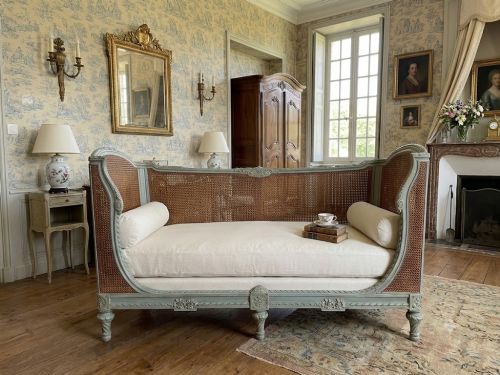


Painted Cane Bench
These painted cane bench pieces bring seating with woven panels and painted frames into your rooms.
Painted Cane Bench
A painted cane bench combines a wooden frame with woven panels and painted surfaces, creating a light yet sturdy seat for a hallway, bedroom or reception room. These pieces range from compact window seats and small daybeds to generous settees and sofas spanning the eighteenth, nineteenth and early twentieth centuries.
The version you are most likely to meet on this page is the French Louis XVI style or Régence style piece, often dating from the nineteenth century or around nineteen ten. These examples feature painted wood, occasionally highlighted with gold leaf, alongside traditional cane work and sometimes upholstered linen or fabric cushions.
Beyond French chateau and neoclassical revivals, the selection includes Swedish Gustavian settees, Italian window seats and Viennese bentwood forms like the Thonet loveseat. Makers and artisans utilised beech, satinwood and rattan cane to construct benches, daybeds and settees that serve both decorative and practical functions.
How they were made
The construction of these seats relies on sturdy timber frames shaped from beech or satinwood, often carved with neoclassical details or flowing curves. Artisans then drill the framework to weave rattan cane by hand, creating resilient and breathable panels for the seat or backrest.
Once the joinery and caning are complete, craftsmen apply layers of paint to the wooden structure, sometimes finishing the surface with gold leaf accents. Many pieces incorporate dropped-in or fixed cushions upholstered in fabric or linen to complement the painted woodwork.
Listings feature pieces spanning from the eighteenth century through to nineteen twenty, incorporating beech, satinwood, linen and gold leaf.
What varies in quality
The distinction between standard examples and superior pieces rests upon the crispness of the timber carving and the uniformity of the hand-woven cane panels. Finer items display tightly tensioned rattan work that follows the structural contours precisely, alongside refined layers of historic paint rather than heavy modern coatings.
Proportion and stylistic coherence also set pieces apart, as seen in balanced neoclassical leg turning and harmonious proportions between the painted frame and the upholstered elements.
The Painted Cane Bench Glossary
- Cane
- Woven material made from the outer skin of rattan palms, utilised for resilient seat and back panels. It provides flexibility and a lightweight appearance.
- Gustavian
- Swedish neoclassical style characterised by restrained symmetry, pale painted finishes and simplified classical motifs. This aesthetic emerged during the late eighteenth century.
- Bergère
- Enclosed upholstered armchair or settee with wooden frames and solid sides. The armrests typically join the upholstered backrest.
- Régence
- French transitional style bridging Louis XIV and Louis XV periods, featuring asymmetric curves and rich carving. Pieces from this era display early rococo movement.
- Satinwood
- Hardwood with a lustrous, satin-like grain frequently employed in fine furniture making. It accepts decorative paint finishes exceptionally well.
Painted Cane Bench: Frequently Asked Questions
Where should I place a painted cane bench?
These seats suit hallways, bedrooms and reception rooms where their decorative painted frames and woven panels add texture without visual heaviness. They work effectively beneath windows or at the foot of a bed.
Ensure the room humidity remains stable to protect both the wooden frame and the natural cane weave from drying out or sagging over time.
How do I care for the cane panels?
Dust the woven surfaces regularly with a soft brush and wipe them gently with a barely damp cloth when necessary. Avoid excessive moisture on the natural rattan fibres.
Keep these pieces away from direct heat sources and harsh sunlight to prevent the cane from becoming brittle and snapping.
What is the difference between a settee and a daybed?
A settee functions primarily as a two or three seater sofa with a defined backrest and arms for upright sitting. It suits living spaces and hallways.
A daybed incorporates an elongated seat or a raised end, allowing a person to recline fully while resting during the daytime.
How do I identify a neoclassical revival piece?
Revival pieces display straight tapered legs, carved fluting and classical motifs inspired by ancient Greece and Rome, echoing eighteenth-century aesthetics. Makers produced these during the nineteenth and early twentieth centuries.
Examine the construction methods, tool marks and paint layering to distinguish nineteenth-century interpretations from earlier eighteenth-century originals.