
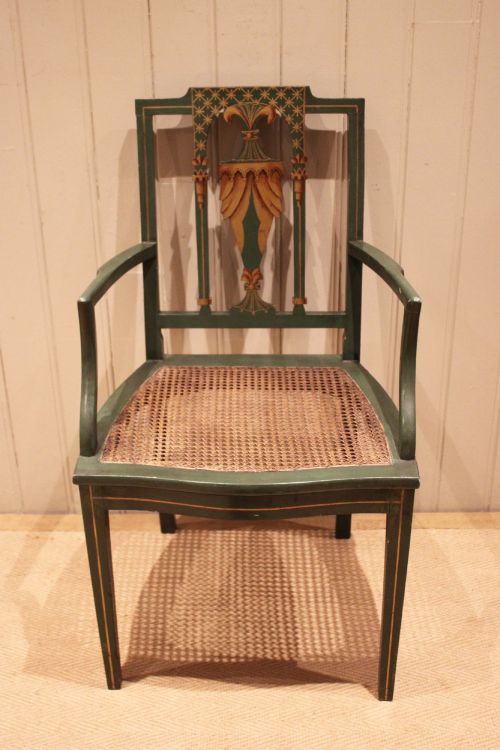
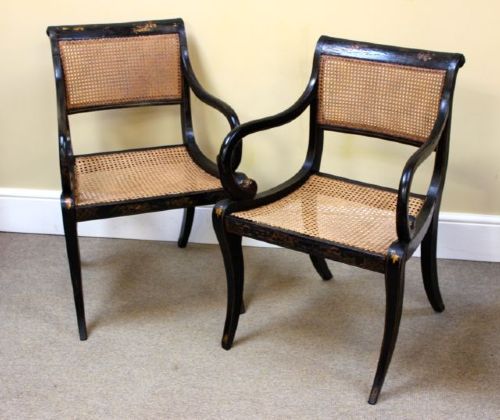
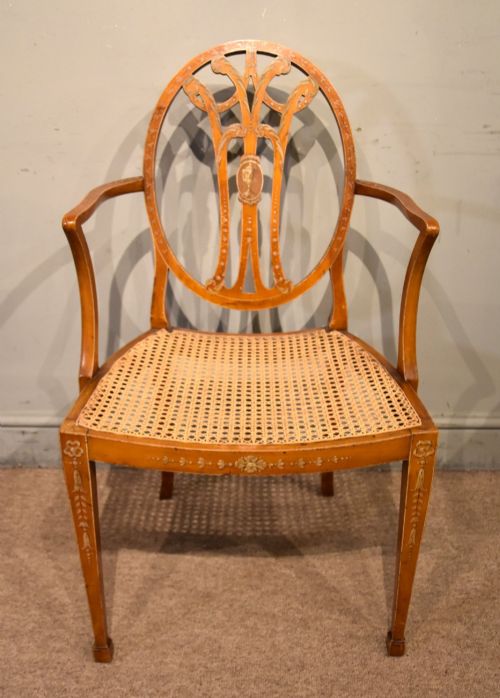
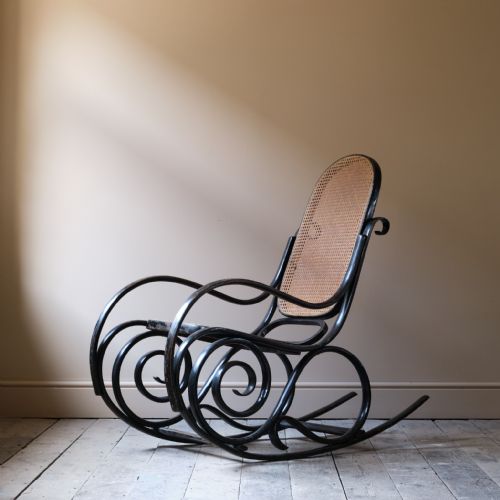
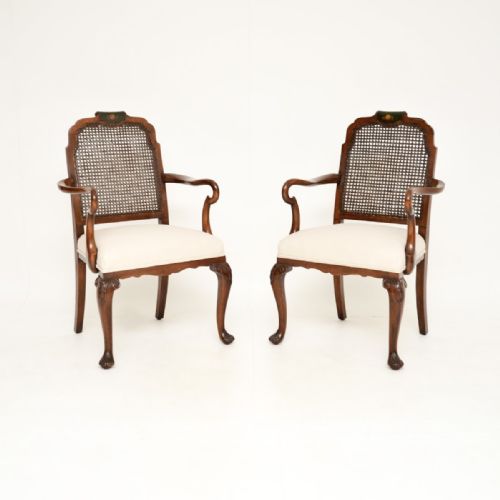


Painted Cane Armchairs
These painted cane armchairs bring lightness and texture to a room, offering sturdy seating framed in wood and woven panels.
Painted Cane Armchairs
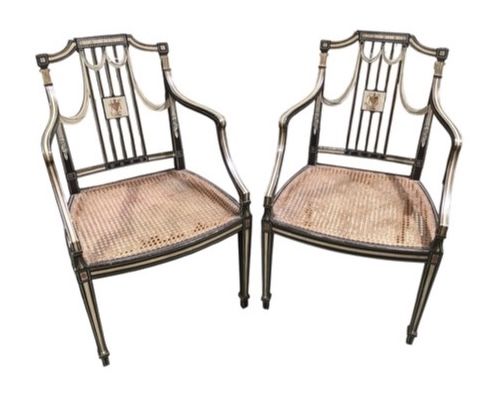
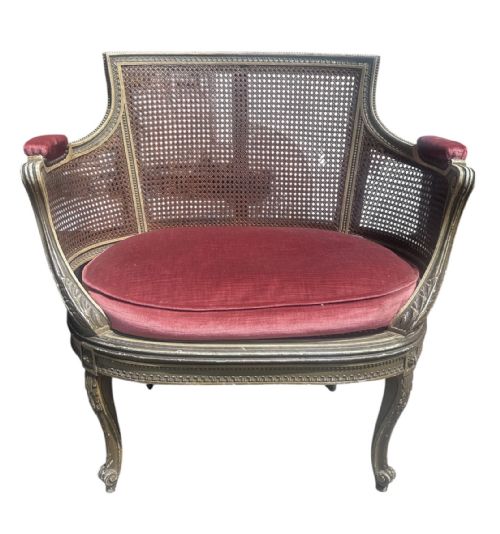
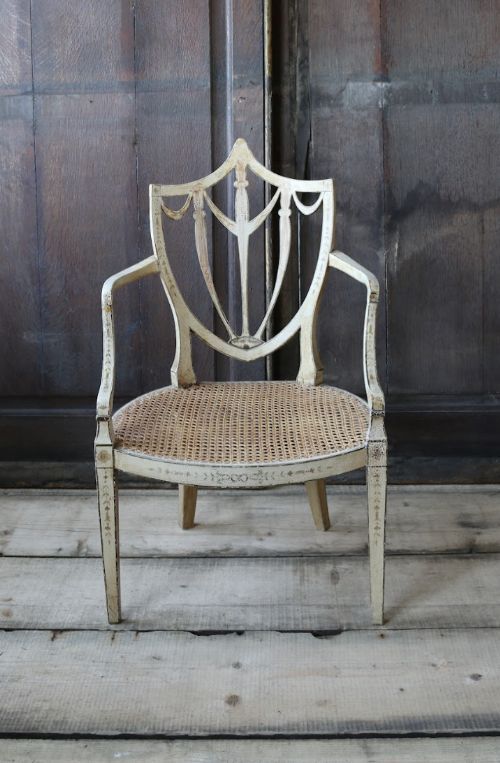
Painted cane armchairs combine timber frames with woven seating or back panels, finished in decorative pigments, gilt, or lacquer. Buyers seeking these painted cane armchairs encounter diverse influences, from crisp Regency proportions to ornate French Louis XV and Louis XVI revivals.
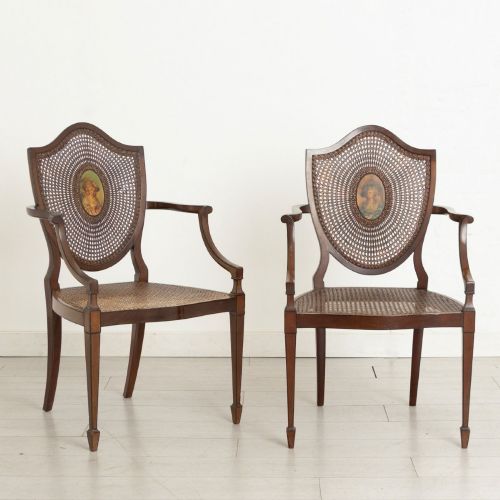
The selection ranges from late eighteenth-century shield-back designs to early twentieth-century satinwood and walnut pieces, including pairs and single salon chairs. Bergere forms with enclosed cane sides appear frequently alongside lighter elbow chairs and occasional rocking chairs.
Origin and period dictate the exact silhouette, with English Regency models favouring classical restraint while French revival examples display flowing cabriole legs and carved crests. Chinoiserie and japanned finishes introduce rich pictorial details to the traditional wooden framework.
Assessing quality and craftsmanship
Quality rests in the crispness of the woodwork carving, the tautness and regularity of the cane weave, and the integrity of the painted finish. Finer examples retain their original decorative schemes and delicate hand-painted motifs rather than heavy modern overcoats.
Construction methods distinguish finer workshop output, where tight joinery and seasoned hardwoods ensure stability without excessive bulk. The balance between the painted decoration and the natural texture of the cane defines the visual success of each piece.
A daring nineteenth-century maker once substituted traditional timber entirely with faux bamboo, proving that even plant mimics deserve a sturdy wooden core.
The Painted Cane Armchairs Glossary
- Bergere
- An enclosed upholstered armchair with solid sides, often featuring cane panels beneath loose cushions. This French form provides a deeper seat than a standard open armchair.
- Cane
- Woven material made from the outer skin of rattan palms, used to create flexible and breathable seats and backs. It requires careful tensioning during manufacture to support weight evenly.
- Japanned
- European imitation of East Asian lacquerwork, built up through successive layers of varnish and pigment. This decorative technique often depicts landscapes and figures in gold on a dark ground.
- Shield-back
- A chair back shaped in the outline of a heraldic shield, popularised by eighteenth-century designers. It typically frames an open splat or a woven cane insert.
- Parcel gilt
- Partially gilded woodwork where gold leaf highlights specific carved details, mouldings, or motifs. This technique contrasts metallic lustre against a painted background.
Painted Cane Armchairs: Frequently Asked Questions
How do I clean painted cane armchairs?
Dust the wooden frame gently with a dry cloth and vacuum the cane weave on a low suction setting using a soft brush attachment.
Avoid liquid cleaners and excessive moisture, which can loosen the woven fibres or damage delicate painted surfaces over time.
Are painted cane armchairs comfortable for daily use?
The woven cane provides a springy, breathable surface that adapts well to body weight during shorter periods of sitting.
Many styles accommodate loose squab cushions upholstered in velvet or fabric to enhance comfort for prolonged lounging.
How do I distinguish Regency from Louis XV style?
Regency pieces lean towards classical geometry, rectilinear frames, and restrained painted decoration inspired by antiquity.
Louis XV style chairs feature asymmetrical curves, cabriole legs, and elaborate carved floral motifs derived from French rococo designs.
Can I place these chairs in direct sunlight?
Intense sunlight causes painted and lacquered finishes to fade or crack, while also drying out natural cane fibres.
Positioning the chairs away from south-facing windows preserves the integrity of the wood and the flexibility of the weave.