

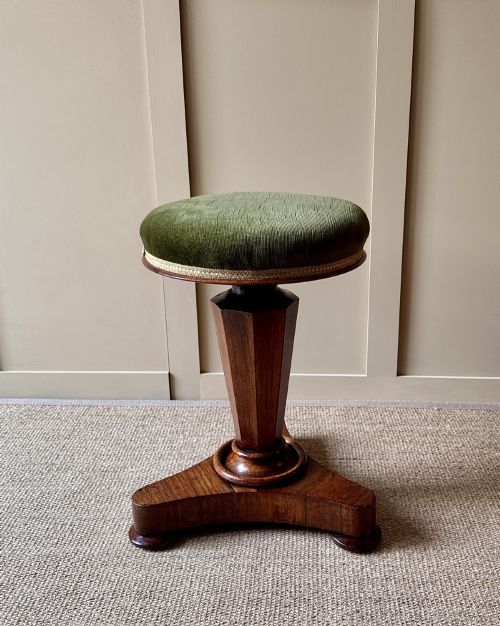


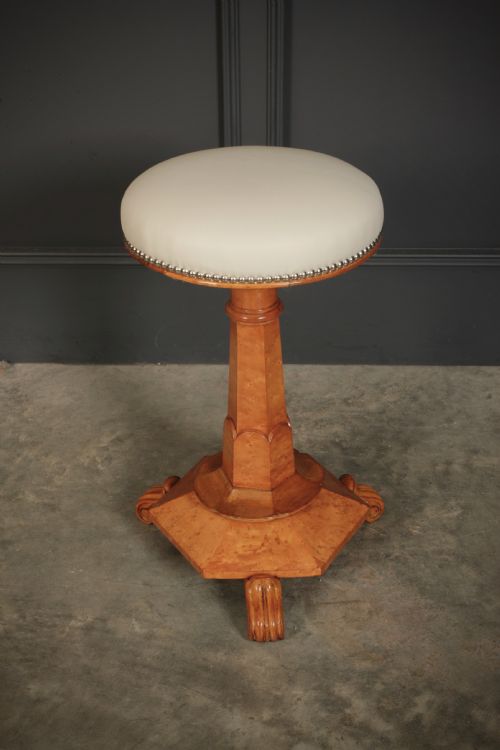


Padded Revolving Piano Stool
These padded revolving piano stool examples offer adjustable comfort at the keyboard, combining period timber work with practical swivel mechanics for daily use.
Padded Revolving Piano Stool
A padded revolving piano stool provides a stable yet adaptable seat for musicians, featuring a central mechanism that raises or lowers the top. The selection includes Victorian, Edwardian, William IV, Art Deco, and Empire examples.
Buyers will encounter circular seats and adjustable screw top designs matched with original fabric, velvet, textile, and leather upholstery. The timber frames often display carved details that reflect the prevailing stylistic periods of their manufacture.
How they were made
Joiners constructed the structural frames using dense hardwoods such as mahogany, walnut, and rosewood, frequently employing turned columns and carved supports. Brass components commonly appear within the revolving screw mechanisms that allow the seat height to change.
Upholsterers padded the circular tops using traditional textile fillings before securing outer coverings of velvet, fabric, or leather. Metal elements like iron also support the internal adjustable hardware found beneath the padding.
Padded Revolving Piano Stool Retail Price Guide 2026
Typical asking prices for padded revolving piano stool among the pieces listed under this phrase on Sellingantiques today, from the lower quarter to the upper quarter. They describe what is for sale here now, not the wider market.
Musicians relied on these spinning tops to find the exact height needed for heavy nineteenth century piano action.
What varies in quality
The sophistication of the timber carving and the richness of the wood grain distinguish simpler workshop output from finer examples. Finer pieces demonstrate careful proportion in the turned legs and superior joinery that maintains stability during rotation.
The integrity of the internal screw mechanism dictates mechanical performance, while the survival of original upholstery textiles adds historical completeness. Finer models exhibit precise metal threading that operates smoothly across the full adjustment range.
James Shoolbred
The Padded Revolving Piano Stool Glossary
- Revolving piano stool
- A seat with a mechanism allowing the top to spin and adjust in height for the player. This design became common during the nineteenth century.
- Screw top
- An adjustable mechanism utilising a central threaded metal rod that raises or lowers the seat when turned. This allows precise height customisation.
- Birds eye maple
- A figured timber showing small contrasting dots resembling bird eyes within the grain pattern. It appears in later styles such as Art Deco.
- William IV
- A British design period spanning the eighteen thirties characterised by robust classical revival forms and heavy timber turning. Pieces from this era often feature rich mahogany.
Padded Revolving Piano Stool: Frequently Asked Questions
How do I adjust the seat height?
The top rotates around a central threaded screw column, rising or lowering as you turn the seat clockwise or anti-clockwise.
This simple mechanical action requires no levers or pins, operating entirely through rotation.
Are these seats comfortable for daily practice?
The padded tops provide firm support suitable for extended periods at the keyboard, utilising traditional upholstery stuffing.
Different models feature varied cushion depths depending on their stylistic period and intended level of luxury.
How do I identify a Victorian example?
Victorian pieces typically display dark hardwoods like walnut or mahogany, often with turned structural members and carved decoration.
Date markers can sometimes be deduced from specific patent hardware or registered design stamps beneath the frame.
Can I use these at a modern desk?
The adjustable height mechanism makes these pieces adaptable for writing desks or dressing tables as well as instruments.
Check the lowest and highest possible settings to ensure compatibility with your existing furniture dimensions.