
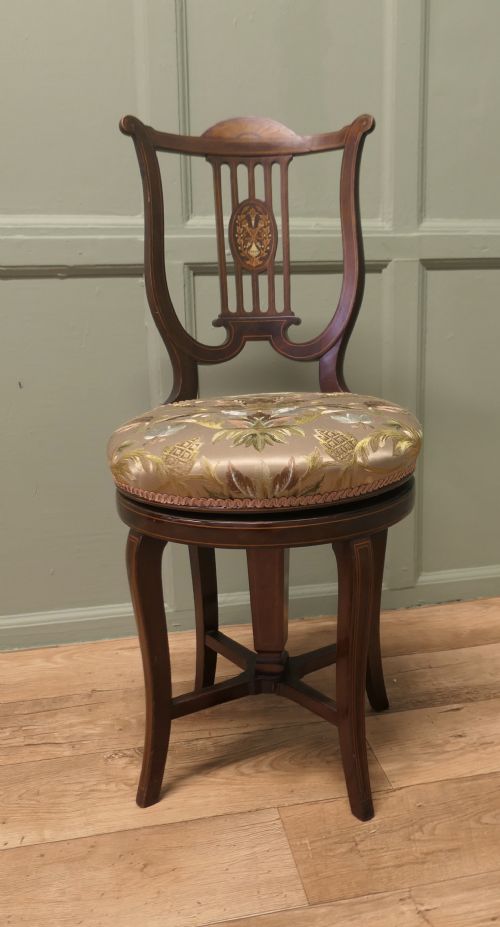

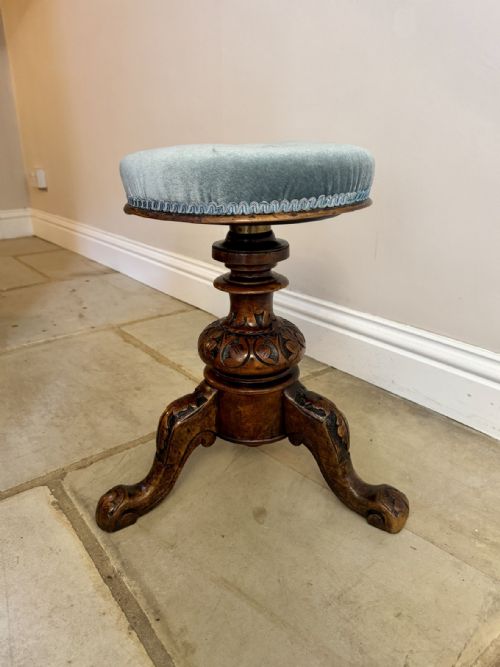


Edwardian Revolving Piano Stool
An Edwardian revolving piano stool offers smooth adjustment at the keyboard through an ingenious mechanical screw action hidden beneath the seat.
Edwardian Revolving Piano Stool
An edwardian revolving piano stool combines practical height adjustment with comfortable seating for the musician at home. These pieces appear in forms such as circular revolving piano stools, music chairs, and swivel base piano stools originating from the nineteenth and early twentieth centuries.
The buyer encounters designs influenced by Victorian, Edwardian, Sheraton Revival, and Victorian Arts and Crafts styles. They feature tripod bases, lyre backs, and carved wooden frames tailored for domestic music rooms.
How they were made
Cabinet makers utilised dense hardwoods including mahogany, walnut, rosewood, and ebonised timber to construct the frames. These woods were often carved with decorative details or finished with satinwood accents.
The revolving mechanism relies on sturdy brass fittings that allow the seat to rise and fall smoothly. Seats were upholstered in durable textiles, velvet, and fabric to provide comfortable support during long practice sessions.
Cellists favoured specialised music chairs with open backs so their bows wouldn't catch while playing.
What varies in quality
The distinction between standard examples and superior pieces rests upon the crispness of the timber carving and the complexity of the frame design. Finer specimens display refined details such as lyre backs, intricate tripod legs, and high-status timbers like rosewood.
The engineering of the internal swivel mechanism dictates the daily performance of the stool. Smooth, reliable rotation and secure height adjustment indicate superior workshop execution from makers who prioritised mechanical longevity.
James Shoolbred
The Edwardian Revolving Piano Stool Glossary
- Revolving
- A seating mechanism that turns full circle on a central threaded screw. This allows the player to adjust their playing height effortlessly.
- Lyre back
- A chair back shaped in the symmetrical outline of an ancient stringed musical instrument. This motif is frequently found on music chairs from the period.
- Tripod base
- A three-legged support structure providing stability on uneven domestic floorboards. It is a common feature on nineteenth-century music seating.
- Ebonised
- Timber treated with a dark finish to imitate expensive ebony. This technique was popular in Victorian and later furniture production.
- Rise and fall
- A mechanical action that alters seat height when turned. It ensures the pianist maintains an ergonomic posture.
Edwardian Revolving Piano Stool: Frequently Asked Questions
Are these stools comfortable to use?
Yes, they were specifically designed to support pianists and cellists during extended periods of practice and performance. The padded circular or chair-back tops offered stable yet flexible seating.
Original upholstery may be replaced over time with matching velvet, fabric, or textile to maintain comfort. The solid timber frames ensure enduring structural stability.
Can I use one as a desk chair?
While originally built for the piano or music stand, their compact footprint makes them suitable as occasional seating at small writing desks. The swivel function is particularly convenient in tight studies.
Check that the lowest height setting matches your desk clearance before daily use. Taller models may sit above standard modern desk heights.
How do I date an Edwardian stool?
Dating relies on stylistic clues, construction methods, and materials recorded across the piece. Edwardian examples often feature lighter mahogany or satinwood decoration compared to heavy Victorian walnut.
Maker stamps or retailer labels, when present beneath the seat, provide definitive dating evidence. Comparing the turned legs and carving style to documented pieces helps narrow the decade of manufacture.