
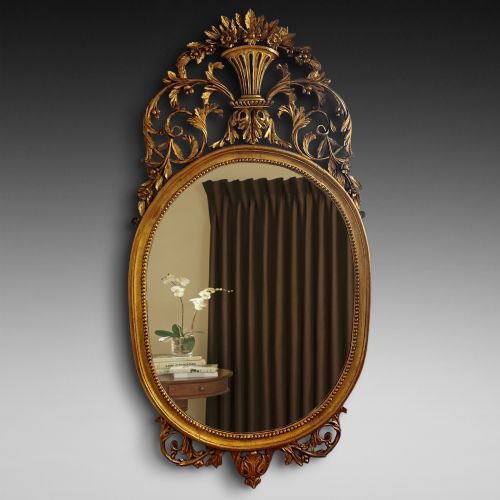
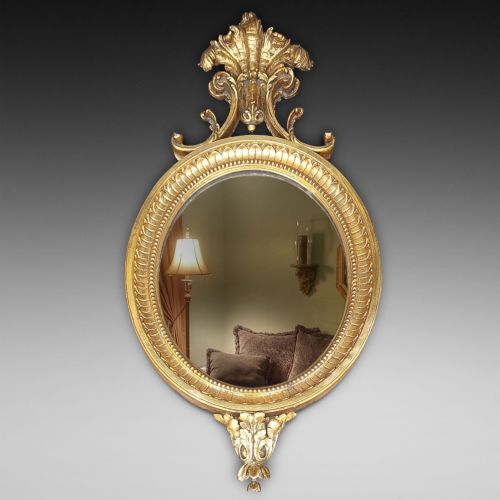


Oval Gilt Looking Glass
An oval gilt looking glass brings warmth and reflected light to a room, pairing a curved wooden frame with a gilded surface.
Oval Gilt Looking Glass
An oval gilt looking glass is a wall mirror defined by its curved frame and metallic finish, appearing across periods from the seventeenth century through the Victorian era. These pieces function primarily as wall mirrors, shaped to soften the rigid corners of a traditional interior.
The versions most frequently met on this page date from the Georgian and Victorian periods, alongside Regency and nineteenth-century examples. Makers shaped these frames from timber such as pine, applying layers of gesso and gold leaf to achieve the characteristic reflective surface.
Materials and construction
Makers constructed the core of these frames using timber like pine, which provided a stable base for detailed carving and moulding. Over this wooden structure, artisans applied gesso to build up decorative motifs and smooth the surface before gilding.
The final appearance relies on gold leaf, gilt, or silver gilt applied to the prepared frame, paired with mirrored glass. Certain examples incorporate rope twist details or carved ribbons and bows, showcasing the precise handwork of the period.
Listings feature periods spanning from the seventeenth century to the twentieth century, including Georgian, Regency, and Victorian examples.
Factors of quality
The distinction between standard examples and the finest pieces rests upon the depth and precision of the carved ornament on the giltwood frame. Crisp detail in the gesso work and the preservation of the original gold leaf indicate superior craftsmanship.
Quality also appears in the retention of the original mirrored glass and the structural integrity of the timber beneath the gilding. Pieces that maintain their primary surfaces without extensive later repairs command greater attention from collectors.
The Oval Gilt Looking Glass Glossary
- Giltwood
- Wood that has been coated with gold leaf or a gold-coloured finish. This technique creates a luminous surface that catches natural light in a room.
- Gesso
- A plaster-like mixture applied to timber frames to create a smooth surface for carving and gilding. It allows artisans to shape intricate relief details.
- Girandole
- A branched wall mirror designed to hold candles alongside the glass. These reflective fixtures amplify the illumination within an interior space.
- Looking glass
- A traditional term for a mirror. Historical pieces often feature slightly distorted or hand-blown glass plates.
- Rope twist
- A carved decorative motif resembling intertwined rope. This pattern frequently edges the frames of nineteenth-century mirrors.
Oval Gilt Looking Glass: Frequently Asked Questions
Where should I hang an oval gilt looking glass?
These mirrors suit principal reception rooms, hallways, or above a mantelpiece where their vertical or horizontal oval shape breaks up wall expanses.
Positioning the glass opposite a window maximises the reflected daylight brought into the interior.
How do I identify a Georgian mirror?
Georgian pieces display the carved wooden and gesso techniques characteristic of the eighteenth century, often showing specific neoclassical or period motifs.
Examining the construction of the timber frame and the backboards helps confirm the period of origin.
Are these mirrors heavy?
The combination of solid timber cores, gesso, and glass creates a substantial weight that requires secure wall fixings.
Due care must be taken to anchor the mirror directly into wall studs or use appropriate load-bearing hardware.
How do I clean a antique gilt frame?
Dust the gilded surface gently with a soft, dry brush to prevent any damage to the delicate leaf or gesso layers.
Avoid liquid cleaners and moisture, as water can degrade historic gilding and affect the underlying timber.