


Ornate White Desk Clock
An ornate white desk clock brings nineteenth-century elegance to a room, offering both decorative presence and practical timekeeping through traditional craftsmanship.
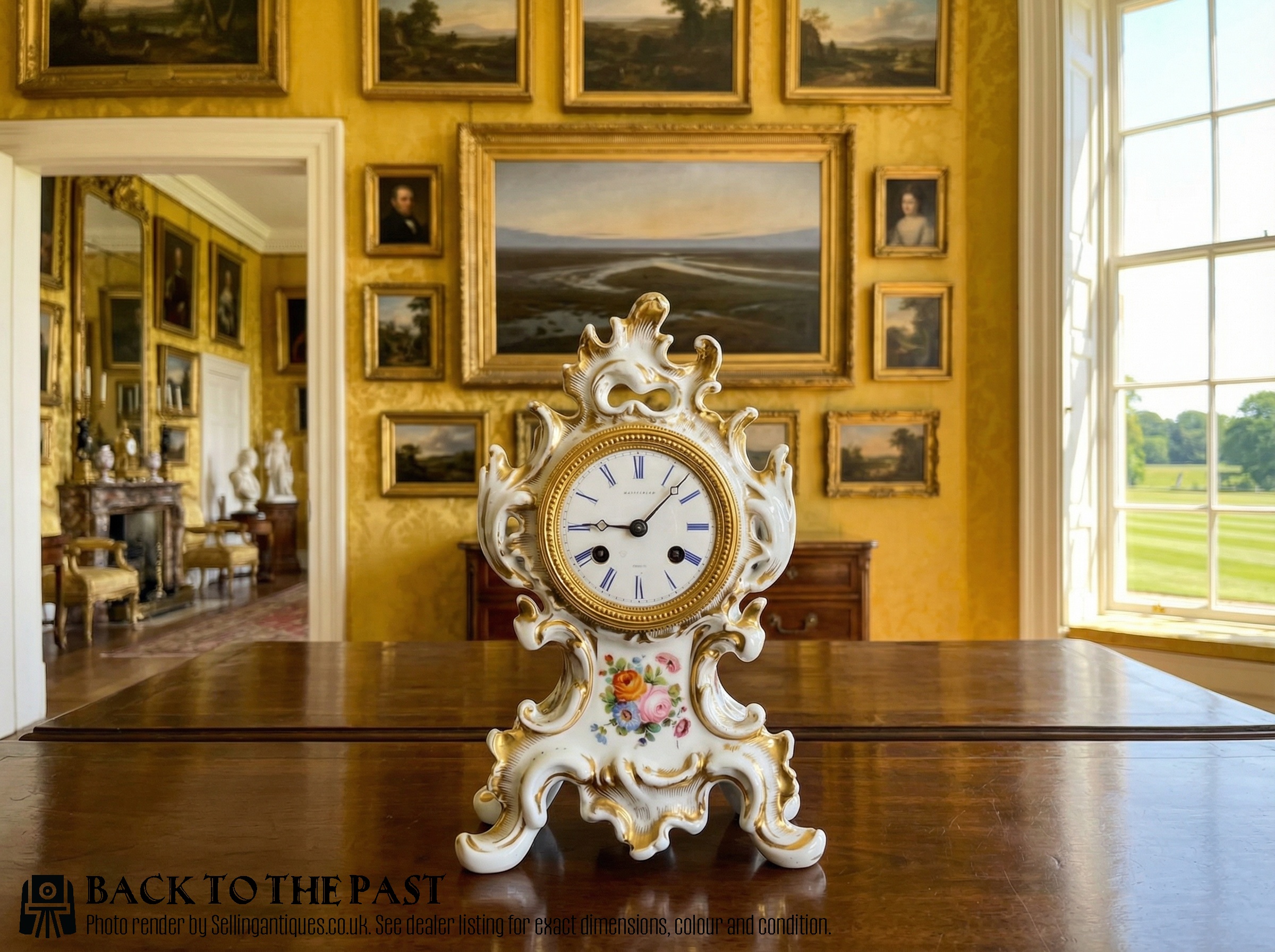
Ornate White Desk Clock
The pieces you are most likely to meet on this page span the Victorian era, the 1850s, 1880s, 1890s, and 1900, reflecting French Louis XIV and Louis XVI styles, French Rococo designs, and neoclassical influences. Such clocks serve as striking tabletop or mantel focal points, uniting classical sculpture and fine metalwork with functional clock movements.
How they were made
These clocks combine carved white marble, alabaster, or delicate porcelain bodies with cast brass, gilt bronze, or ormolu mountings. Artisans shaped the stone bases and housings by hand, pairing them with glazed panels and enamel dials.
Metal components received fire-gilding or brass casting to create intricate floral, cherubic, or architectural framing around the dial. Complex mechanical movements were then fitted within these decorative cases by skilled horologists.
Listings feature items from the 1850s to 1900, uniting white marble, porcelain, and gilt bronze within Victorian and French Louis styles.
What varies in quality
Quality in these timepieces rests upon the crispness of the bronze casting and the purity and uniformity of the white marble or porcelain. Superior examples display deeply chased gilt mounts, hand-painted porcelain details, and finely polished stone surfaces that retain sharp architectural lines.
The sophistication of the mechanical movement and the integration between the metalwork and the stone body separate standard production pieces from finer studio work. Heavier, more substantial metal components and pristine enamel dials indicate a higher grade of manufacture.
The Ornate White Desk Clock Glossary
- Ormolu
- Gilt bronze, where a finely ground high-carat gold-mercury amalgam is applied to a bronze base. This technique creates a rich, enduring golden finish seen on many nineteenth-century clock mounts.
- Portico clock
- A mantel clock featuring a architectural frame supported by four columns, resembling a classical temple facade. They often combine white marble with gilt bronze details.
- Carriage clock
- A small, portable spring-driven timepiece developed for travel, typically fitted with a carrying handle and glass panels. Many examples from this period feature brass cases and white enamel dials.
- Boudoir clock
- A small, decorative clock designed for private rooms, frequently constructed from porcelain or ornate metal. These pieces emphasise delicate aesthetic appeal over large-scale presence.
Ornate White Desk Clock: Frequently Asked Questions
Where should I place my clock?
These timepieces suit prominent locations such as mantelpieces, desks, or console tables where their decorative marble and gilt details can be fully appreciated.
Because many rely on delicate mechanical movements, they perform best on stable, level surfaces away from direct sunlight and damp environments.
How do I wind the clock?
Winding requires inserting the appropriate key into the winding arbour on the dial or movement backplate and turning it gently until resistance is felt.
Care must be taken not to overwind the mainspring, as this can damage the internal mechanism.
How do I identify the period?
Dating relies on observing the stylistic markers, such as French Rococo curves or Louis XVI neoclassical symmetry, combined with material choices like white marble and ormolu.
Signatures on the movement backplate or style indicators within the titles help narrow the decade of production between the mid-nineteenth century and nineteen-hundred.
Are these clocks suitable for daily use?
While these pieces were built as functional timekeepers, their age means they function best with regular, gentle care rather than continuous heavy operation.
Periodic professional servicing helps keep the mechanical movements running accurately.