

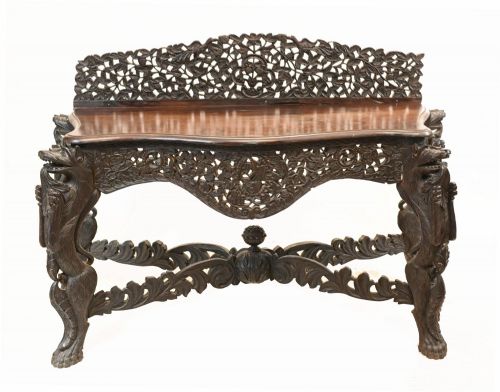


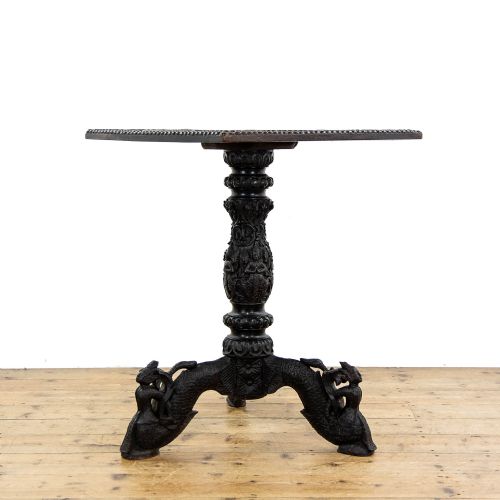


Ornate Carved Teak Table
An ornate carved teak table brings deep relief work and rich tropical timber together, offering a striking centrepiece for any room.

Ornate Carved Teak Table
An ornate carved teak table is a heavy furniture piece shaped by artisans during the nineteenth and early twentieth centuries, spanning the Victorian and Edwardian eras. These items include side tables, console tables, partners desks, centre tables, pedestals, and stands.
The versions most commonly met on this page originate from Anglo-Indian, Anglo-Burmese, and North Indian traditions. They display dense floral, foliate, and scrollwork relief carved directly into the dense timber.
Buyers seeking an ornate carved teak table encounter forms designed for colonial residences and grand houses. The inventory centres heavily on nineteenth-century examples alongside later Edwardian and 1910 pieces.
How they were made
Carpenters utilised teak and allied hardwoods, occasionally incorporating rosewood for contrast or structural support. Artisans carved the dense timbers by hand using specialised chisels to achieve deep, multi-layered relief patterns.
Construction techniques combined traditional joinery with heavy panel and pedestal framing to support the substantial weight of the timber. Surfaces received hand-applied finishes that highlighted the natural grain and intricate depth of the carving.
Ornate Carved Teak Table Retail Price Guide 2026
Typical asking prices for ornate carved teak table among the pieces listed under this phrase on Sellingantiques today, from the lower quarter to the upper quarter. They describe what is for sale here now, not the wider market.
Current listings span the nineteenth century to nineteen-ten, featuring teak, rosewood, and hardwood across desks, console tables, and stands.
What varies in quality
The depth, crispness, and undercut precision of the hand-carving separate superior examples from simpler work. Finer pieces maintain sharp edges and intricate detail across every surface without losing structural symmetry.
The selection and figure of the teak or hardwood timber dictate the visual weight and richness of the piece. Uniform colour, tight grain, and careful matching of wood components indicate higher workshop standards.
The Ornate Carved Teak Table Glossary
- Anglo-Indian
- Furniture made in India during the British colonial period, often combining British furniture forms with local carving traditions. These items frequently employ dense tropical hardwoods.
- Teak
- A durable, heavy tropical hardwood prized for its rich brown colour and natural oils. It resists moisture and takes deep hand-carving exceptionally well.
- Console table
- A table designed to stand against a wall, traditionally supported by fixed brackets or front legs. In this inventory, these pieces feature heavy carved decoration.
- Partners desk
- A large double-sided desk designed for two people to work opposite each other. Early nineteenth-century examples in this group display extensive carved detailing.
- Pedestal table
- A table supported by a single central pillar resting on a weighted base or feet. They function as centre tables, display stands, or torchieres.
Ornate Carved Teak Table: Frequently Asked Questions
What is an ornate carved teak table?
An ornate carved teak table is a nineteenth or early twentieth-century furniture piece originating from Indian and Burmese workshops. These items display dense, hand-carved floral and foliate relief across heavy tropical timber.
Such tables range from small stands and pedestals to large console tables and partners desks. They reflect colonial craftsmanship that blended traditional British forms with local decorative artistry.
How do I style an ornate carved teak table?
An ornate carved teak table works well as a focal point in a hallway, drawing room, or study. Placing it where adequate light can strike the carved surfaces allows the deep relief work to stand out.
Keep surrounding decor relatively simple to let the dense timber and intricate woodwork draw the eye. These pieces pair naturally with other wooden furniture and textured fabrics.
How do I tell Victorian tables apart from Edwardian ones?
Victorian examples from the mid-to-late nineteenth century typically feature heavier proportions and extremely deep, complex carving. They often reflect robust Anglo-Indian or Burmese colonial designs.
Edwardian pieces from the early twentieth century tend to be slightly lighter in scale while retaining oriental carved motifs. Examining the density of the wood and the style of the relief work helps clarify the period.
Were these tables made for export?
Many ornate carved teak tables were produced in India and Burma during the nineteenth century specifically for the British export and colonial market. British residents stationed abroad and collectors at home drove the demand for these decorative goods.
Workshops adapted traditional motifs to suit European furniture forms such as centre tables, desks, and console tables. This trade resulted in the distinct Anglo-Indian and Burmese styles seen today.