
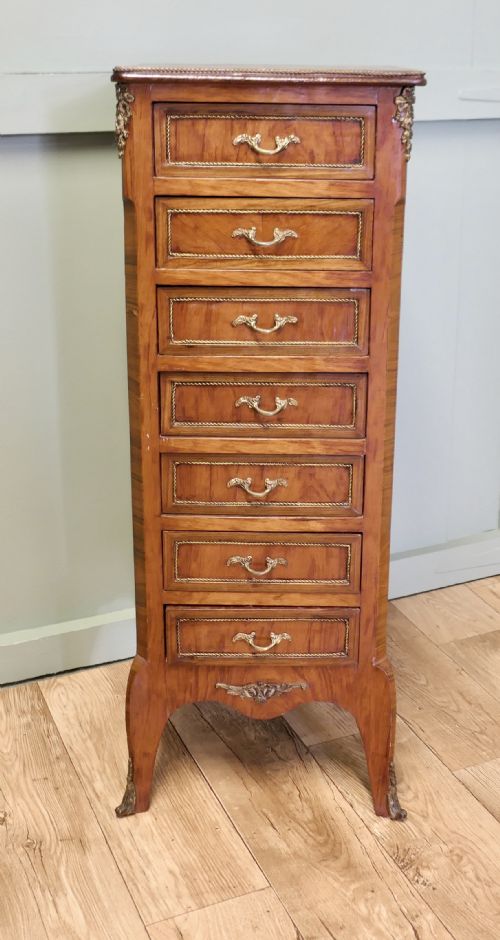
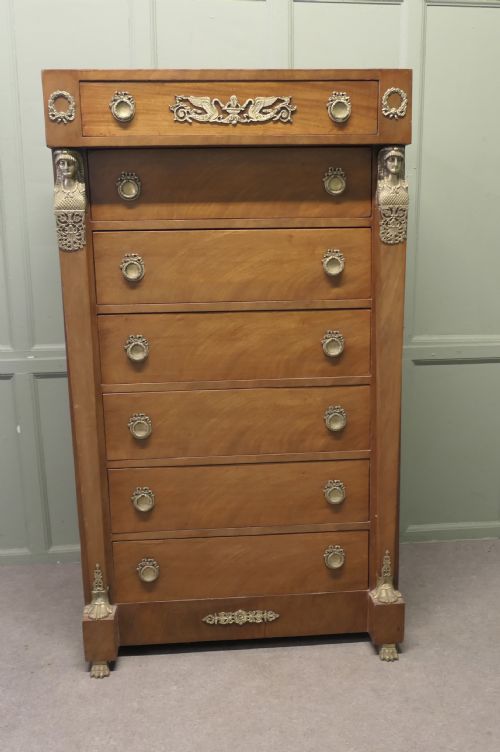
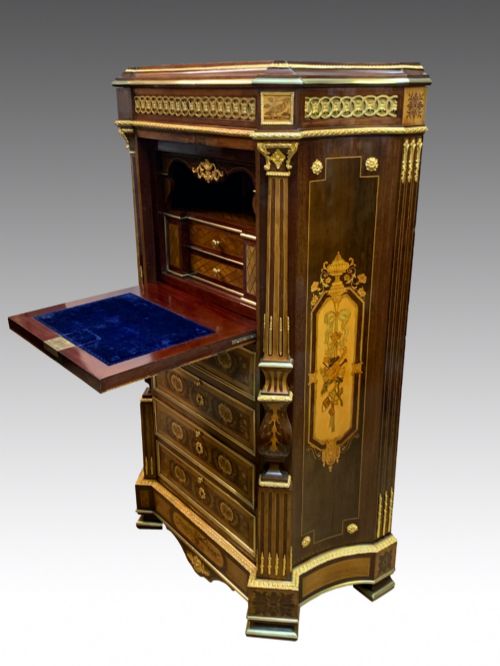
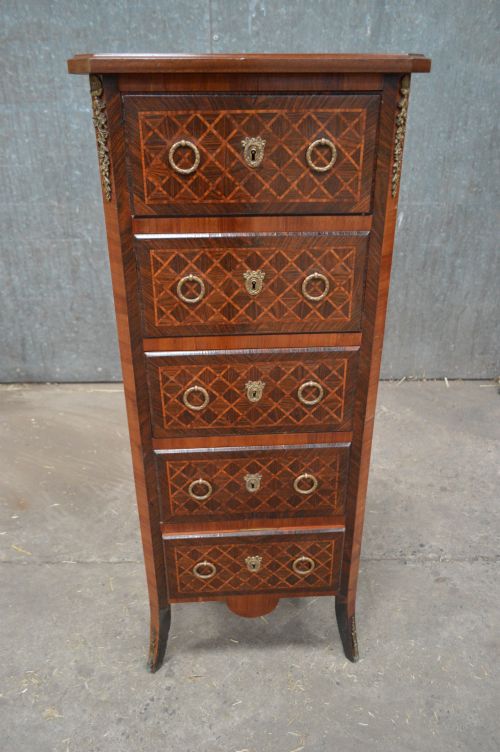
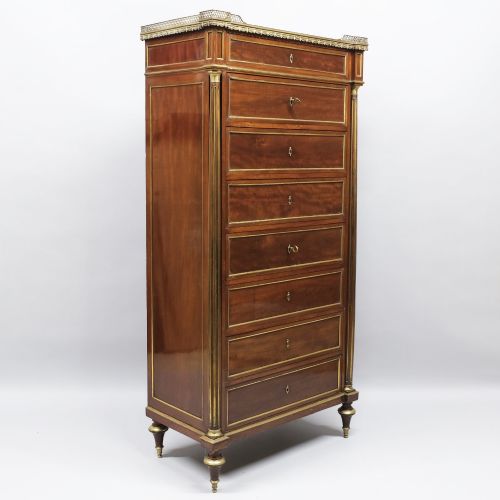


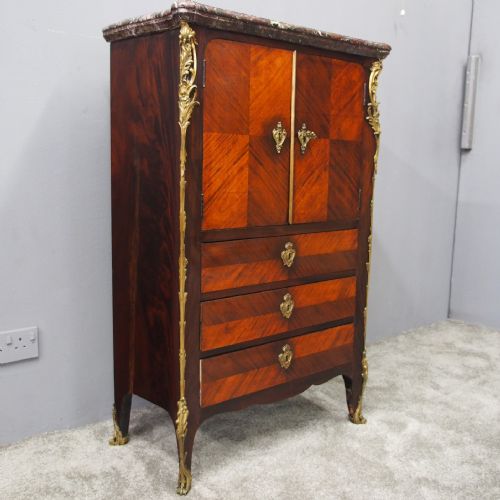
Ormolu Mounted Semainier
An ormolu mounted semainier brings seven drawers of French elegance to a bedroom, combining tall storage with gilt bronze mounts.
Ormolu Mounted Semainier
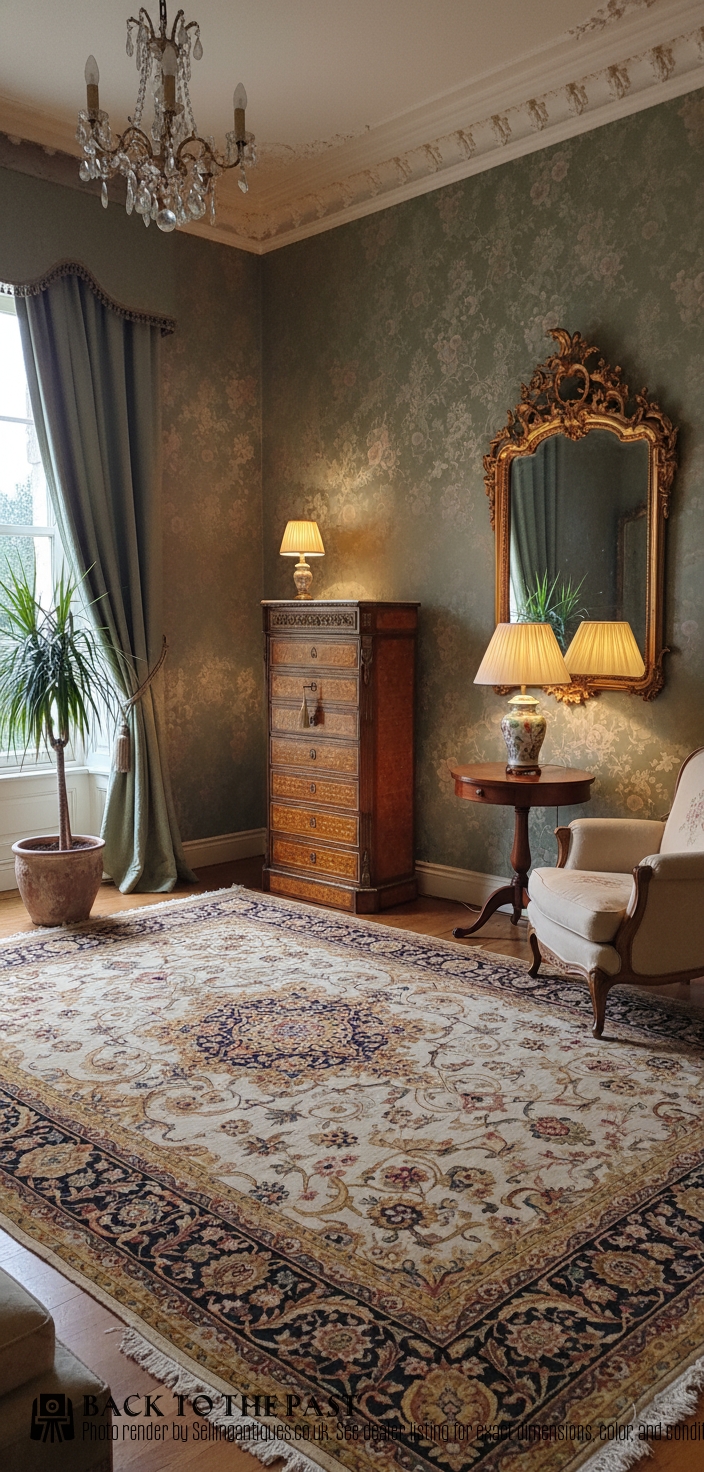
An ormolu mounted semainier is a tall, narrow chest of drawers traditionally designed with seven drawers, one for each day of the week. These pieces appear in styles such as French Empire, Louis XV, and Louis XVI, often configured as tall chests of drawers or secretaire cabinets.
Most examples found here date from the nineteenth century, reflecting revival aesthetics and classical French cabinet-making traditions. The vertical format offers substantial storage capacity while occupying a minimal floor footprint in a room.
Materials and construction
Cabinet makers utilised dense timber carcasses of walnut, kingwood, rosewood, mahogany, and tulipwood, frequently decorated with intricate marquetry and parquetry geometric patterns. These rich wood veneers provide a warm, patterned ground for the metallic decorative elements.
Gilt bronze or ormolu mounts are cast and chased to frame the drawers, corners, and aprons, adding structural definition and decorative contrast. Marble tops frequently complete the upper surface, providing a smooth, durable finish above the upper drawer.
Legend suggests the seven drawers were originally designated for a fresh set of stockings for every day of the working week.
Quality variations
The precision of the ormolu casting and the crispness of its chasing separate standard pieces from exceptional examples. Finer mounts fit the contours of the timber carcase precisely and retain deep, clear gilding.
Veneer selection and parquetry alignment dictate visual harmony across the seven drawers. Superior cabinets display thoughtful grain matching and tightly fitted joints that maintain structural integrity over time.
Maison Krieger·Leonard Boudin
The Ormolu Mounted Semainier Glossary
- Semainier
- A tall seven-drawer chest originating in France, traditionally intended to hold a week's supply of undergarments or daily attire. The vertical arrangement makes efficient use of wall space.
- Ormolu
- Gilt bronze ornamentation applied to furniture and decorative objects during the eighteenth and nineteenth centuries. The technique involves creating a mercury-gilt coating on a bronze base.
- Parquetry
- Geometric wood-veneer patterns resembling mosaic work, frequently utilised on the drawer fronts and sides of French cabinetry. Artisans arrange contrasting timber pieces to create optical depth.
- Secretaire abattant
- A tall cabinet featuring a drop-down writing flap that conceals a fitted interior of small drawers and compartments. This form combines desk functionality with vertical storage.
- Cartonnier
- A set of vertical compartments or drawers designed for holding papers, documents, or cartons. These pieces share the tall proportions often seen in semainiers.
Ormolu Mounted Semainier: Frequently Asked Questions
What fits inside an ormolu mounted semainier?
The seven drawers provide ample space for folded garments, linen, or personal accessories. Each drawer typically corresponds to a day, offering structured organisation.
Because the footprint is narrow, these chests suit bedrooms and dressing rooms where floor space is limited. They keep items accessible without dominating the room layout.
How do I care for marble and ormolu?
Marble tops require gentle cleaning with a soft cloth and neutral soap to prevent staining from liquids or cosmetics. Avoid acidic substances that can etch the polished stone surface.
Ormolu mounts should be dusted dry with a soft brush rather than polished with abrasive metal cleaners. This preserves the original fire-gilt or surface finish on the bronze.
Are these chests difficult to move?
The tall proportions and dense hardwood construction make these pieces heavy and top-heavy when loaded. Removing the drawers prior to transport reduces weight and protects the internal runners.
Marble tops are frequently removable, which also lightens the load and prevents damage during relocation. Professional handling is recommended for antique furniture of this scale.
How do I distinguish revival styles from earlier periods?
Nineteenth-century revival pieces often display mechanised construction methods and specific timber preparations visible inside the drawer carcases. Cabinet makers of that era reinterpreted Louis XV and Louis66 designs with contemporary hardware.
Examining the dovetails, secondary timbers, and the casting quality of the ormolu mounts helps determine whether a piece originates from the eighteenth century or later.