
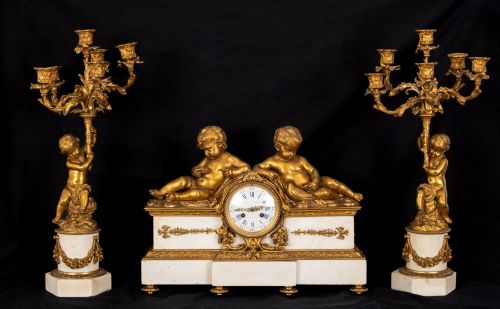
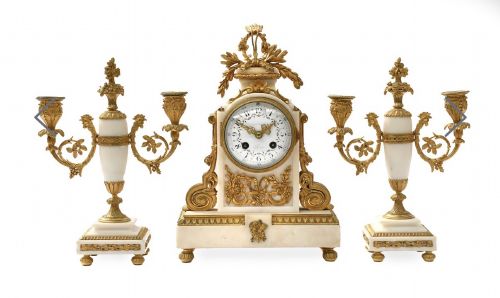
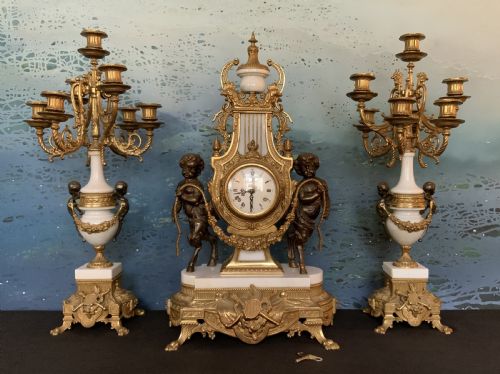


Ormolu Marble Clock Set
When an ormolu marble clock set catches the eye, you are meeting a grand centrepiece ensemble designed to command a formal interior.
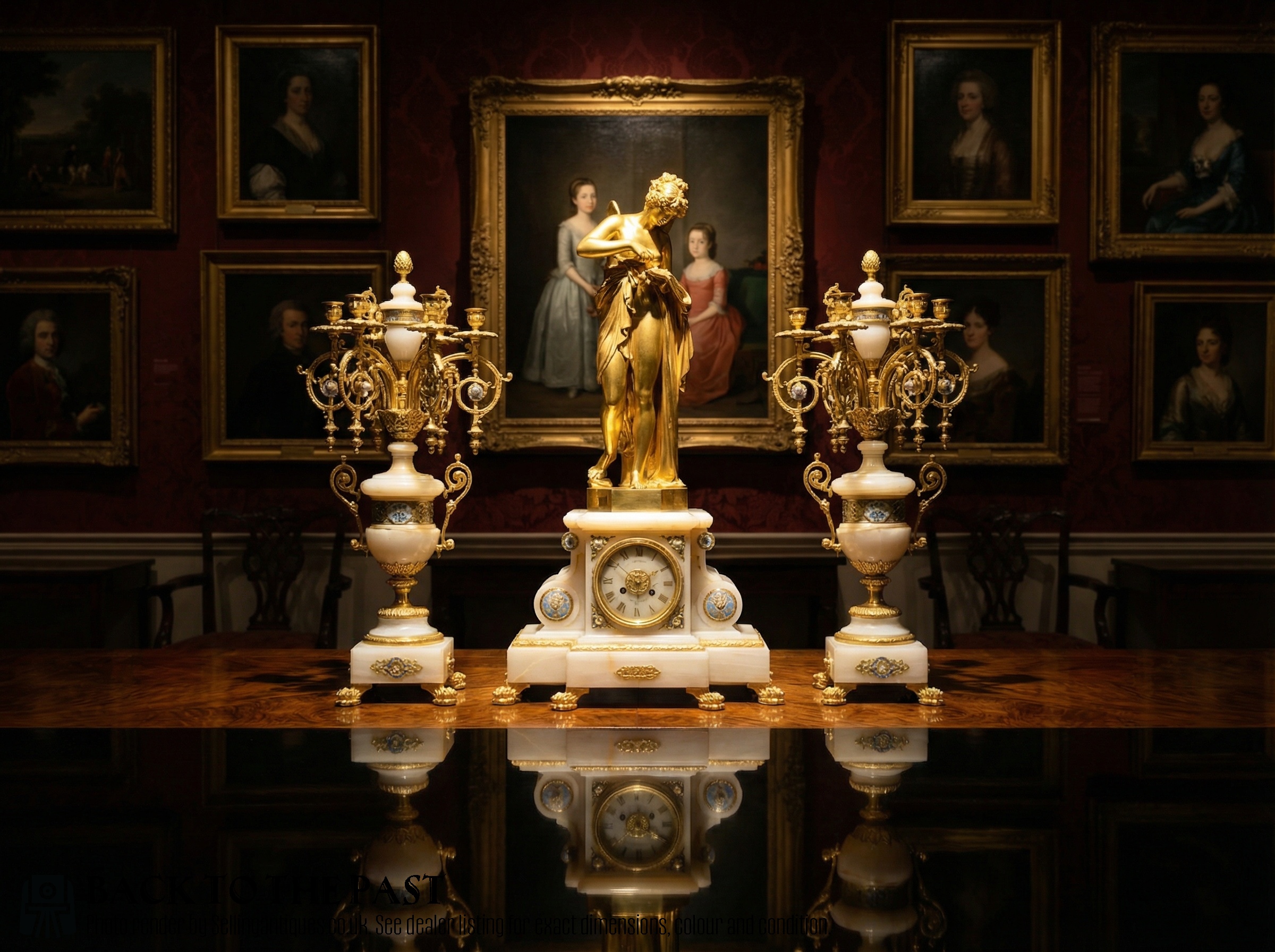
Ormolu Marble Clock Set
An ormolu marble clock set typically consists of a central mantel timepiece flanked by matching side ornaments such as candelabras, urns or vases. The evidence shows these configurations appearing frequently across nineteenth-century French production, often adopting Louis XVI, Empire or Second Empire styling.
The central clock anchors the composition with a brass or bronze movement housed in natural stone, while the side pieces echo the architectural motifs and metalwork mounts. Buyers searching this phrase encounter both compact boudoir variants and monumental three-piece garnitures designed for large salon mantelpieces.
Most surviving examples trace their origins to French workshops active during the Victorian era and the late nineteenth century. These ensembles combine functional timekeeping with sculptural display, frequently incorporating allegorical figures, cherubs or classical architectural details into the matched suite.
Indicators of distinction
The integration between the mechanical movement and the decorative housing also distinguishes finer work from standard production. Master horological makers and established bronze foundries produced balanced suites where every component of the clock set shares a unified design standard.
Listings feature nineteenth-century French forms, incorporating white, red, green and sienna marble paired with gilt bronze and enamel dials.
H Luppens Paris·AD Mougin Paris·Vincenti·Ferdinand Berthoud·Japy Freres·Samuel Marti·Charles Hour of Paris·Fritz Marti
The Ormolu Marble Clock Set Glossary
- Ormolu
- Gilded bronze or brass created through a process of mercury gilding or modern electroplating applied to cast metal. This technique produces a durable, rich golden surface finish that resists tarnish.
- Garniture
- A set of matching ornamental objects designed to be displayed together on a mantelpiece or sideboard. In clock sets, this usually pairs a central timepiece with matching candelabras or urns.
- Portico clock
- A distinct architectural clock form featuring a dial suspended between four supporting columns. These are frequently mounted on stepped marble bases with ormolu capitals and pediments.
- Chasing
- The hand-tooling of cast bronze surfaces with small punches and chisels to sharpen details, add texture and remove casting flaws before gilding. Superior chasing separates high-end mounts from mass-produced castings.
- Movement
- The internal mechanical assembly of gears, springs and escapements that drives the clock hands and strikes the hours. Nineteenth-century French movements often featured eight-day duration capability.
Ormolu Marble Clock Set: Frequently Asked Questions
What is a clock garniture?
A clock garniture is a matched decorative set featuring a central mantel clock accompanied by side pieces like candelabras or urns. These suites were designed to create a balanced, symmetrical display on a fireplace mantel or sideboard.
The matching elements share identical bronze mounts, marble types and stylistic motifs to unify the entire decorative arrangement.
How do you wind an antique French clock?
Antique French movements are typically wound using a matching metal key inserted into winding holes on the enamelled dial face. Most nineteenth-century examples utilise an eight-day spring-driven mechanism requiring attention once a week.
Care must be taken not to over-wind the springs, and moving the hands backwards should be avoided to prevent damage to the striking train.
Are these clock sets heavy?
These ensembles are exceptionally heavy due to the dense combination of solid natural marble and cast bronze components. The central clock alone often requires two people to lift safely, while the matching side pieces add substantial total weight to a mantelpiece.
When placing a set, ensure the supporting furniture or shelf is sturdy enough to bear the combined load without sagging.
How do I identify Louis XVI style mounts?
Louis XVI style ormolu mounts are characterised by classical restraint, symmetry and straight architectural lines rather than the exuberant curves of earlier rococo designs. Look for motifs such as acanthus leaves, flaming urns, beaded borders and ribbon-tied swags.
The marble bodies beneath these mounts are frequently geometric, taking the form of rectangular porticos, urns or pillared structures.