


Ormolu Brass Desk Set
An ormolu brass desk set brings tactile weight and golden warmth to a writing surface through French Empire and Victorian craft.
Ormolu Brass Desk Set
An ormolu brass desk set comprises functional writing accessories and clock garnitures fashioned in brass, gilt bronze, and ormolu. You find pieces spanning the eighteenth century through the late Victorian period, originating predominantly from French and English workshops.
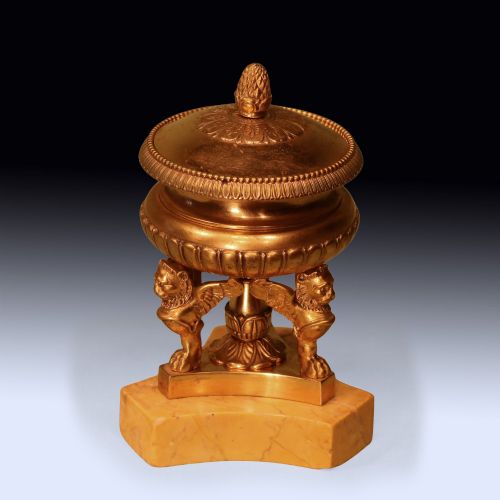
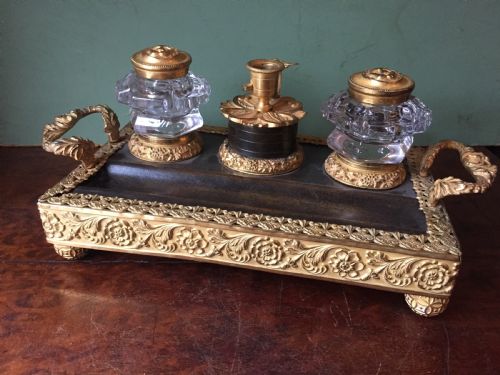
The objects on this page include inkstands, desk stands, inkwells, desk clocks, and clock garniture sets. Many combine metalwork with materials such as Sienna marble, vert marble, coromandel wood, and glass.
French Empire, Louis XV, Louis XVI style, and Chinoiserie designs shape the visual vocabulary of these desk accessories. Buyers seek them to anchor a traditional study with period metalwork and carved stone.
How they were made
Makers cast bronze and brass into intricate forms before applying fire gilding to create ormolu surfaces with lasting golden lustre. Stonework bases in Sienna and vert marble provide heavy, stable foundations for these metal mounts.
Selected pieces incorporate decorative details such as champleve enamel panels, hand-painted glass, and coromandel wood bodies. Mechanical elements like chaff-cutter escapements drive desk clocks within garniture sets.
Desk accessories occasionally depict playful subjects, such as gilded bronze cats or kittens caught mid-play.
What varies in quality
The crispness of the chased ormolu mountings separates standard production from superior examples. Sharp, deep detailing in the cast bronze indicates skilled hand-finishing.
The integration of materials determines the success of a piece. High-quality sets unite heavy marble bases, well-fitted glass inkwells, and fire-gilt mounts without structural looseness.
Japy Freres·Moser
The Ormolu Brass Desk Set Glossary
- Ormolu
- A gilded bronze technique utilising mercury amalgamation to produce a bright golden finish on decorative metal mounts. It appears frequently on French and English desk accessories.
- Champleve enamel
- An enamelling technique where troughs are dug into a metal surface and filled with vitreous paste before firing. This technique adds vibrant colour to clock sets and desk stands.
- Garniture
- A set of matching decorative objects, typically comprising a central clock flanked by candelabras or urns. These sets coordinate with desk accessories in period interiors.
- Coromandel wood
- A dense, dark timber featuring contrasting light streaks, used for the bodies of nineteenth-century desk stands. It provides a rich dark background for ormolu mounts.
- Escapement
- The internal mechanism in a clock that regulates the release of power from the gear train. The chaff-cutter escapement is an example found in period desk clocks.
Ormolu Brass Desk Set: Frequently Asked Questions
What is an ormolu desk set?
An ormolu desk set is a collection of writing accessories made from fire-gilt bronze and brass, often mounted on marble or exotic wood.
These sets combine utility with decorative metalwork designed for nineteenth-century writing desks.
How do I date a desk set?
Dating relies on stylistic clues like French Empire or Victorian proportions, alongside material combinations such as coromandel wood and marble.
Examination of the cast bronze mounts and clock escapements also helps establish the period of manufacture.
Where were these pieces made?
Most of these desk accessories originate from French and English workshops operating during the eighteenth and nineteenth centuries.
French makers specialised in gilt bronze and champleve enamel, while English makers often paired ormolu with coromandel wood.
How do I care for ormolu?
Ormolu requires gentle dusting with a soft brush to protect the delicate fire-gilt surface from abrasion.
Avoid chemical polishes that can strip the historic gilding from the underlying bronze or brass.