


Antique English Desk Set
An antique english desk set gathers the inkstands, blotters and appointments of a writing table into a matched group.
Antique English Desk Set
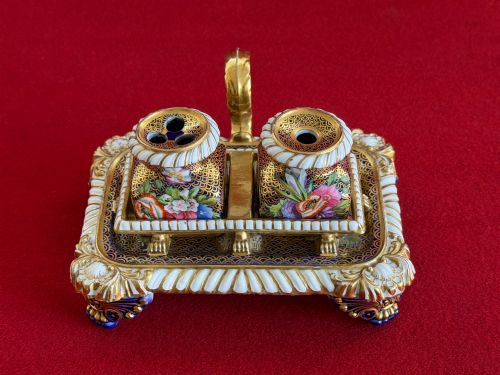
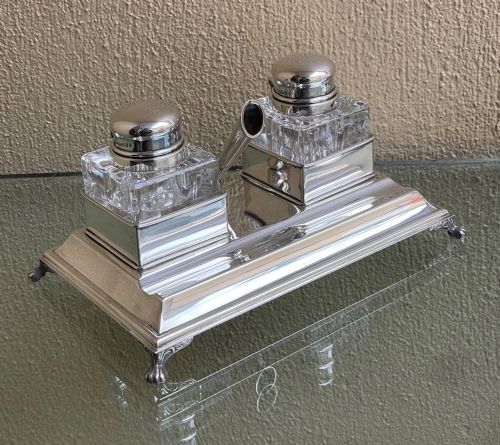
An antique english desk set appears in forms ranging from silver and glass inkstands to walnut writing slopes and novelty figural pieces. The pieces on this page span the Georgian, Regency and Victorian eras through to the early twentieth century.
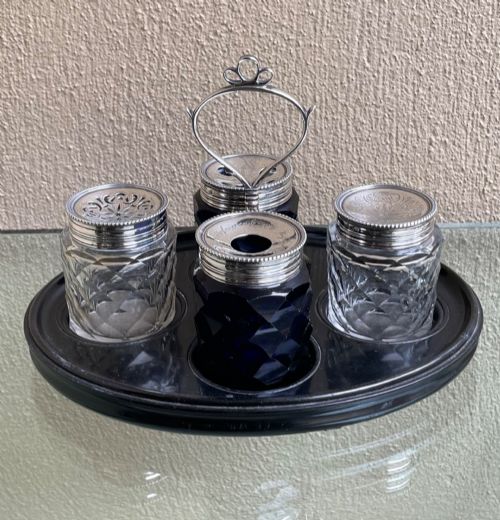
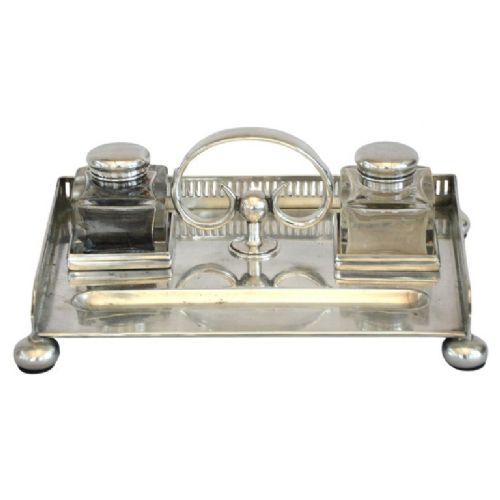
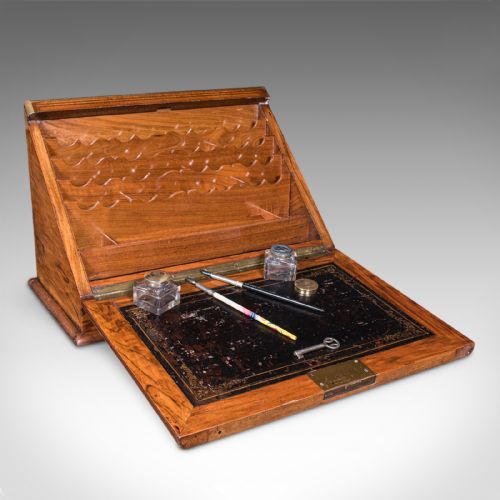
Inkstands form the core of the selection, often incorporating cut glass inkwells alongside sterling silver or Sheffield plate trays. Walnut writing slopes and multi-piece desk sets with mounted brass and agate also recur frequently across the periods.
Novelty items add variety to the category, with brass owls, bulldogs and dogs in kennels serving as functional inkwells. Makers such as Spode and Flight, Barr and Barr contribute porcelain examples dating to the early nineteenth century.
Materials and construction
Silversmiths shaped solid sterling silver and silver plate into trays and stands, whilst makers like Walker and Hall and Martin Hall applied plating techniques to base metals. Cabinetmakers utilised walnut, mahogany and coromandel for writing slopes and stationery cases, frequently incorporating brass stringing and ormolu mounts.
Potteries in Worcester and Stoke-on-Trent fired porcelain bodies, applying hand-painted enamel decoration and gilding. Glassmakers cut crystal and glass for inkwell inserts, paired with brass, bronze, onyx and tortoiseshell across the mid-nineteenth century pieces.
A Victorian bulldog stares from the desk with glass eyes, hiding an inkwell beneath its heavy bronze chin.
Quality and execution
Quality rests on the integrity of the materials and the precision of the assembly, such as the crispness of casting on a bronze figural inkwell or the weight of a solid silver tray. Heavier gauge silver and thick-cut crystal indicate superior production.
The sophistication of the secondary materials marks the upper tier, including genuine tortoiseshell with brass boullework, finely carved coromandel, or hand-painted porcelain from established factories. Matching sets that retain all original glass liners and accessories command higher regard than assembled groups.
Spode·Walker And Hall·Flight Barr And Barr·Robert Garrard·Martin Hall·Hukin And Heath·Leuchars And Son·Gillows Lancaster
The Antique English Desk Set Glossary
- Inkstand
- A desk stand holding one or more inkwells, often with pen recesses and sanders. These trays are formed from silver, brass, porcelain or wood.
- Writing slope
- A portable desk with a slanted, hinged lid that opens to reveal a writing surface and compartments for stationery. They are frequently veneered in walnut or mahogany.
- Boullework
- Marquetry of tortoiseshell and brass or pewter, named after French cabinetmaker André-Charles Boulle. This technique appears on nineteenth-century desk sets and boxes.
- Sheffield plate
- A composite material made by fusing a sheet of silver to a copper core, common in items dating from the eighteenth and early nineteenth centuries.
- Novelty inkwell
- An ink container modelled to represent an animal, figure or object. Victorian examples frequently depict dogs, owls or equestrian subjects.
Antique English Desk Set: Frequently Asked Questions
What is included in an antique desk set?
These sets commonly comprise a central inkstand or tray holding one or two glass inkwells, alongside companion items like stamp boxes, pen trays and sealing wax compartments.
Larger configurations may incorporate matching candlesticks, blotters, paper knives or complete portable writing slopes fitted with stationery storage.
How do I identify a Georgian desk set?
Georgian pieces typically exhibit restrained neoclassical or early Regency lines, executed in heavy sterling silver, Sheffield plate or fine porcelain without the heavy ornamentation of later periods.
Look for hallmarks dating to the reigns of George III or George IV, alongside simple geometric tray shapes and plain cut-glass inkwell collars.
Were novelty inkwells used daily?
Victorian novelty inkwells served as functional desktop accessories despite their playful appearance as animals, birds or architectural forms.
Heads or figures lift or hinge open to reveal the glass ink container nestled within the bronze, brass or ceramic body.
How are wooden desk sets constructed?
Cabinetmakers built these pieces using dense hardwoods like walnut, coromandel or mahogany, often over a stable pine or oak secondary carcass.
Finer examples feature decorative veneers, brass stringing, mother-of-pearl inlay or ormolu mounts to frame the leather-lined writing surfaces.