


Original Loch Painting
An original loch painting captures the distinct light, water and mountain scenery of the Scottish landscape through historical British artistry.
Original Loch Painting
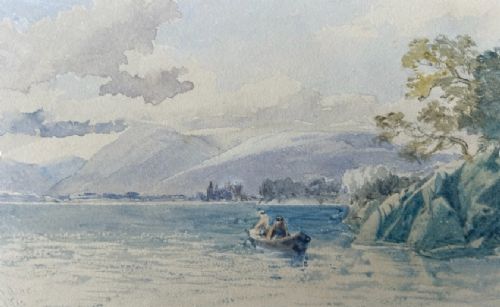
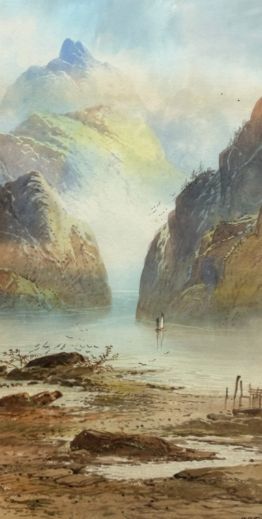
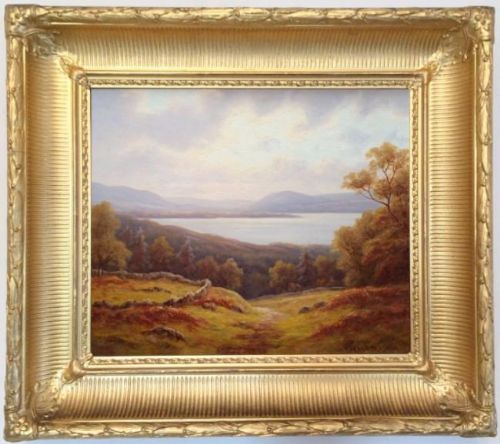
An original loch painting depicts bodies of water and mountainous terrain across Scotland, created during the nineteenth and twentieth centuries. These artworks document specific locations such as Loch Lomond, Loch Tay and Loch Awe within traditional British and Scottish school frameworks.
Most examples found here date from the Victorian era onward, taking the form of watercolours on paper or oil paintings on canvas and wood panel. Landscapes often incorporate atmospheric elements like morning mist, sunset light, ruined castles or Highland cattle.
Collectors encounter both signed works by named Victorian and twentieth-century painters and attributed or school pieces from the broader nineteenth century. These landscape paintings serve as historical records of changing artistic interpretations of the Scottish countryside.
How they were made
Artists painted these scenes using oil paint or watercolour applied to canvas, paper, wood panel or board. Oil paintings often utilise gesso preparation on canvas or board to provide a stable ground for pigment.
Watercolour works employ transparent washes on paper, occasionally supported by grisaille underdrawing or gouache highlights. Frames incorporate traditional materials like wood and gilt moulding to house the finished artwork.
Several Highland cattle and the occasional stray bagpipe player have wandered into these Scottish vistas over the centuries.
What varies in quality
Quality depends upon the artist's ability to render light, atmosphere and topography convincingly within the medium. Works by established Royal Scottish Academicians or recognised professional painters demonstrate superior handling of perspective and colour harmony compared to routine school pieces.
The preservation of the paper, canvas or panel affects the condition and visual impact of the landscape. Strong provenance, legible signatures and original framing elements further distinguish finer examples from standard decorative works.
Thomas Miles Richardson Jnr RWS·William Henry Earp·Everett Watson Mellor·Henry Hillier Parker·Stanley Orchart·William Miller Frazer·Daniel Sherrin·Alfred de Breanski Snr·James Kinnear·George Melvin Rennie·Robert Houston·Louis F Flexman·George Stratton Ferrier·H M Krause·Thomas Austen Brown·Francis Jamieson·Kenneth Holmes·Robert Finlay McIntyre·J Gibb·Frank Hider·Herbert Moxon Cook·James Drummond·John Patrick Downie·Lennard Lewis·Francis E Jamieson
The Original Loch Painting Glossary
- Watercolour
- A painting method in which the paints are made of pigments suspended in a water-based solution. It is typically applied to paper to achieve translucent effects.
- Gesso
- A plaster mix used as a base coat on wood panels or canvas before painting. It prepares the surface to receive oil paint.
- Grisaille
- A painting executed entirely in shades of grey or neutral monochromatic tones. This technique is often used for underpainting or as a finished monochrome work.
- Gouache
- An opaque water-based paint method that includes a white pigment filler. It creates heavier, more solid passages of colour than standard watercolour.
Original Loch Painting: Frequently Asked Questions
What is an original loch painting?
An original loch painting is a unique artwork depicting a Scottish lake and mountain scene, executed by hand in oil or watercolour during the nineteenth or twentieth century.
These pieces range from small topographical watercolours to large oil canvases created by artists associated with the Scottish school of landscape painting.
How were nineteenth-century loch paintings framed?
Nineteenth-century paintings were typically housed in wooden frames, frequently featuring gesso ornamentation and gilt finishes to complement the artwork.
Some surviving works retain their original frames, which may include raw silk mats or deep decorative mouldings characteristic of the period.
Who painted these Scottish landscapes?
These landscapes were produced by professional artists, members of academic institutions such as the Royal Scottish Academy, and regional painters working across Britain.
Many works are signed by the artist, while others are attributed to specific schools or painters active during the Victorian era and the early twentieth century.
How do I identify the period of a loch painting?
The period is often indicated by the framing materials, the type of support such as canvas board or handmade paper, and stylistic markers associated with Victorian or twentieth-century British art.
Signatures, dates, inscriptions on the reverse, and artist biographies provide additional evidence for dating individual works.