



Orientalist Figural Bronze
These orientalist figural bronze works capture the romanticised nineteenth and early twentieth century view of distant lands through finely cast figures and decorative objects.
Orientalist Figural Bronze
When you search for orientalist figural bronze, you enter a world of nineteenth and early twentieth century sculptures, clocks, lamps, and candlesticks depicting figures from North Africa and the Middle East. The pieces on this page span the Victorian era, Art Nouveau, and Art Deco periods, showing varied interpretations of foreign cultures by European makers.
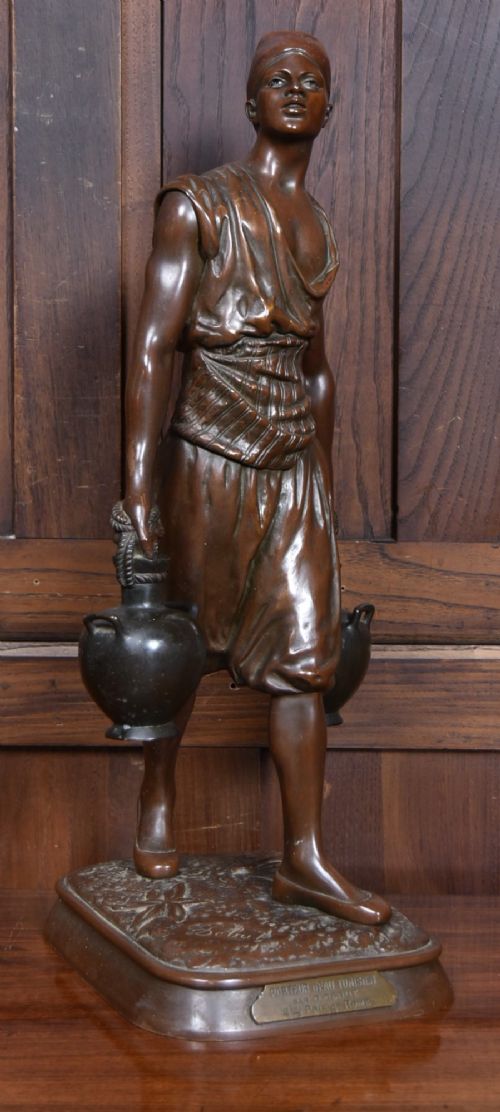
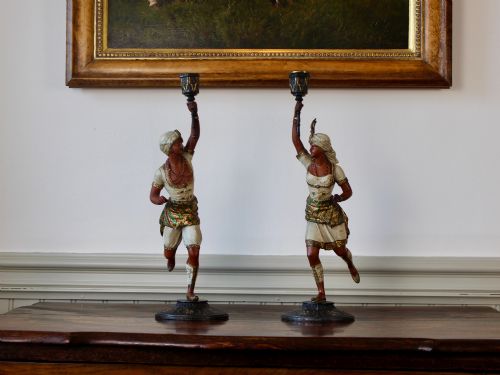
The forms range from large floor and table lamps to mantel clocks and match strikers, often incorporating textiles and glass alongside the metalwork. You will frequently encounter subjects such as water carriers, snake charmers, and harem figures, executed in styles ranging from French Orientalism to Venetian Revival and Chinoiserie.
Materials and Method
The casting process combined sculptural modelling with functional metalwork, integrating clock movements, lamp fittings, or match striking surfaces into the figural compositions. Artisans utilised patination and surface finishing to give depth to the drapery and skin tones.
Orientalist Figural Bronze Retail Price Guide 2026
Typical asking prices for orientalist figural bronze among the pieces listed under this phrase on Sellingantiques today, from the lower quarter to the upper quarter. They describe what is for sale here now, not the wider market.
One unexpected match striker depicts a Middle Eastern figure holding a spark ready to ignite your evening hearth.
Assessing Quality
Quality reveals itself in the sharpness of the casting and the finesse of the surface finish, particularly in the rendering of facial expressions, hands, and textile folds. Sculptures with distinct cold painted details or rich patination display a higher level of workshop skill than simpler, mass-produced casts.
The integration of the figure into functional objects such as clocks and lamps also dictates the standard of the piece, with superior examples maintaining sculptural integrity while housing complex movements or fittings. The reputation of the artist or foundry adds another layer of distinction to the casting.
Emmanuel Villanis·Bruno Zach·Louis Hottoot
The Orientalist Figural Bronze Glossary
- Spelter
- A zinc alloy commonly used as a less expensive alternative to bronze in the manufacture of figures and decorative items. It takes patination and cold paint well.
- Cold Painted
- A technique where oil paint is applied to a metal object after casting, without being fired in a kiln. This finish is delicate and prone to chipping over time.
- Ormolu
- Gilded bronze or brass, created by applying a mercury and gold amalgam to the base metal and heating it. The process yields a rich, golden surface finish.
- Patina
- The surface sheen and colour acquired by metal through age, handling, or chemical treatment. It highlights the contours of the casting.
- Chinoiserie
- A European artistic style reflecting Chinese and East Asian motifs, often blended with nineteenth century decorative arts.
Orientalist Figural Bronze: Frequently Asked Questions
What is an orientalist bronze?
An orientalist bronze is a nineteenth or early twentieth century sculpture or decorative object depicting people and scenes from North Africa, the Middle East, or Asia, created by European artists.
These works often take the form of figures engaged in daily life or dramatic pursuits, reflecting the period's fascination with distant cultures.
Are these pieces made of solid bronze?
Not all pieces are solid bronze, as many period items utilise spelter, an affordable zinc alloy, often finished with paint or bronze-coloured patination.
You can distinguish bronze from spelter by checking the weight, magnetic properties, and the nature of any wear on the surface metal.
How do I identify the period of a figural clock?
Period identification relies on examining the casting style, the mechanics of the clock movement, and design cues associated with movements like Art Nouveau or Victorian design.
The presence of specific maker signatures or foundry marks on the base also helps narrow down the decade of production.