
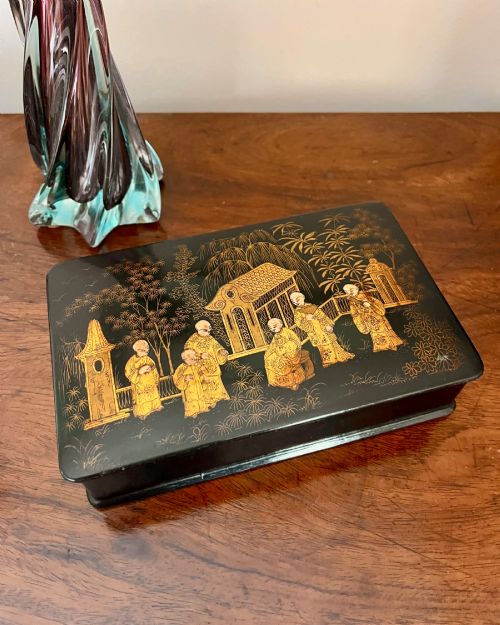


Oriental Trinket Casket
An oriental trinket casket brings worldly craft to a dressing table, holding small keepsakes inside surfaces of lacquer, silver, and hardwood.
Oriental Trinket Casket
When you search for an oriental trinket casket, you encounter small decorative containers shaped by traditions spanning Chinese export workshops, Ottoman chests, and Japanese Meiji lacquerware. These pieces serve primarily as tabletop storage for jewellery, keepsakes, and tobacco, taking forms that range from simple rectangular boxes to miniature cabinets.
The versions you meet most frequently on this page date from the nineteenth and early twentieth centuries, though occasional examples stretch back to earlier periods. They cross several distinct regional styles, including Chinoiserie, Anglo-Indian, and Qing Dynasty aesthetics.
Makers utilised diverse materials to construct these vessels, combining structural woods with precious metals and intricate surface decoration. Each box reflects the specific decorative vocabulary of its origin, whether carved Burmese timber or inlaid mother-of-pearl.
Materials and construction
Artisans built the structural core of these caskets using solid hardwoods or lacquered bases, providing a stable foundation for detailed surface work. Wood selection determined the weight and durability of each tabletop cabinet.
Surfaces received elaborate treatments such as black lacquer, gold leaf application, and meticulous mother-of-pearl inlay arranged in geometric or pictorial motifs. Metal elements, particularly silver and silver plate, appeared as decorative mounts or primary construction materials in pieces like cigarette and tobacco boxes.
Carving and repoussé work demanded high skill, seen particularly in Burmese wooden caskets and Chinese export silver items bearing detailed dragon motifs.
Listings feature items spanning from the seventeenth century through to the Edwardian era, utilising lacquer, silver, and mother-of-pearl.
Distinctions in quality
Quality rests upon the precision of the inlay work and the stability of the lacquered or carved surfaces. Superior examples display tight joints in the hardwood and securely seated mother-of-pearl panels that remain flush with the surrounding wood.
The depth and clarity of the carving distinguish finer pieces from standard production, particularly in Burmese wooden boxes and Ottoman chests where hand-chased detail defines the aesthetic. Marks or named maker signatures on silver elements elevate certain caskets above unsigned decorative wares.
Wang Hing & Co.
The Oriental Trinket Casket Glossary
- Chinoiserie
- European artistic interpretation of Chinese and East Asian decorative motifs. This style frequently appears on eighteenth and nineteenth-century lacquered boxes.
- Meiji
- The period in Japanese history spanning from eighteen sixty-eight to nineteen twelve, known for refined lacquer and metalwork. Pieces from this era often show exceptional surface finishing.
- Repoussé
- A metalworking technique where metal is hammered from the reverse side to form a raised design in relief. This method decorates many silver boxes from Asian export workshops.
- Qing Dynasty
- The last imperial dynasty of China, lasting until nineteen twelve, which produced distinctive decorative arts. Caskets from this period often feature intricate inlaid ornamentation.
- Mother-of-pearl
- The iridescent inner layer of mollusc shells used extensively for inlay work on hardwood boxes. Artisans cut this material into thin plates to form geometric patterns or pictorial scenes.
Oriental Trinket Casket: Frequently Asked Questions
What did people store in an oriental trinket casket?
These vessels served to hold personal valuables, rings, keepsakes, and tobacco products on dressing tables or desks.
Owners kept smaller personal items secure within lined compartments away from dust and light.
How do I clean a lacquered trinket box?
Dust surfaces gently with a soft, dry cloth without applying modern chemical polishes or water.
Excess moisture can damage old lacquer and lift delicate mother-of-pearl inlay from the hardwood base.
Are these boxes made of solid silver?
Composition varies between solid silver export pieces, silver-plated items, and purely wooden constructions with metal mounts.
Maker marks and hallmarks on the metal components generally indicate the specific standard of the silver used.
How do I distinguish Chinese Export styles?
Chinese Export pieces combine traditional Asian motifs with forms tailored for Western markets, such as cigarette boxes and fitted jewellery cases.
Specific dragon motifs and export silver marks often help identify these workshop origins.