
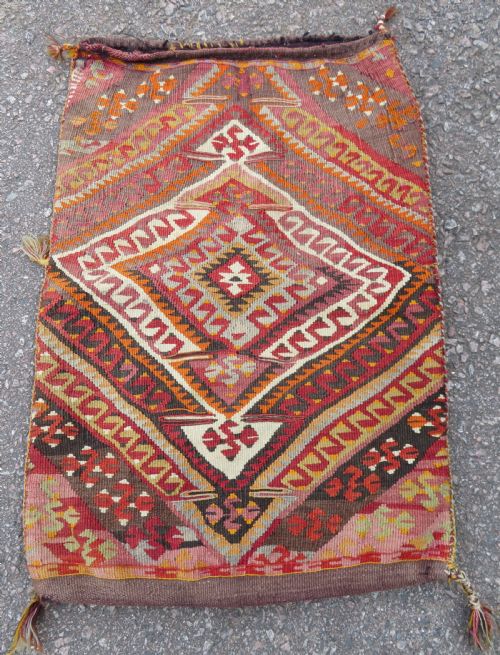
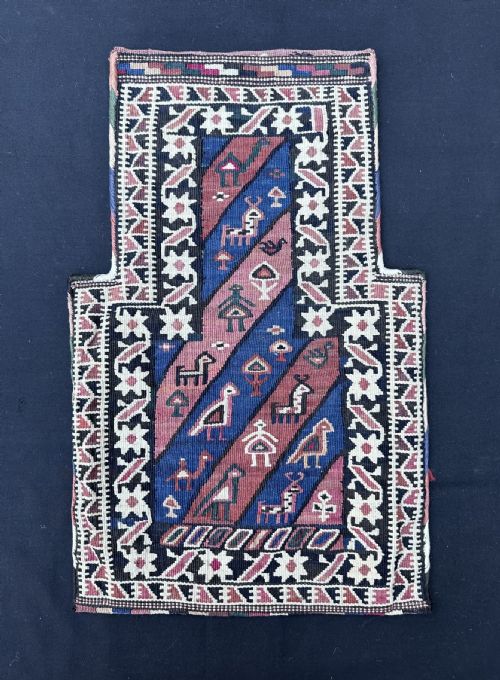


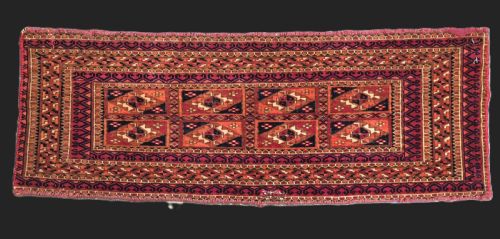


Oriental Storage Bag
When you handle an oriental storage bag, you touch the nomadic weaving traditions of Central Asia, Persia, and the Caucasus.
Oriental Storage Bag
An oriental storage bag represents the utilitarian weaving traditions of tribal and nomadic groups across Central Asia, Persia, and the Caucasus. These textile pieces include salt-bags, spindle bags, and larger storage receptacles designed for daily domestic use in tents and settlements.
The selections available here span from the mid-nineteenth century into the early twentieth century, encompassing tribal groups such as the Yomut, Tekke, Ersari, Kordi, and Shahsavan. Buyers will frequently encounter bag faces preserved as wall hangings alongside complete examples retaining their original plain weave backs.
These woven items served practical functions for holding household goods, bedding, or provisions during nomadic migrations. Their survival offers a direct connection to the tribal communities that utilised natural dyes and hand-spun materials for their daily living.
How They Were Made
The construction of an oriental storage bag relies primarily on wool, cotton, and hand-spun wool manipulated through traditional tribal weaving techniques. Artisans deployed natural dyes to colour the fibres, creating rich hues that stabilise and mature with age.
Many examples combine dense pile knotting on the face with durable plain weave backs designed to withstand the wear of travel and hanging. Specialised pieces incorporate hanging loops or structural elements tailored for securing contents within a nomadic camp.
The listings demonstrate tribal traditions from the nineteenth and early twentieth centuries, highlighting works from Yomut, Tekke, Ersari, Kordi, and Shahsavan weavers.
What Varies in Quality
Quality in an oriental storage bag rests upon the density of the weave, the clarity of the tribal motifs, and the depth of the natural dye palette. Finer knotting and sophisticated guls or tribal emblems signal superior technical execution by the weaver.
The preservation level of the piece also dictates its standing, particularly whether it retains its original plain weave back, hanging loops, or complete structural integrity. Pieces displaying balanced proportions and well-rendered designs distinguish themselves within the range.
The Oriental Storage Bag Glossary
- Gul
- A primary medallion or repeated octagonal motif characteristic of Turkmen and Central Asian tribal weaving. These designs often indicate the specific tribe or sub-group responsible for the textile.
- Chuval
- A large tent storage bag traditionally used for bedding and household belongings. These rectangular pieces frequently appear as complete bags or preserved bag faces.
- Torba
- A smaller storage bag utilised for carrying or hanging various domestic provisions. They display distinct tribal patterns scaled down from larger formats.
- Mafresh
- A rectangular box-like storage bag associated with Shahsavan and South Caucasian nomadic groups. They were typically woven in pairs and used during migrations.
- Plain weave
- A simple, unknotted flatweave structure commonly used for the backs of bags to reduce weight and thickness. This technique contrasts with the denser pile front.
Oriental Storage Bag: Frequently Asked Questions
What were oriental storage bags used for?
These bags served practical domestic functions within nomadic and tribal tents across Central Asia and Persia. Families utilised them to store household goods, provisions, bedding, and small tools during migrations.
Specific forms like salt-bags and spindle bags held designated materials for daily life. Their sturdy construction allowed them to endure the rigours of nomadic transport.
How do I hang a storage bag on the wall?
Many bag faces and complete storage pieces feature original hanging loops or sturdy upper edges suited for mounting. Textile specialists recommend using a padded sleeve or discreet conservation mounts to distribute the weight evenly.
Avoid hanging pieces in direct sunlight to protect the natural dyes from fading over time. Ensure the wall bracket supports the textile without straining the historic wool fibres.
How do I tell different tribal designs apart?
Tribal attribution relies on specific repeating motifs, such as the characteristic guls used by Yomut, Tekke, and Ersari weavers. Colour palettes and border arrangements also provide strong indicators of regional origin.
Caucasian and Shahsavan pieces often display distinct geometric structures compared to Turkmen or Kordi examples. Examining the weave density and back construction helps clarify the specific tribal roots.
What is the difference between a bag face and a complete bag?
A complete storage bag retains both its decorative pile front and its original plain weave back, sometimes including closure flaps or hanging mechanisms. These examples present the piece in its original functional form.
A bag face consists solely of the knotted front panel, often separated from the back over decades of use or removed specifically for display as wall art.