

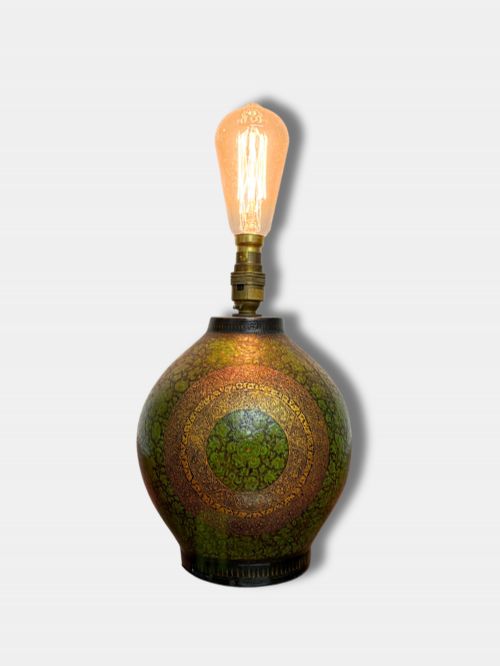


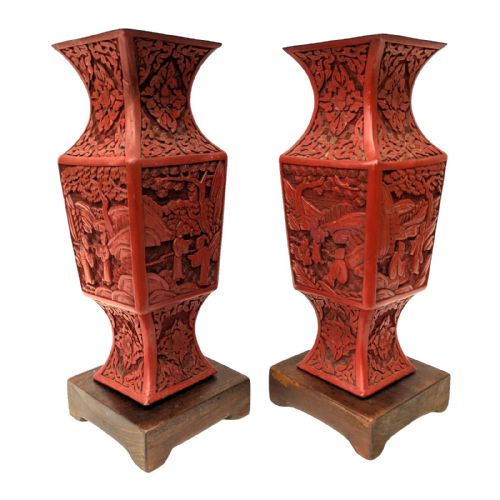


Oriental Lacquered Urn
An oriental lacquered urn brings depth, rich gilding and layered surface finish to a room, drawing the eye instantly.
Oriental Lacquered Urn
An oriental lacquered urn encompasses decorative vessels, temple jars and table lamps drawn from diverse origins including China, Japan and India. These objects emerge from periods ranging from the Victorian era and Edwardian times through to the early decades of the twentieth century. Forms span monumental temple vases, flared porcelain vessels, plant stands and fitted table lighting.
The aesthetic vocabulary encompasses traditional Chinoiserie, Qing Dynasty designs, Japanese Meiji period work, Aesthetic Movement pieces and Kashmiri craftsmanship. Surface finishes incorporate black paint, gold leaf, and carved red cinnabar. Buyers will frequently encounter large pairs of vases, lacquered wooden stands, and converted lighting fixtures.
Vessels utilise diverse foundational materials such as wood, toleware, papier-mâché, brass and porcelain. Many pieces combine traditional Asian decorative arts with European functional forms like lamps and display tables. Each item demonstrates the cross-cultural exchange of design motifs during the nineteenth and early twentieth centuries.
How they were made
Maker workshops utilised natural lacquer resins applied in multiple successive layers over rigid foundations of wood, papier-mâché or ceramic. Artisans carved intricate pictorial reliefs into thick accumulations of red cinnabar lacquer, revealing depth and detail through patient handwork. Other pieces combined porcelain bodies with overlaid lacquer and black paint depicting motifs like koi fish.
Gilding techniques involved the careful application of gold leaf and gold paint to contrast against dark black or red backgrounds. Metal components including brass hardware provided structural support and decorative mounts for lamps and stands. Artisans finished surfaces through extensive polishing to achieve deep, lustrous sheens characteristic of fine Asian export wares.
Oriental Lacquered Urn Retail Price Guide 2026
Typical asking prices for oriental lacquered urn among the pieces listed under this phrase on Sellingantiques today, from the lower quarter to the upper quarter. They describe what is for sale here now, not the wider market.
Listings feature items spanning the 19th Century, Victorian, Edwardian, 1880, 1890, 1920, and 1930 periods.
What varies in quality
Quality rests upon the depth and precision of the carved lacquer work and the refinement of the underlying form. Superior examples display crisp relief carving in cinnabar or meticulously detailed gold leaf painting that retains its adhesion over time. Lesser pieces exhibit flat, unvaried surfaces or crude applications of black paint lacking the luminosity of genuine layered resin.
The integrity of the structural foundation determines longevity, distinguishing solid carved wood and heavy porcelain from fragile compositions. Scale and proportion also separate standard decorative items from monumental temple vases and matched pairs. The harmony between the original Asian decorative panels and any subsequent European adaptations, such as lamp conversions, dictates overall coherence.
The Oriental Lacquered Urn Glossary
- Cinnabar lacquer
- A technique where numerous layers of red lacquer, derived from mineral pigments and tree sap, are built up and carved with intricate designs. This method requires months of meticulous labour to achieve substantial depth.
- Chinoiserie
- A European stylistic interpretation of Chinese and East Asian artistic traditions, popular during the eighteenth, nineteenth and early twentieth centuries. It frequently employs motifs of landscapes, pagodas and figures rendered in black and gold.
- Meiji Period
- The era in Japanese history spanning from 1868 to 1912, noted for opening trade with the West and producing highly detailed export porcelain, metalwork and lacquers. Pieces from this time often feature naturalistic subjects like koi and flora.
- Toleware
- Painted and lacquered sheet metal items, often executed in black with gilt decoration to emulate Asian export lacquer. This technique became popular in British and European manufacturing during the nineteenth and early twentieth centuries.
- Aesthetic Movement
- A late nineteenth-century British design movement that promoted art for art's sake and drew heavy inspiration from Japanese art and decorative objects. It valued craftsmanship, asymmetry, and rich surface decoration.
Oriental Lacquered Urn: Frequently Asked Questions
How do I clean an oriental lacquered urn?
Dust surfaces gently using a soft, dry, lint-free cloth without applying chemical cleaning agents or abrasive polishes. Moisture can damage older lacquer and vulnerable gold leaf applications.
Keep pieces away from direct sunlight and fluctuating radiator heat to prevent the underlying wood or lacquer from cracking over time. Gentle handling preserves the original finish.
Were these lamps originally made as lighting?
Many table lamps listed under this category began life as vases, jars or decorative vessels before conversion by later makers. Wiring is often a modern addition to accommodate domestic lighting requirements.
Collectors should inspect the fitting method to ensure the original ceramic, wood or lacquer body remains unaltered by the conversion process.
What is the difference between Chinese and Japanese lacquer?
Chinese cinnabar lacquer typically relies on deep, heavy relief carving into thick layers of red pigment. Japanese pieces often incorporate contrasting techniques such as gold leaf over black painted wood or porcelain.
Regional motifs also differ, with Chinese export work frequently showing architectural landscapes and Japanese Meiji pieces highlighting natural fauna like koi.
How can I tell the period of a lacquered urn?
Dating relies on examining the material composition, the style of decoration, and manufacturing markers like wiring or base construction. Edwardian and 1920s pieces often reflect Western interior tastes adapted from Asian imports.
Nineteenth-century examples frequently exhibit traditional Qing Dynasty or Meiji Period export characteristics tied to specific historical trade eras.