




Oriental Folding Side Table
An oriental folding side table brings ingenious portable design and rich global craftsmanship straight into a modern sitting room.
Oriental Folding Side Table
An oriental folding side table unites decorative arts from varied traditions across the nineteenth and early twentieth centuries into a practical, collapsible format.
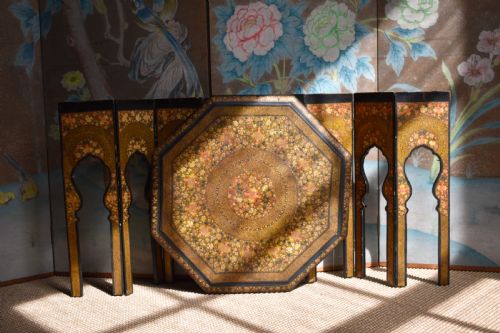
The pieces appearing here span from late Victorian and Edwardian examples up to the nineteen-thirties, taking the form of side tables, occasional tables, coffee tables, and card or games tables.
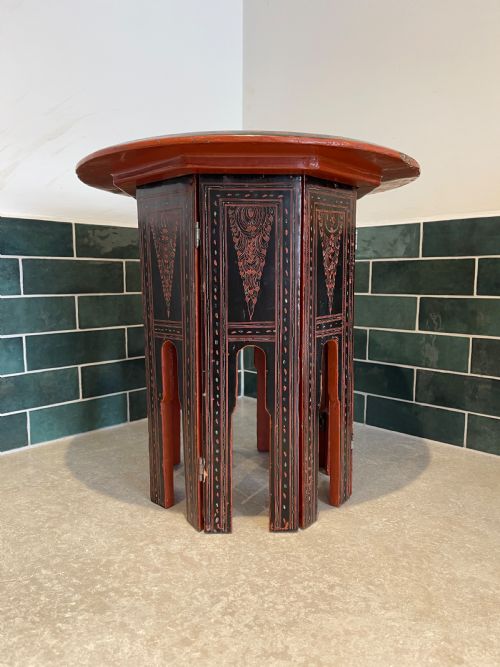
Makers drew on diverse regional vocabularies, producing Anglo-Indian, Chinese Export, Anglo-Burmese, Qing Dynasty, and Moorish Revival styles designed for convenient storage and relocation.
Materials and construction
Craftsmen shaped these tables from dense timbers including teak, sheesham wood, sandalwood, Hongmu, and general hardwood, pairing them with folding bases for mobility.
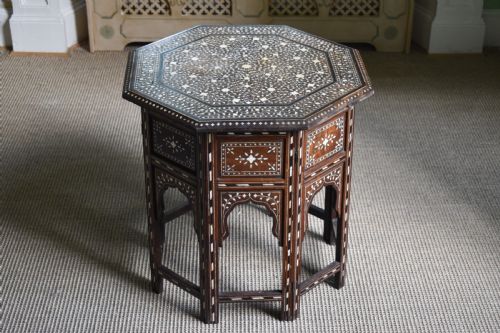
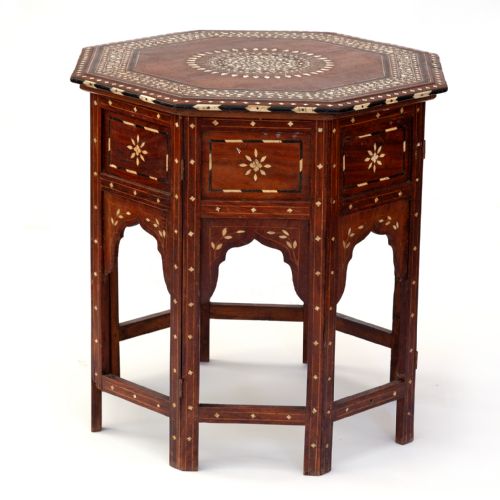
Decoration relied on contrasting details, employing brass inlay, bone inlay, copper tops, and painted or black lacquered finishes.
Carving formed a central technique, yielding profusely worked surfaces and geometric star motifs across octagonal and rectangular tops.
Materials recorded on this page include teak, sheesham wood, sandalwood, Hongmu, brass, copper, lacquer, paint, and bone inlay.
Assessing quality
Quality rests upon the crispness of the hand-carving and the precision with which bone, brass, or copper elements fit into the surrounding timber.
The integrity of the folding mechanism dictates the success of the piece, where sound joints ensure the table stands level when open and collapses smoothly when needed.
Finer examples maintain complete inlay work without losses, presenting harmonious patination across lacquer, paint, or polished wood.
The Oriental Folding Side Table Glossary
- Anglo-Indian
- A style describing furniture made in India during the British period, combining local craftsmanship with British room forms. It frequently incorporates dense carving and intricate inlay.
- Hoshiarpur
- A town in Punjab renowned for intricate woodwork, producing tables distinguished by elaborate bone or brass inlay work. Pieces from this tradition often feature geometric star patterns.
- Qing Dynasty
- The last imperial dynasty of China, spanning the seventeenth to early twentieth centuries. Furniture from this era often utilises carved hardwoods like Hongmu.
- Hongmu
- A traditional Chinese term for dense, reddish-black hardwoods used in fine furniture making. It provides a heavy, durable surface suitable for detailed carving.
Oriental Folding Side Table: Frequently Asked Questions
How do you fold these tables?
Most examples utilise an ingenious interlocking wooden base that collapses flat when the top is lifted off or pivoted. The hinges and folding X-frames rely on precise carpentry rather than metal fixings.
Ensure you support both sides equally when operating the mechanism to prevent strain on the joints and carved elements.
Where should I place one?
These compact tables suit small spaces, sitting beside a sofa or armchair as an occasional surface for books or lamps. Their folding nature means they store easily behind furniture if floor space is needed.
Keep them away from direct heat sources and strong sunlight to protect delicate lacquered finishes and bone inlay.
How do I date these pieces?
Dating relies on stylistic clues, timber choice, and construction methods recorded across late nineteenth and early twentieth-century examples. Edwardian and Qing Dynasty pieces often carry distinct decorative motifs from their respective regions.
Examine the wear on the folding mechanism and the patina of the wood to understand the age of the table.
How do I clean bone inlay?
Maintain bone inlay surfaces by dusting gently with a dry, soft cloth to prevent dirt settling into the recessed grooves. Avoid using water, harsh chemical cleaners, or polishes that might discolour the bone or loosen the adhesive.
Professional conservation is recommended if any small sections of inlay become loose over time.