





Oriental Flatweave Floor Runner
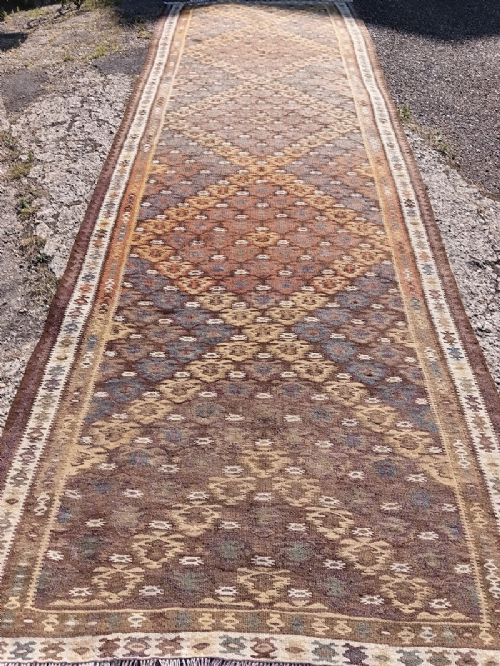
An oriental flatweave floor runner brings nomadic design and flat-woven texture to a hallway, formed from wool and cotton.
Oriental Flatweave Floor Runner
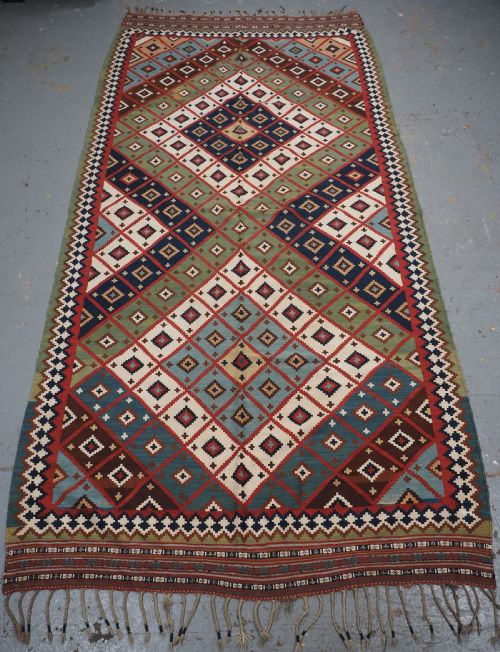
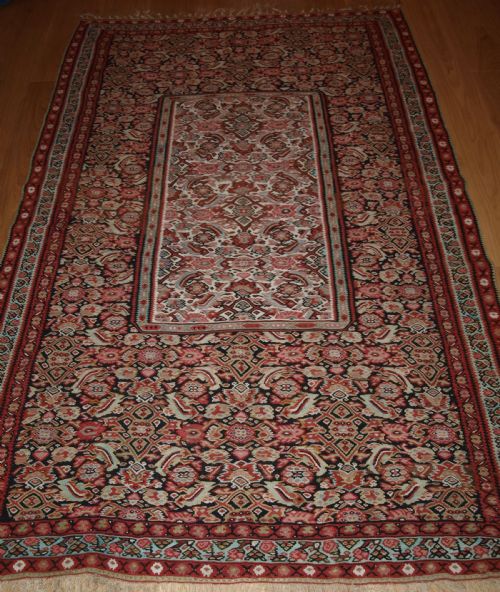
An oriental flatweave floor runner is a long, narrow textile designed for corridors and passages, represented here by kilims and soumak carpets spanning the late nineteenth and early twentieth centuries. These pieces originate from diverse tribal and regional traditions including Persian, Anatolian, Caucasian, Uzbek, and Turkmen workshops.
Buyers seeking an oriental flatweave floor runner encounter various distinct tribal styles, such as Qasvin, Ushak, Yomut, Qashqai, Kayseri, and Senneh weaves. The selection ranges from multi-strip construction to triple medallion designs and long kilim ends.
The forms on this page consist primarily of runner rugs, kilim rugs, and carpets dating across periods from eighteen-ninety to nineteen-twenty. Each textile demonstrates the flat-woven characteristic that distinguishes these pieces from pile carpets.
Materials and construction
These floor runners are constructed using wool and cotton as the primary materials, providing both structural stability and soft surface texture. Artisans wove these textiles by hand, employing flat-weaving techniques such as kilim and soumak structures without a traditional knotted pile.
Construction methods vary from single-piece flatweaves to multi-strip formats, exemplified by pieces woven in nine strips or large-size two-part configurations. Artisans integrated long kilim ends and specific medallion layouts directly into the foundational weave during production.
Oriental Flatweave Floor Runner Retail Price Guide 2026
Typical asking prices for oriental flatweave floor runner among the pieces listed under this phrase on Sellingantiques today, from the lower quarter to the upper quarter. They describe what is for sale here now, not the wider market.
Some nineteenth-century weavers carefully joined nine separate narrow strips together to form a single expansive floor covering.
Distinctions in quality
Quality in these flatweave runners is evident in the tightness of the weave and the precision of the geometric or medallion designs. Examples featuring scarce designs or traditional methods like Soumak wrapping demonstrate higher artisan skill.
Condition and colour retention also determine the quality of each piece, ranging from soft faded reds to deep tribal palettes. Intact long kilim ends and structural integrity across multiple woven strips indicate superior preservation of the original textile.
The Oriental Flatweave Floor Runner Glossary
- Kilim
- A flat-woven carpet or rug produced without a pile, common throughout Turkey, the Caucasus, and Persia. This technique creates a lightweight textile with identical patterns visible on both sides.
- Soumak
- A flat-weave technique involving wrapping supplementary weft threads around the warp threads for added durability and texture. It results in a raised braid-like surface on the face of the textile.
- Palas
- A traditional flatweave textile term often associated with nomadic Yomut Turkmen weaving. These pieces utilise simple utility weaves for floor coverings and transport bags.
- Warp
- The stationary vertical threads stretched on a loom before weaving begins. The weft threads are passed over and under these foundational threads to form the textile.
- Weft
- The horizontal threads passed back and forth through the warp threads to create the pattern and structure. In flatweaves, these coloured threads completely conceal the vertical warp.
Oriental Flatweave Floor Runner: Frequently Asked Questions
What is an oriental flatweave floor runner?
An oriental flatweave floor runner is a narrow, pileless textile made by nomadic and tribal weavers across the Middle East and Central Asia. These pieces utilise flat-woven techniques like kilim and soumak to create durable floor coverings suited for hallways and corridors.
Items in this category date from the late nineteenth and early twentieth centuries, featuring wool and cotton construction. They showcase regional designs including Persian, Caucasian, and Turkmen motifs.
Where should I place a flatweave runner?
These runners are suited for high-traffic corridors, hallways, and narrow entryways where a flat profile prevents doors from catching. Their slender proportions help elongate visual space in long passages.
Because they lack a raised pile, flatweave carpets sit flat against floorboards and tiles. They provide a practical layer of wool and cotton underfoot without adding excessive height.
How do I care for a vintage flatweave?
Care for a vintage flatweave floor runner involves regular gentle vacuuming without a rotating brush roll to protect the flat-woven structure. Professional cleaning tailored to antique textiles preserves the natural wool and cotton fibres.
Placing an appropriate underlay beneath the runner prevents slipping and reduces friction against the floor. This simple addition extends the working life of nineteenth and early twentieth-century weaves.
How are kilim runners different from pile rugs?
Kilim runners are constructed using an interlacing flat-weave technique rather than knotting pile yarn around warp threads. This produces a lightweight, reversible textile with a smooth surface texture.
Pile rugs feature vertical tufts of wool that stand upright to form a dense surface cushion. Flatweaves rely entirely on the tension of the woven warp and weft for their structural integrity.