




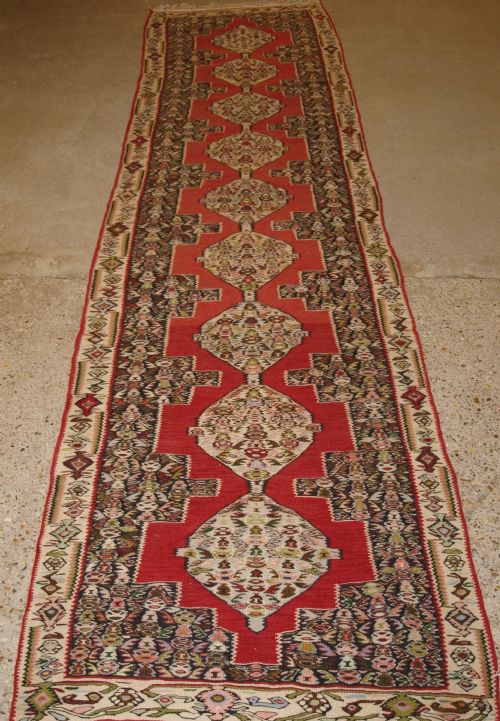

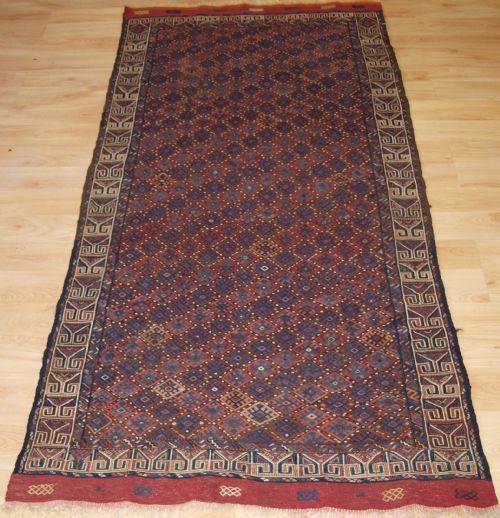


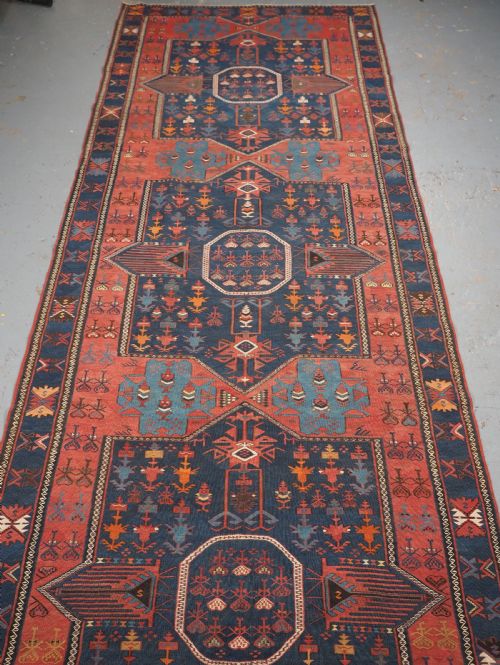


Flatweave Wool Hallway Runner
A flatweave wool hallway runner brings practical warmth and tribal geometry to an entrance, offering durable foot traffic coverage through flat, pileless construction.

Flatweave Wool Hallway Runner
A flatweave wool hallway runner is a long, narrow textile designed for corridors and passages, represented here by pieces originating from Persian, Anatolian, Caucasian, Moroccan, and Central Asian tribal traditions. These runners span from the late nineteenth century through to the early decades of the twentieth century, encompassing various regional weaving styles.
Most examples rely on flat kilim and soumak structures rather than knotted pile, making them exceptionally well-suited for heavy traffic areas where doors need to clear the floor covering easily.
Assessing quality in antique runners
Quality in these runners rests on the tightness of the weave, the crispness of the tribal geometric motifs, and the depth achieved through natural dyes. Finer examples display meticulous execution of intricate bands and medallions.
The integrity of the selvedges and ends, along with the resilience of the hand-spun wool, distinguishes superior pieces from standard specimens. Structural soundness directly reflects the skill of the original weaver.
Flatweave Wool Hallway Runner Retail Price Guide 2026
Typical asking prices for flatweave wool hallway runner among the pieces listed under this phrase on Sellingantiques today, from the lower quarter to the upper quarter. They describe what is for sale here now, not the wider market.
Some runners incorporate traditional saddle bags repurposed or woven in matching tribal techniques for narrow spaces.
The Flatweave Wool Hallway Runner Glossary
- Kilim
- A flatwoven textile produced by tightly interweaving warp and weft strands to create a smooth surface without pile. This technique results in a lightweight, reversible rug ideal for corridors.
- Soumak
- A brocading technique where weft threads are wrapped over and under warp threads before moving across the row. It produces a textured, braided face and a heavier structure than standard kilims.
- Warp
- The stationary vertical threads stretched onto the loom that form the structural foundation of the textile. All weft yarns are woven through these parallel lines.
- Weft
- The horizontal threads passed through the warp to build the pattern and colour fields. In these runners, wefts are tightly packed to conceal the foundation.
- Natural Dyes
- Colouring agents derived from plants, insects, and minerals rather than synthetic compounds. They yield subtle tonal variations and age with a characteristic patina.
Flatweave Wool Hallway Runner: Frequently Asked Questions
How do I clean a flatweave runner?
Regular gentle vacuuming without a rotating brush roll prevents dust accumulation within the flatweave structure. Professional textile cleaning is recommended for deeper maintenance to protect natural wool fibres.
Avoid excessive moisture and harsh chemical detergents, which can disturb natural dyes and weaken hand-spun wool. Prompt blotting handles accidental spills effectively.
Do I need an underlay for these runners?
Using a quality rug underlay is essential to prevent slipping on smooth hallway floors. It also cushions the flatweave against hard subfloors, reducing friction and wear.
A breathable, rubberized mesh pad keeps the runner securely in place while allowing air circulation beneath the textile.
How do I date a tribal kilim runner?
Dating relies on stylistic analysis, structural characteristics, and the specific palette of natural dyes. Pieces from the late nineteenth and early twentieth centuries often exhibit distinct regional wool preparation methods and tribal motifs.
Examining the regularity of the weave and the specific types of materials used provides further clues to the period of origin.
Are flatweave runners durable enough for hallways?
The dense flatweave construction makes these textiles remarkably resilient against constant foot traffic. Without a raised pile to crush or mat, they maintain their structural integrity over decades of corridor use.
Their slim profile ensures doors swing freely overhead without catching on the edges of the rug.