
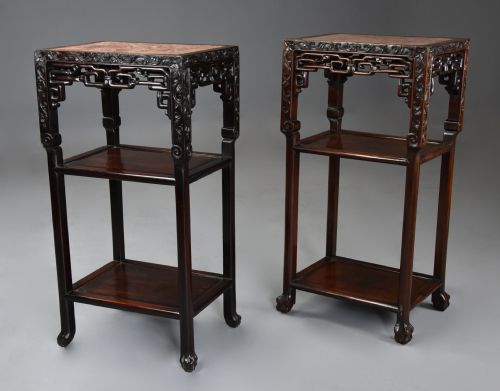
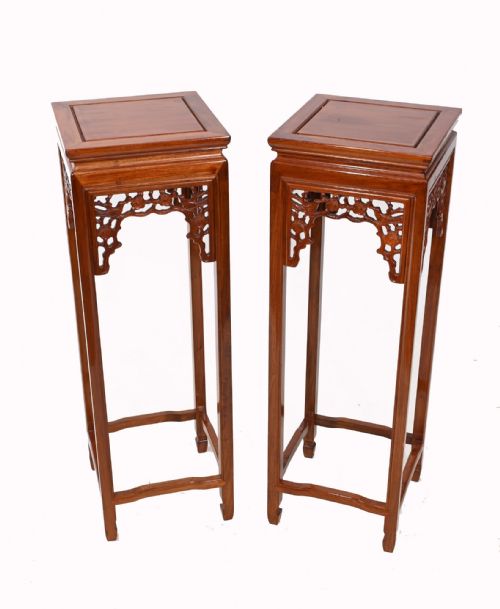
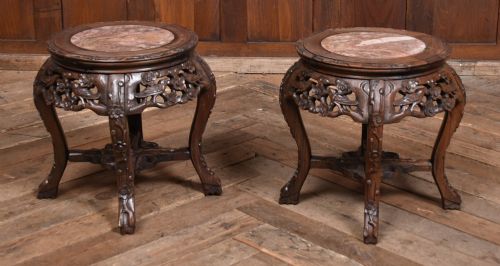

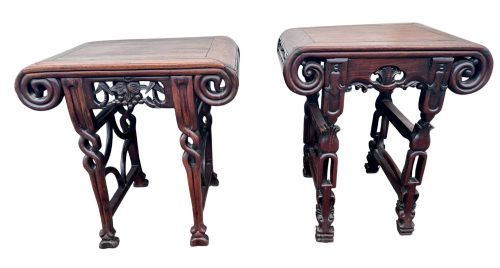


Oriental Display Stand Pair
An oriental display stand pair brings focused elevation to interiors, offering symmetrical support for urns, plants and decorative objects.
Oriental Display Stand Pair
An oriental display stand pair comprises symmetrical furniture pieces designed to elevate decorative items within a room, appearing frequently as plant stands, urn supports and occasional tables.
These pieces emerge predominantly from nineteenth-century Asian craftsmanship, including Qing Dynasty and Republic Period iterations, alongside Edwardian Chinoiserie interpretations.
Most examples function as matched pairs of freestanding supports, utilising compact footprints suited to supporting porcelain, marble and bronze vessels.
Materials and construction
Carpenters utilised dense exotic timbers such as hardwood, rosewood, padouk and hongmu to construct durable frames capable of bearing heavy stone and ceramic vessels.
Many surfaces integrate inset rouge marble tops or porcelain panels, whilst others employ painted lacquer finishes and intricate mother-of-pearl or gold-lip shell inlay.
Joinery methods focused on rigid structural support for vertical loads, combining carved wood frames with inset tabletops.
What distinguishes finer examples
Quality rests upon the density and selection of the timber, alongside the depth and precision of hand-carved decorative motifs across the frame.
The integration of materials determines distinction, particularly where flawless rouge marble inserts or intricate mother-of-pearl shell details align harmoniously with the carved woodwork.
The Oriental Display Stand Pair Glossary
- Hongmu
- A dense, dark tropical hardwood traditionally utilised in classical Chinese furniture manufacturing. Its heavy weight and fine grain provided exceptional stability for carved display pieces.
- Padouk
- A durable reddish timber prized for its resilience and rich colouration. Craftsmen selected this material for structural stability in load-bearing furniture.
- Jardiniere
- An ornamental container designed for holding plants or floral arrangements. These vessels frequently stood atop pedestals and low tables within period interiors.
- Chinoiserie
- European artistic interpretations of Chinese decorative motifs and styles. This aesthetic influenced furniture production during the Edwardian era and surrounding decades.
- Tazza
- A shallow saucer or bowl mounted upon a stem and foot. Such items appeared alongside table displays and pedestals.
Oriental Display Stand Pair: Frequently Asked Questions
What were oriental display stands used for?
These pieces served primarily to elevate decorative objects, urns, and large plants within formal rooms. By raising vessels off the floor, they highlighted individual items.
They also functioned as occasional tables or side surfaces in various domestic settings, providing balanced symmetry when arranged in pairs.
How do I style a display stand pair?
Matching pairs look effective when positioned symmetrically on either side of a fireplace, doorway, or large piece of furniture. Placing identical urns or matching plants upon them reinforces this visual balance.
Alternatively, separating the pair into different corners of a room creates a cohesive decorative theme throughout the interior space.
How do I identify Qing Dynasty pieces?
Identification relies on examining the timber density, traditional joinery techniques, and the specific style of hand-carved ornamentation. Nineteenth-century examples often feature dense rosewood or hongmu construction.
Details such as inset marble tops and traditional carving motifs further distinguish these pieces from later interpretations.
What is the difference between rosewood and hongmu?
Both terms describe dense, heavy tropical hardwoods prized in classical furniture making. Hongmu refers broadly to a category of red-brown dense woods used in Chinese craftsmanship.
Rosewood denotes specific timber varieties with distinct grain patterns and colouration, both utilised for their superior strength and ability to hold fine carved details.