



Opalescent Glass Vessel
An opalescent glass vessel brings a shifting play of milky blue and amber tones to a room, catching the light in a way clear glass never manages.
Opalescent Glass Vessel
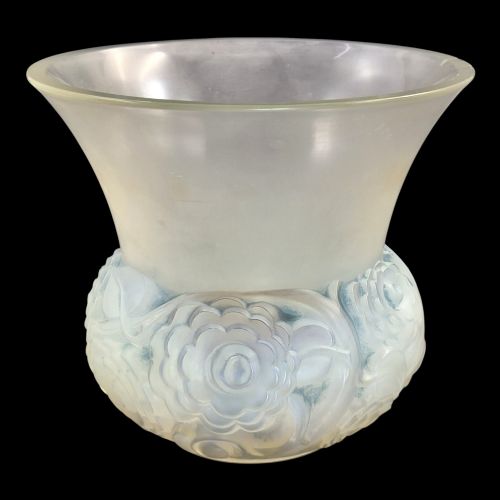
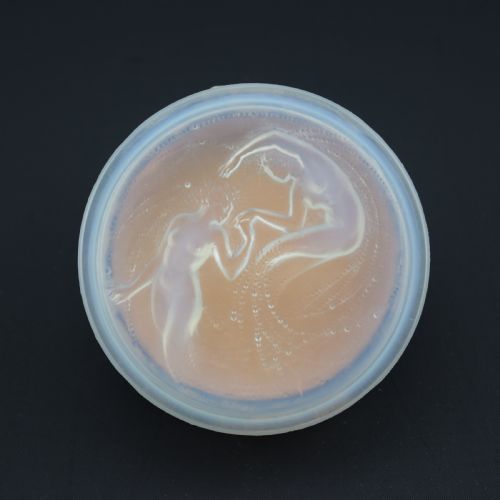
An opalescent glass vessel combines tactile form with a translucent body that appears pale blue in reflected light and warm amber when backlit. This selection centres on pieces shaped as vases, decorative bowls, and trinket boxes.
The objects on this page belong predominantly to the Art Deco and Art Nouveau movements, with production dates spanning the early decades of the twentieth century. Forms range from low bowls bearing moulded birds to tall vases encircled by floral and animal motifs.
Makers from the 1900 to 1930 period dominate the examples present, utilising pressed and cameo techniques to achieve their characteristic sculptural depth. Buyers encounter both French studio work and moulded production pieces from these foundational design eras.
How they were made
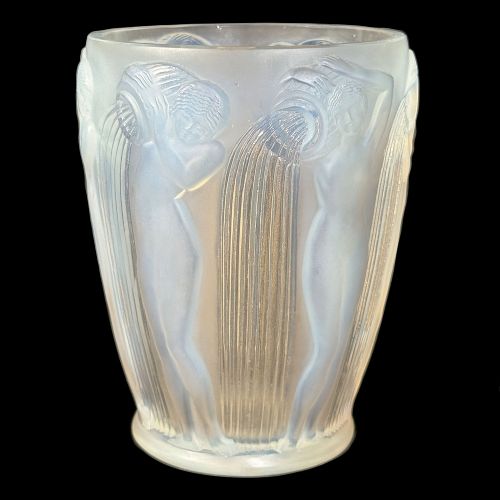
Makers shaped these items using pressed glass and cameo glass techniques, often employing moulds to raise intricate low relief designs like rams, water carriers, and foliage from the body. Molten material received chemical additives to create the milky, light-scattering quality inherent to the medium.
Certain pieces received applied blue staining into the recessed portions of the moulded design to accentuate the contrast against the pale opalescent background. Artisans then finished the surfaces through acid-etching, fire-polishing, or hand-carving layers of coloured glass as seen in cameo work.
Some vessels feature sculpted rams and water carriers frozen in glass.
What varies in quality
Quality rests in the crispness of the moulded relief and the intensity of the opalescence as it catches the light from different angles. Pieces with sharper definition in motifs like leaves or figures show greater precision in the original metal moulds.
The depth and uniformity of the blue staining also separate standard production from finer examples, as does the subtlety of the transition between the milky surface and the warm interior glow.
R Lalique·Galle
The Opalescent Glass Vessel Glossary
- Opalescence
- An optical effect in glass where particles suspended within the clear matrix scatter shorter wavelengths of light, making the surface appear milky white with a bluish cast in reflected light and yellowish-orange in transmitted light.
- Cameo glass
- A vessel formed of multiple fused layers of different coloured glass, where the outer layer is carved or acid-etched away to leave a raised design standing out against a contrasting background.
- Pressed glass
- A manufacturing method where molten glass is dropped into a metal mould and forced outward by a matching plunger, allowing complex three-dimensional patterns to be produced with consistency.
- Stained glass
- The application of coloured pigments or metallic oxides to the surface of a finished vessel, often wiped into recessed carved lines to highlight the underlying design details.
Opalescent Glass Vessel: Frequently Asked Questions
How do I clean an opalescent glass vessel?
Wash the glass gently in warm water using a mild, non-abrasive liquid soap and a soft cloth. Avoid harsh scrubbing brushes or abrasive detergents that can damage the delicate surface texture and any applied staining.
Dry the vessel thoroughly with a lint-free towel to prevent water spots from obscuring the subtle interplay of light across the milky surface.
Where should I display an opalescent glass vessel?
Place the piece near a natural light source such as a window or on a glass shelf where light can pass through the body from behind. This allows the material to shift from a pale milky blue to a warm amber glow.
Keep the vessel away from direct, harsh sunlight for extended periods and secure it on a stable, vibration-free surface to protect its fragile structure.
How do I tell Art Nouveau from Art Deco pieces?
Art Nouveau vessels typically feature asymmetrical floral motifs, whiplash curves, and organic plant forms inspired by the natural world. The Galle cameo vase on this page exemplifies this flowing, nature-driven aesthetic.
Art Deco pieces lean towards geometric symmetry, stylised representations of animals or figures, and bold, repeating patterns. The Lalique vases with rams or water carriers show this more structured approach.
What causes the milky blue effect in the glass?
The milky blue appearance results from adding specific minerals or chemical compounds, such as bone ash or arsenic, to the molten batch during manufacture. These agents form microscopic crystals that scatter light unevenly as it passes through the vessel.
When viewed against direct light, the same suspended particles allow warmer yellow and amber tones to dominate the visual field.