


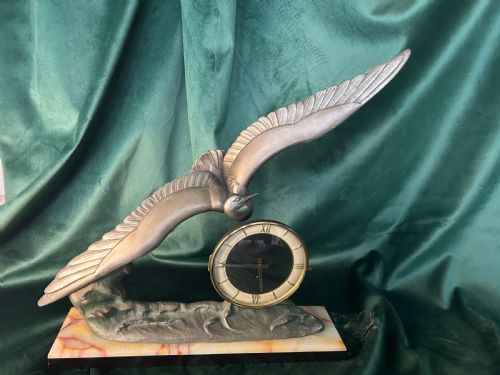


Onyx Art Deco Clock
An onyx art deco clock brings geometric gravity and rich, polished stone into a room, offering a functional centrepiece with period presence.
Onyx Art Deco Clock
An onyx art deco clock is a heavy, sculptural timepiece built from banded stone and metals, designed to anchor a mantelpiece or desk. When you search for this phrase, you find items predominantly from the 1920s and 1930s, reflecting the interwar passion for streamlined modernity.
The most common formats on this page are mantel clocks and clock sets that include matching sidepieces or garnitures, sometimes incorporating metal figures of animals. French and English workshops dominate the output, ranging from simple geometric surrounds to elaborate sculptural compositions.
Beyond the standard mantel clock, variants appear with integrated barometers and thermometers, or paired with desk lamps. These pieces demonstrate how timekeeping merged with domestic utility during the early twentieth century.
How they were made
The primary material is natural onyx, frequently green onyx, complemented by sections of contrasting marble or cast metal elements like brass, chrome, spelter and bronze. Masons cut and polished the stone into stepped architectural blocks or smooth curved surrounds to frame the circular dial.
Metal components such as bezels, hands and decorative sculptures were cast and finished separately before being mounted onto the stone chassis. Movements were typically mechanical eight-day mechanisms, fitted behind glass faces protected by brass or chrome bezels.
German Shepherds and greyhounds keep a watchful eye over the passing hours on several mantel designs.
What varies in quality
Quality rests primarily on the depth of the stone and the ambition of the design, distinguishing mass-produced commercial items from bespoke studio pieces. Superior examples feature striking variations in the natural banding of the onyx and harmonious integration of contrasting marbles.
The quality of associated metalwork and sculptural elements creates a distinct tier in these objects. Pieces featuring named sculptors or finely chased bronze and spelter figures demand greater attention than standard geometric housings.
Elliott·Michel Decoux·Ferdinand Priess·Garrards·F. H. Danvin
The Onyx Art Deco Clock Glossary
- Onyx
- A form of banded chalcedony prized for its translucent layers and rich colouration, frequently utilised in interwar mantel pieces. It provides a dense, polished housing that reflects light across its patterned surface.
- Garniture
- A matching set of ornamental objects, usually comprising a central clock flanked by two matching sidepieces or vases. These sets were designed to create a balanced arrangement on a fireplace mantel.
- Spelter
- A zinc alloy commonly used as a cost-effective substitute for bronze in decorative figures mounted on clock cases. It was often painted or electroplated to simulate more expensive metals.
Onyx Art Deco Clock: Frequently Asked Questions
How do I wind an eight day clock?
You insert the key into the winding holes on the dial and turn it gently until you feel resistance. Do not overwind the spring.
Most mechanical movements of this period require weekly attention to maintain accurate timekeeping across the dial.
Where should I place a heavy stone clock?
Choose a sturdy surface like a mantelpiece or a solid sideboard that can easily support the substantial weight of stone and metal. Ensure the furniture is completely level so the pendulum or balance wheel operates evenly.
Keep the stone away from direct sunlight and damp environments to preserve the polished finish of the onyx.
How do garniture sets work?
A garniture set uses a central clock accompanied by matching side ornaments to create a balanced display on a mantel or large shelf. The flanking pieces often echo the materials and geometric motifs of the main timepiece.
In some instances, the sidepieces share the function of vases or matching candle holders.
How do I distinguish 1920s pieces from 1930s pieces?
Twenties pieces frequently incorporate figurative bronzes or spelter sculptures, such as animals or dancers, mounted beside the dial. They often display classical transitional shapes alongside early modernist lines.
Thirties items lean more towards austere modernist geometry, streamlined chrome accents, and clean architectural silhouettes without figurative attachments.