
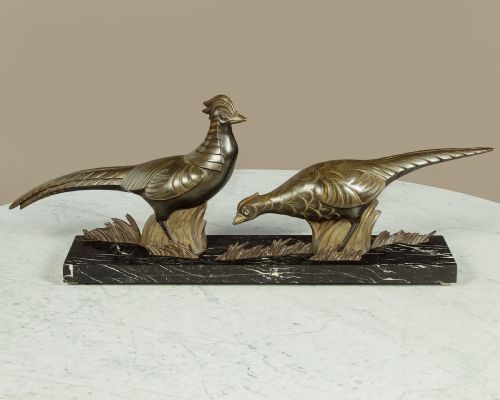


French Art Deco Mantelpiece
These french art deco mantelpiece pieces bring strong geometric lines and striking animal bronzes straight to your hearth.
French Art Deco Mantelpiece
When you search for a french art deco mantelpiece, you encounter solid marble, onyx and contrasting metal figures that anchor a room. The selections here heavily feature mantel clocks and sculptural groups, often combining bold timepieces with flanking ornaments or integrated animal figures.
The dominant period represented is the 1920s and 1930s, capturing the sleek modernity of interwar design. Alongside these, you find earlier nineteenth century marble clocks sitting comfortably within the decorative lineage that preceded the modern movement.
Materials and construction
Makers utilised heavy natural stones like marble and onyx to build substantial bases that could support weighty metallic elements. These stone plinths often combined different colours and textures to create layered architectural facades.
Figures and sculptural groups were cast in bronze, spelter or ormolu, while later iterations embraced innovative synthetic materials like bakelite. Glass and brass also appeared frequently to accent clock dials and decorative vessels.
Even fierce lions and heavy stags had to stand still on the mantelpiece, frozen mid-stride in polished metal.
Assessing quality and execution
Quality rests heavily on the crispness of the metal casting and the depth of detail in sculpted figures such as stags, dogs and human forms. Superior pieces exhibit clean finishing on patinated surfaces and precise fitting where metal meets stone.
The choice and combination of materials dictate the status of a piece, with multi-coloured marble and onyx assemblies or genuine bronze outperforming simpler cast spelter bodies. Signed works by recognised modellers also elevate the standing of an item.
Sibylle May·C Masson·H Bal·JAZ·Blangy
The French Art Deco Mantelpiece Glossary
- Spelter
- A zinc alloy frequently used as a cost-effective alternative to bronze for casting decorative figures during the period. It takes patination well to simulate heavier metals.
- Garniture
- A set of matching decorative objects, typically comprising a central clock flanked by matching vases or urns designed for a mantelpiece. These create a balanced symmetrical display.
- Bakelite
- An early form of synthetic plastic utilised for clock cases in the later interwar years. It allowed for vibrant solid colours and smooth moulded geometric shapes.
- Ormolu
- Gilded bronze applied to clock mounts and decorative fittings to provide a rich golden highlight. The technique requires meticulous mercury gilding or modern electroplating.
- Onyx
- A banded variety of chalcedony quartz frequently used for decorative clock bases and architectural stonework. Its translucent layers catch the light differently than standard marble.
French Art Deco Mantelpiece: Frequently Asked Questions
How do I style a mantel clock?
Pair the central timepiece with matching garniture vases or let it stand alone on a heavy stone mantelpiece to showcase its geometric silhouette.
Ensure the scale of the clock matches the width of the fireplace surround so it does not look lost against the architectural stonework.
What is the difference between bronze and spelter?
Bronze is a robust copper alloy that accepts fine detail and holds a deep patina for generations. Spelter is a softer zinc-based alternative that was common for decorative figures due to lower production costs.
Carefully inspect the underside or base to understand the weight and composition of the metalwork.
Are these clocks still in working order?
Many vintage clocks retain their original mechanical movements, though operational status varies across individual pieces. Some require professional servicing to keep accurate time.
Check the listing details to confirm if the key and pendulum are present with the movement.
How do I clean marble and onyx?
Use a soft, dry microfibre cloth to gently remove dust from the polished stone surfaces. Avoid harsh chemical cleaners that can strip the natural sheen from the marble.
Keep moisture away from the metal fittings and clock dials to prevent corrosion over time.
What subjects are common in these sculptures?
Animals such as stags, dogs, lions and pheasants frequently appear alongside stylised human figures and dancers. These subjects reflect the dynamic movement favoured by designers of the era.
Many figures are mounted directly onto contrasting rectangular marble bases to emphasise their horizontal lines.