


Art Deco Garniture
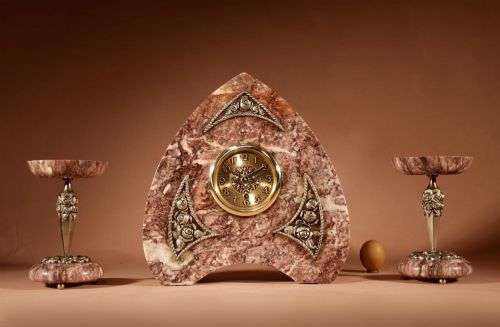
An art deco garniture brings a striking symmetry to a mantelpiece, pairing a central clock with matching side pieces.
Art Deco Garniture
An art deco garniture typically comprises a central mantel clock accompanied by a pair of matching side ornaments, designed to be displayed together as a unified centrepiece. When searching for an art deco garniture, buyers encounter complete three-piece sets arranged symmetrically for a formal interior display.
The selections span the 1910s, 1920s, and 1930s, reflecting the progression of the style from early twentieth-century designs through to the height of the period. French origin is particularly common among the pieces, frequently taking the form of a clock set accompanied by matching garnitures.
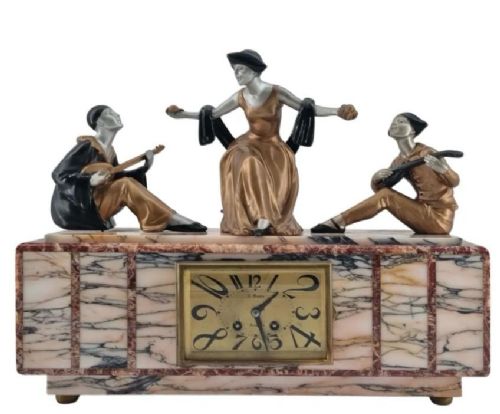
Figural elements often anchor the design, featuring sculptural subjects such as dancers, animals like greyhounds and elephants, and pierrot figures mounted directly onto the clock or the flanking pieces. Marble bodies dominate the physical forms, often paired with side vases or matching pedestals to complete the composition.
Materials and construction
Marble and onyx provide the heavy, solid foundations for the majority of bodies and bases, frequently contrasted with metals such as brass, chrome, and silver plated bronze. These dense stone structures give the sets their characteristic weight and substantial presence on a mantel.
Figural components utilise bronze, spelter, and enamel to render detailed human and animal subjects, adding varied textures and metallic sheens above the stone plinths. Glass also appears within the material mix, contributing translucent elements to select clock faces and garniture bodies.
Listings feature items dated across the 1910s, 1920s, and 1930s, utilising marble, brass, onyx, spelter, glass, metal, chrome, and enamel.
Distinctions in quality
The calibre of a set rests heavily on the integration of its sculptural components, where named artist figures or finely cast metal sculptures elevate the work far beyond standard production. Finer examples display meticulous carving of the marble and breccia, alongside crisp casting in the spelter or bronze figures.
Cohesion across the three pieces determines the visual success of a garniture, as matching side garnitures must share the exact material grain and design vocabulary of the central clock. Complete sets that retain their original pairings demonstrate a higher degree of integrity than assembled or mismatched groups.
Sega·Michel Decoux·P Sega·Suzanne Bizard·Odyv
The Art Deco Garniture Glossary
- Garniture
- A set of ornaments designed to be displayed together, typically consisting of a central clock flanked by two matching vases or figures.
- Spelter
- A zinc alloy commonly used in the period as a less expensive alternative to bronze, often finished with patination to resemble heavier metal.
- Breccia marble
- A composite rock made of broken fragments of minerals embedded in a fine-grained matrix, valued for its variegated and mottled patterns.
- Mantel clock
- A clock designed to sit on the shelf above a fireplace, forming the central anchor of a garniture arrangement.
Art Deco Garniture: Frequently Asked Questions
What is included in an art deco garniture?
A standard set comprises a central mantel clock accompanied by two matching side pieces, such as vases or sculptural ornaments. These three items share a cohesive design language and are intended to be displayed together.
The side pieces mirror the materials and decorative motifs of the clock, creating a balanced and symmetrical arrangement for a mantelpiece or sideboard.
How do I date an art deco garniture?
Dating relies heavily on the combination of materials, such as specific types of marble, and the stylistic cues of the figural subjects. Pieces from the 1910s often retain heavier transitional shapes, while 1920s and 1930s examples embrace streamlined geometric forms.
Maker signatures or marks on the clock movements and bronze or spelter sculptures also provide precise chronological reference points for the manufacture date.
Are the side garnitures always clocks?
The side pieces in a garniture set are ornamental rather than timekeeping devices, frequently taking the form of matching vases, urns, or figural sculptures. Their purpose is to visually balance the central clock.
While the central object houses the timepiece, the flanking items repeat the marble bodies, metal mounts, or sculptural themes of the main clock to unify the group.