




Officer Travel Clock
An officer travel clock is a portable timepiece built for movement, housed in brass and glass to keep time on the march or in camp.
Officer Travel Clock
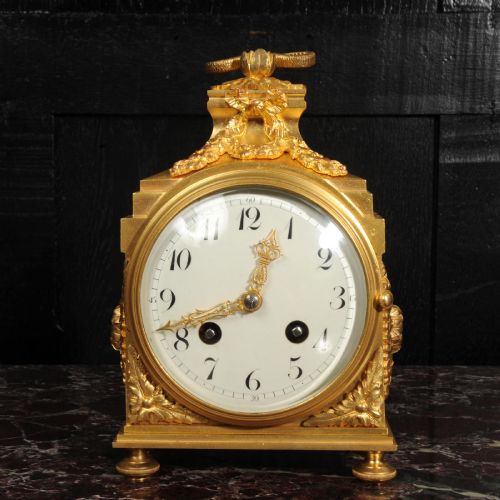
An officer travel clock is a portable timepiece designed for convenience during campaign or journey, appearing here primarily as nineteenth-century French carriage clocks and mantel clocks. These pieces span periods from the early nineteenth century through to the end of the Victorian era, reflecting rigorous engineering scaled for transport.
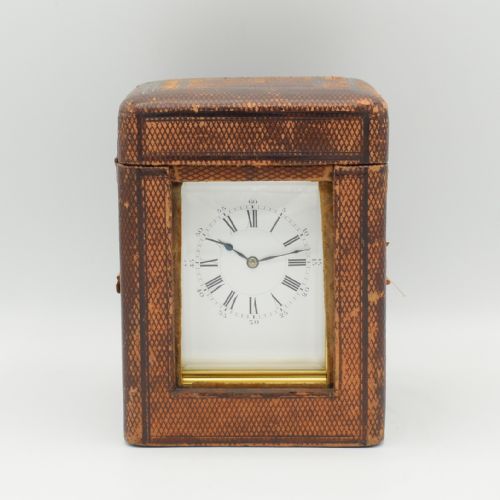
The construction typically involves robust brass, gilt brass, or ormolu framing glass panels that reveal the escapement within. Many examples arrive with fitted leather or rosewood travel cases, preserving the casework against the knocks of transit.
What varies in quality
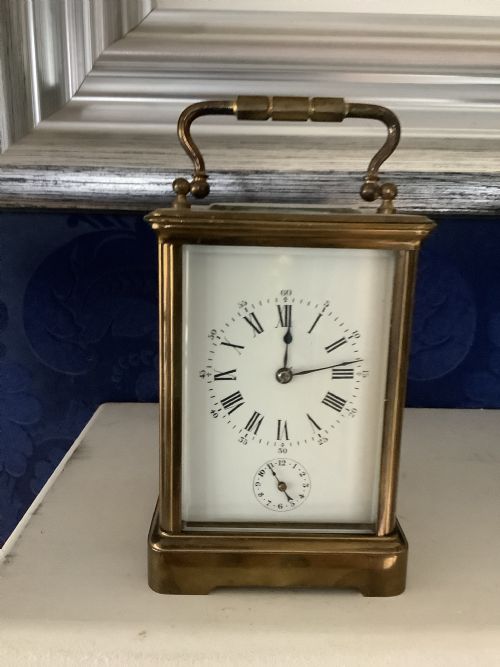
Quality rests upon the complexity of the internal movement and the crispness of the exterior metalwork, where signed Parisian makers command greater regard. Simple timepieces differ significantly from those featuring grande sonnerie striking mechanisms, alarm functions, or perpetual calendars.
The finish of the gilt brass or ormolu and the presence of the original matching leather or wooden travel case elevate the standing of a piece. Substantial gorge cases with thick, heavy bevelled glass represent the upper tier of period production.
The listings span the nineteenth century, uniting Victorian British taste with French horological output in brass, glass, and gilt bronze.
Henri Jacot·C. Detouche Paris·J. F. Bautte Et Cie·Le Roy et Fils·Bourdin·Drocourt·E.J.Dent·Paul Garnier·J.W.BENSON·Joseph Soldano
The Officer Travel Clock Glossary
- Gorge case
- A distinct style of carriage clock case featuring stepped mouldings to the top and base. This architectural framing is characteristic of better-quality nineteenth-century French production.
- Grande sonnerie
- A complex striking train that chimes both the hours and the quarters automatically on every quarter-hour. Such movements require exceptional skill to regulate within a compact portable frame.
- Escapement
- The mechanical linkage that regulates the speed of the clock by controlling the release of the gear train. Platform escapements allow portable clocks to maintain accuracy despite movement.
- Ormolu
- Finely ground gold cast and amalgamated onto a bronze or brass object using mercury, creating a durable golden finish. This technique gives nineteenth-century French frames their rich metallic lustre.
Officer Travel Clock: Frequently Asked Questions
How do I wind an officer travel clock?
Most of these portable timepieces utilise a key inserted into the backplate to tension the mainsprings for both the going train and any striking complications. Care must be taken not to overwind the springs, stopping as soon as resistance is felt.
Time setting is typically achieved by moving the hands directly or via a dedicated arbor, depending on whether the platform escapement is exposed or protected beneath a dust cover.
Were these clocks actually used in military campaigns?
The earliest iterations, such as those associated with Napoleon, were commissioned specifically for officers needing reliable time on active service. Their robust brass frames and thick glass panels were engineered to withstand the rigours of horseback transport and rough terrain.
As the nineteenth century progressed, the form evolved into a luxury domestic accessory and carriage companion, though the foundational design retained its portable strength.
What is the difference between a carriage clock and a pendule d'officier?
A pendule d'officier generally refers to the earlier, distinct style invented for military officers on campaign, often featuring a more utilitarian or classical architectural outline. Standard carriage clocks developed later into refined mantel ornaments with decorative gorge or corniche cases.
Both share the core requirement of portability, but the officer designation points closer to the foundational military roots of the form.