
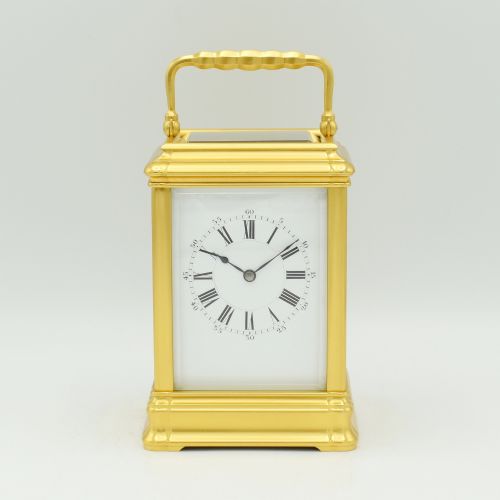
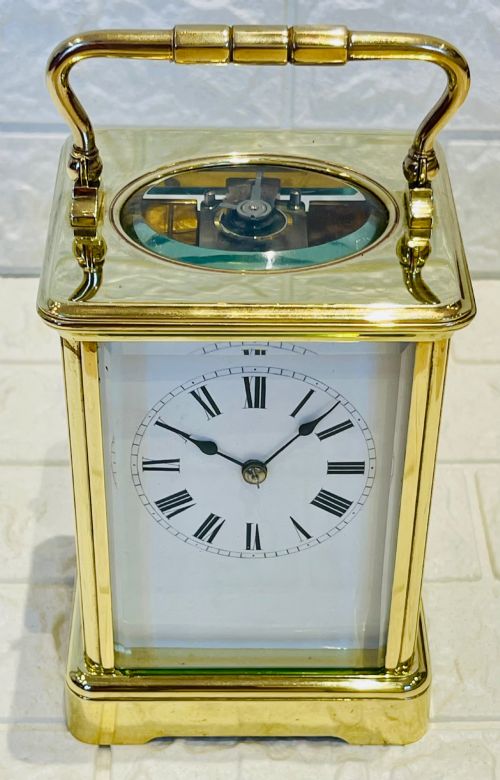


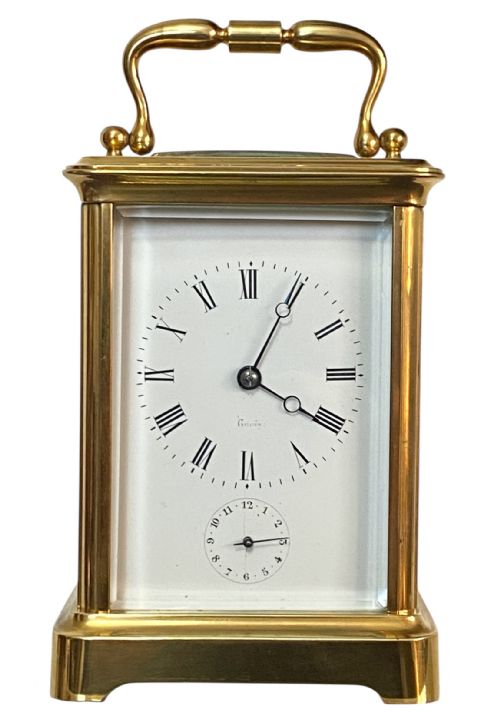


Corniche Case Carriage Clock
A corniche case carriage clock offers bevelled glass panels and a stepped brass framework, built for travel and prized for mechanical complexity.
What a corniche case carriage clock is
A corniche case carriage clock houses a portable mechanical movement inside a brass frame with flat glass panels. This design provides clear views of the escapement and gear train from every angle.
The pieces listed on this page span the Victorian era, the year 1860, 1880, 1900, and the nineteenth century. French makers created the majority of these carriage clocks during the late nineteenth century.
Common forms on this page include standard striking models, repeating mechanisms, alarm functions, and miniature timepieces. Certain pieces incorporate quarter-striking systems known as petite-sonnerie alongside matching numbered outer travel cases.

How they were made
Workshops constructed these clocks using heavy brass frameworks, frequently finished with a gilt surface to enhance the metallic sheen. Thick glass panes were bevelled at the edges to fit snugly into the rebated brass channels of the corniche case.
Clockmakers fitted enamelled dials with Roman or Arabic numerals behind the front glass panel, while eight-day movements drove the striking, repeating, and alarm complications.
Retail Price Guide 2026
Typical UK retail prices for corniche case carriage clock, calculated from the Sellingantiques database of over a million retail prices indexed since 2003. This retail price guide relies exclusively on Sellingantiques data; no external sources or auction records are used, so the figures do not describe the wider market.
Listings on this site show carriage clocks spanning the Victorian period, 1860, 1880, 1900, and the nineteenth century in brass, gilt brass, glass, and enamel.
What varies in quality
Quality rests upon the complexity of the internal mechanism, distinguishing a basic time-only timepiece from pieces featuring striking trains, alarm systems, and quarter-repeating capabilities. The presence of original numbered components, such as matching keys and outer leather travel cases, elevates the significance of a piece.
The weight and crispness of the gilt brass casting dictate the tactile presence of the corniche case, alongside the precision with which the bevelled glass panels are set into the frame.
Alfred DROCOURT·DROCOURT
The Corniche Case Carriage Clock Glossary
- Corniche case
- A distinctive carriage clock case style featuring a stepped top and base with rounded or column-like corners. It frames the glass panels securely.
- Striking
- A mechanical function that causes the clock to sound the hours and sometimes halves automatically on a bell or gongs. This system operates via an internal rack or count wheel.
- Repeating
- A mechanism activated by pressing a button on the case, which causes the clock to repeat the last struck hour or quarter-hour on demand. It proved useful for telling time in the dark.
- Petite-sonnerie
- A quarter-striking system that sounds the hours on the exact hour and the quarters as they pass without repeating the hours each time. It represents a high level of horological output.
- Gilt brass
- A brass substrate coated with a thin layer of gold to impart a bright, lasting finish. This treatment protects the underlying metal from tarnishing over decades.
Frequently Asked Questions
What is a corniche case?
A corniche case is a specific architectural housing style designed for portable clocks, characterised by its flat top, stepped mouldings, and rounded or pillared corners that frame the bevelled glass panels.
This form provides an open view of the escapement and dial while offering robust housing for travel.
How do repeating mechanisms work?
A repeating mechanism allows the user to press a button on the top of the case to make the clock restrike the most recent hour or quarter-hour.
This function was designed for checking the time during the night without needing a candle.
What does petite-sonnerie mean?
Petite-sonnerie is an advanced striking train that automatically chimes the hours on the hour and the passing quarters as they arrive.
Unlike grand-sonnerie, it does not chime the previous hours alongside every quarter-hour sequence.
How are these clocks dated?
Dating relies on stylistic markers within the brass casting, dial typography, and movement signatures, such as maker marks from firms like Drocourt.
Victorian examples often correspond to French production spanning the mid to late nineteenth century.