


Octagonal Wooden Caddy
An octagonal wooden caddy is a refined tea vessel that brings tactile warmth and period geometry to a room.
Octagonal Wooden Caddy
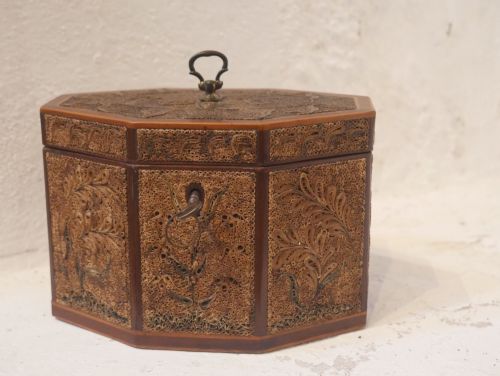
An octagonal wooden caddy takes the form of a polished storage box designed for loose tea leaves during the eighteenth and nineteenth centuries. Examples on this page span the Georgian, Regency, and William IV periods, alongside later revivals.
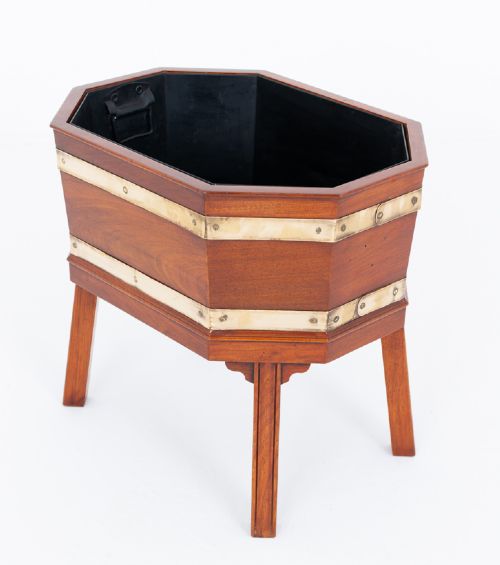
The dominant forms are table tea caddies and freestanding teapoys, frequently shaped with eight sides to showcase figured timbers and geometric inlay.
Makers utilised woods such as mahogany, satinwood, boxwood, and partridge wood to construct these vessels, often incorporating brass mounts or bone escutcheons.
How they were made
Cabinetmakers constructed these caddies using solid timbers and fine veneers, sawing and fitting multifaceted sides to achieve the precise octagonal geometry. Surface decoration relied on contrasting stringing, shell inlays, and paper filigree work.
Fittings often included metal hinges, brass carrying handles, and bone keyhole escutcheons, securing the inner compartments where dry tea leaves were stored.
What varies in quality
The quality of an octagonal wooden caddy rests on the choice of timber and the precision of its veneers, such as flame mahogany or figured satinwood. Master cabinetmakers achieved clean joins at the eight angles and subtle balance in the decorative inlay.
Makers working at a high level integrated refined brass hardware and intact interior compartments, whereas simpler pieces relied on plain wood construction without complex banding.
Gillows
The Octagonal Wooden Caddy Glossary
- Teapoy
- A freestanding table designed to hold tea caddies, usually set on a pillar and claw base or four carved feet.
- Escutcheon
- A small protective plate surrounding a keyhole, frequently fashioned from bone or brass on these caddies.
- Stringing
- A narrow line of contrasting wood inlay used to outline panels and accentuate the geometric angles of the box.
- Satinwood
- A hard, yellow-toned timber utilised for cabinetmaking and decorative veneering during the Georgian period.
Octagonal Wooden Caddy: Frequently Asked Questions
What is an octagonal wooden caddy?
An octagonal wooden caddy is a lidded storage box created to hold and preserve dry tea leaves in domestic interiors.
These vessels emerged in various timbers and styles across the eighteenth and nineteenth centuries.
How were tea caddies used?
Tea caddies were kept in the parlour or drawing room to store expensive tea leaves securely under lock and key.
Households often relied on the master or mistress of the house to dispense the tea for each social gathering.
How do I date an octagonal wooden caddy?
Dating relies on observing the timber choice, construction methods, and decorative styles associated with periods like Georgian or Regency.
Details such as brass hardware, bone escutcheons, and veneer types offer further clues to the decade of manufacture.
Where should I place a teapoy?
A teapoy functions well as a decorative occasional table in a living space or study, highlighting its original form.
Positioning the piece away from direct heat sources helps protect the antique veneers and wooden structure.