
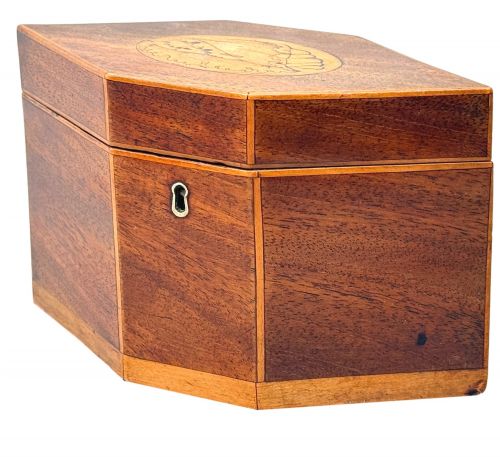


Inlaid Shell Tea Caddy
These inlaid shell tea caddy examples are decorative timber and shell boxes built to store precious leaves, offering collectors tangible Georgian and Victorian craftsmanship.
Inlaid Shell Tea Caddy
An inlaid shell tea caddy is a functional storage box designed during the Georgian and Regency eras to keep dry leaves secure under lock and key. The core forms range from hexagonal and bow-fronted shapes to classical casket silhouettes intended for display on a parlour table.
Buyers encountering this phrase most frequently meet satinwood or mahogany boxes embellished with contrasting wood stringing and central shell medallions. Tortoiseshell variants featuring mother of pearl or bone detailing also appear across the selection.
The objects span periods from the eighteenth century into the Victorian era, showing how domestic tea storage evolved from simple wooden caddies into ornate decorative boxes. Examples range from plain mahogany tea caddies with minimal shell inlay to elaborate double tea caddy designs.
How they were made
Carpenters constructed the primary carcass from dense timbers such as mahogany, satinwood, and rosewood, often applying veneers to achieve a smooth exterior surface. Boxwood and bone formed contrasting stringing lines around the edges and panels.
Inlay work relied on precise hand-cutting techniques where artisans inserted thin pieces of shell, mother of pearl, and contrasting woods into recessed channels. Tortoiseshell veneer was carefully applied over a wooden base, sometimes backed with metallic foils to enhance the translucent depth of the material.
Some tortoiseshell boxes hide thin metallic foils beneath their translucent shell to make the inlaid mother of pearl catch the candlelight.
What varies in quality
The precision of the woodwork and the crispness of the shell inlay define the upper tier of these pieces. Finely figured timbers with well-matched grain patterns separate standard boxes from exceptional examples.
The complexity of the internal arrangement also influences the grade of the piece, with surviving inner cannisters, sugar dishes, and original brass hardware indicating superior original manufacture.
The Inlaid Shell Tea Caddy Glossary
- Caddy
- A small box or chest once used for storing tea leaves. The word derives from the Malay word kati, a unit of weight.
- Inlay
- A technique where pieces of contrasting material are inserted into a recessed surface to form a decorative pattern. Artisans utilised shell, bone, and lighter woods.
- Tortoiseshell
- The mottled brown and yellow shell of certain sea turtles, used as a decorative veneer on luxury boxes. It is often paired with mother of pearl.
- Satinwood
- A durable tropical timber with a lustrous, golden sheen. It provided a pale ground for shell and floral inlays during the Georgian period.
- Stringing
- Narrow strips of contrasting wood inlaid into the edges of furniture and boxes to create a decorative border.
Inlaid Shell Tea Caddy: Frequently Asked Questions
What were tea caddies used for?
Tea was an expensive commodity in the eighteenth and nineteenth centuries, requiring secure storage under lock and key to prevent pilfering by domestic staff.
The boxes often contained fitted interior compartments or removable cannisters to keep different varieties of black and green tea separate.
How do I date a tea caddy?
Dating relies on observing the timber species, the box silhouette, and the style of the inlay work. Georgian pieces frequently feature satinwood with neoclassical shell motifs.
Later Victorian examples often incorporate tortoiseshell or mother of pearl with heavier proportions and different interior fittings.
Why do some caddies have two compartments?
Double tea caddies allowed households to store two distinct types of tea, typically green and black, within the same locking chest.
A central mixing section sometimes sat between them for blending the leaves before brewing.
Are keys usually original?
Original working keys are uncommon because locks were easily jammed or keys misplaced over centuries of domestic use.
Many surviving boxes retain their brass escutcheons even when the matching key has been lost to time.