
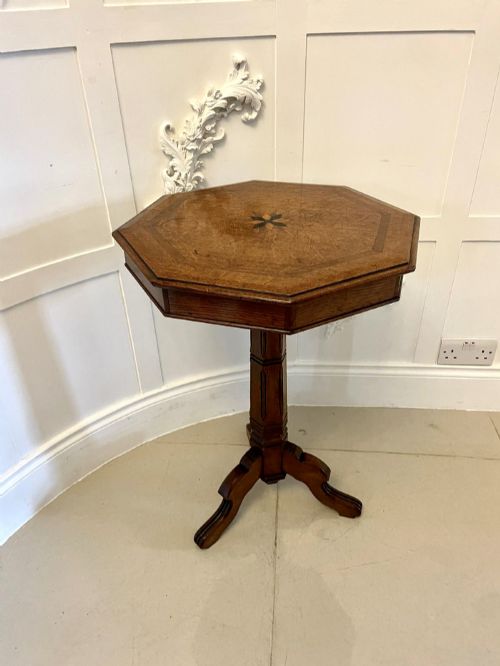
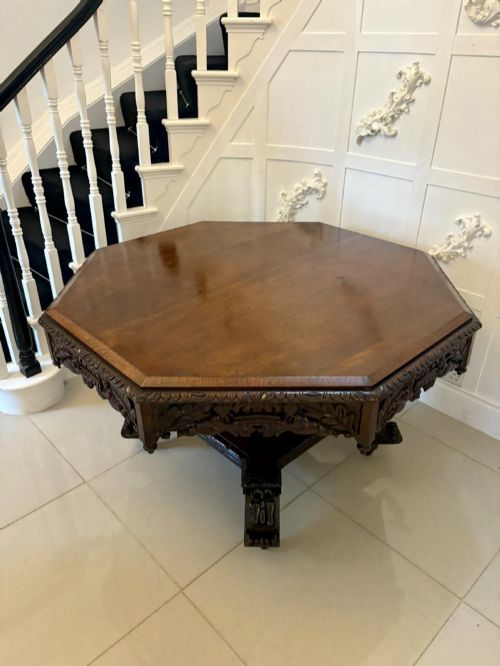
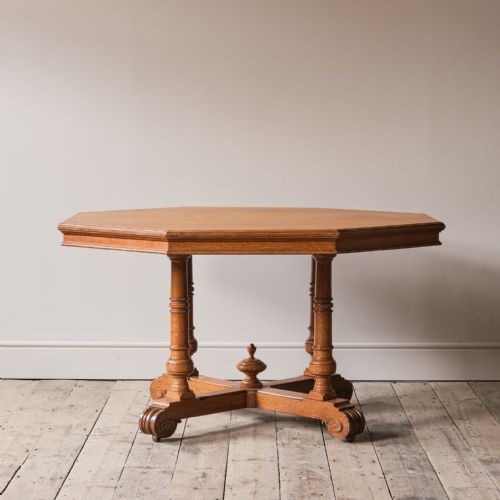
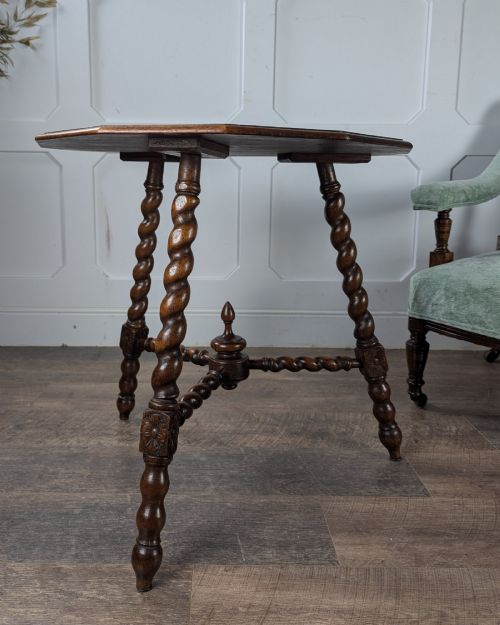
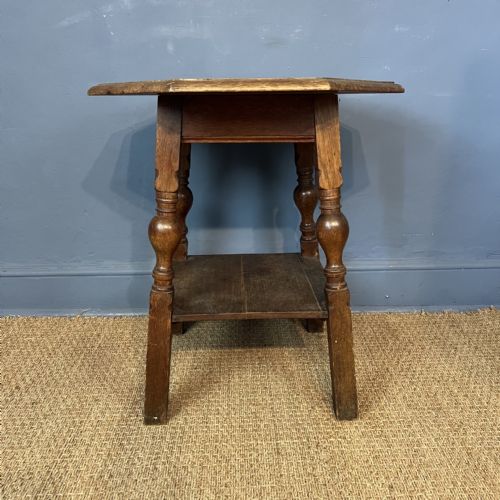
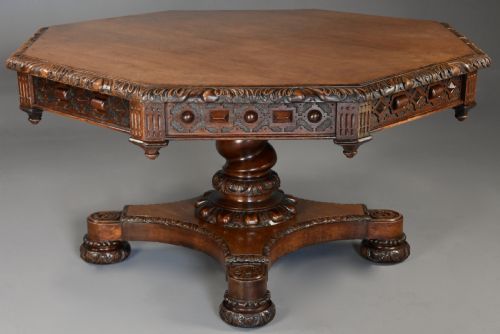
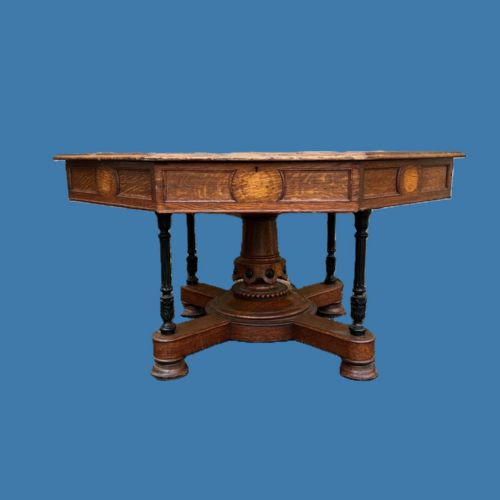


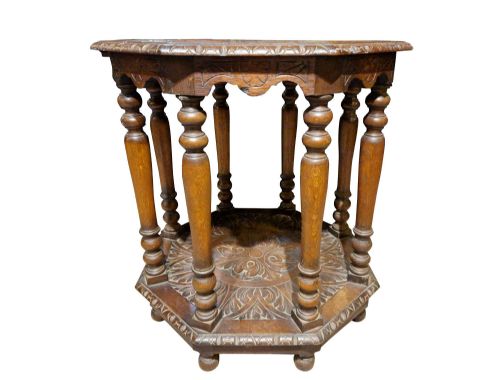


Octagonal Oak Hall Table
An octagonal oak hall table gives a hallway an architectural anchor, combining geometric form with sturdy domestic timber.
Octagonal Oak Hall Table
The octagonal oak hall table stands as a distinctive piece of furniture designed to occupy entrance spaces and central hallways. These tables frequently appear under various historical labels, including Victorian centre tables, Arts and Crafts occasional pieces, and heavy library tables. Buyers seeking an octagonal oak hall table will discover works spanning from the nineteenth century through to the early twentieth century.
Makers and workshops of the Victorian and Edwardian eras adapted the eight-sided format to suit diverse aesthetic revivals. Examples range from robust Jacobean and Elizabethan revivals to austere Arts and Crafts designs and Gothic Reform interpretations. While primarily termed hall tables or centre tables, these items also function effectively as occasional or library tables depending on their proportions.
How they were made
Solid oak and selected veneers form the structural foundation of these tables, frequently complemented by secondary timbers such as mahogany and walnut. Artisans employed traditional joinery techniques alongside detailed carving, turning timber into barley twist legs and shaped supports. Surfaces occasionally incorporate contrasting materials, with ebonised wood details, leather top inserts, and brass hardware adding tactile and visual depth.
The construction methods reflect the dominant stylistic movements of their respective decades. Victorian workshops utilised heavy carving and linenfold panels, whereas Arts and Crafts makers favoured exposed construction and simpler geometric planes. Parquetry surfaces also appear, demonstrating precise geometric wood inlay work across the octagonal table tops.
Listings show octagonal oak hall tables spanning the Victorian period through to the 1930s, incorporating styles from Jacobean Revival to Arts and Crafts.
What varies in quality
Quality in an octagonal oak hall table rests upon the selection of timber and the crispness of the hand carving. Superior examples exhibit tightly grained solid oak, well-balanced proportions, and tight joinery that resists movement over decades of use. Lesser pieces often rely on simpler veneering over secondary woods with softer, less defined decorative carving.
The sophistication of the design execution dictates the standing of a piece within the range. Tables bearing attribution to notable makers or specific reform movements display a higher level of artistic intent and finishing detail. The integrity of secondary materials, such as undamaged leather inserts or original turned stretchers, further distinguishes the finer works.
Liberty and Co·Gillows
The Octagonal Oak Hall Table Glossary
- Octagonal
- Having eight sides and eight angles. This geometric shape provides a balanced footprint for freestanding tables placed in the middle of a room or hallway.
- Barley twist
- A type of furniture leg turned in a spiral resembling a twisted barley sugar stick. This decorative turning appears frequently on Victorian and later oak tables.
- Parquetry
- A geometric mosaic of wood pieces used for decorative surfaces on floors and tabletops. It showcases contrasting timber tones within precise patterns.
- Library table
- A large freestanding table traditionally used for reading and writing. These pieces usually offer substantial proportions and robust framing.
- Gothic Revival
- An architectural and decorative style drawing inspiration from medieval Gothic forms. It manifests in pointed arches, heavy mouldings, and structural oak framing.
Octagonal Oak Hall Table: Frequently Asked Questions
Where should I place an octagonal table?
An octagonal table works best as a freestanding centrepiece in a hallway or large landing where its multi-sided shape can be appreciated from all angles. It provides a convenient surface for incoming post and decorative objects without blocking natural walking routes.
Because these tables lack a flat side to push flush against a wall, they demand a certain amount of open floor space to sit comfortably within a room.
How do I care for an oak table top?
Solid oak surfaces benefit from regular dusting with a soft, dry cloth and occasional treatment with quality beeswax to nourish the timber. Avoid placing wet items directly on the wood to prevent water marks.
Tables with leather inserts require separate care, keeping leather cleaners away from the surrounding oak framework to preserve the finish.
Are these tables sturdy enough for daily use?
Victorian and Edwardian oak tables were built for robust domestic service using dense hardwoods and traditional joinery. Their substantial weight and solid construction make them well-suited for everyday household tasks.
Checking the stability of the leg stretchers ensures the frame remains capable of supporting daily weight without loosening over time.
How do I identify an Arts and Crafts oak table?
Arts and Crafts tables generally feature simpler lines, exposed construction details, and a focus on the natural grain of the solid oak rather than heavy ornamentation. They often reflect a deliberate move away from industrial mass production.
Look for honest joinery and restrained decorative elements that emphasise material quality over applied historical revival motifs.