
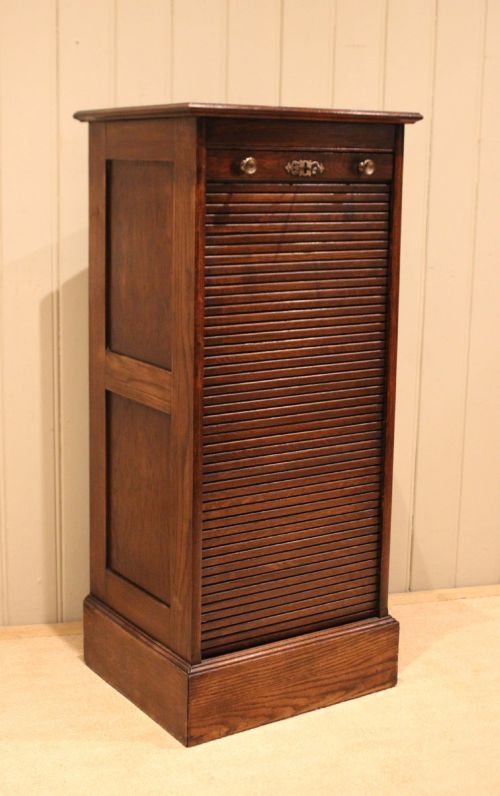
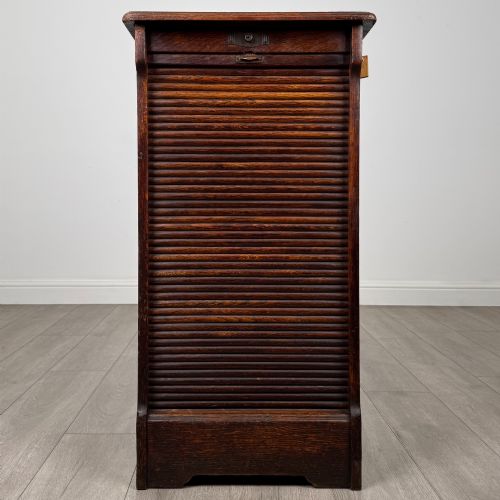
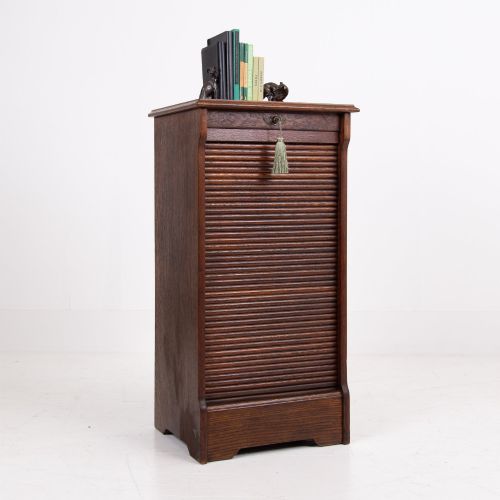
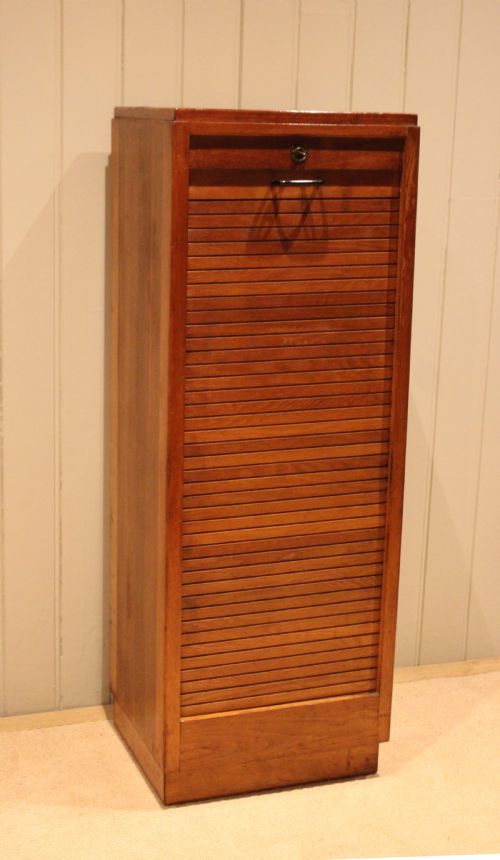
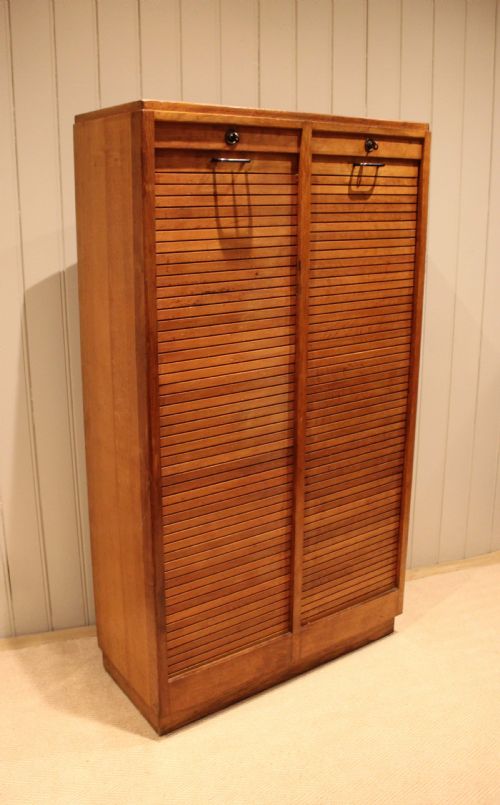


Oak Tambour Door Cabinet
These oak tambour door cabinet examples are clever storage workhorses built to slide smoothly and save precious floor space.
Oak Tambour Door Cabinet
An oak tambour door cabinet brings functional vertical filing into the room with slatted wooden shutters that track seamlessly around corners. These pieces serve primarily as office filing cabinets and storage cabinets designed for workspaces.
The versions appearing here span the Edwardian era through the nineteen-forties, including French Utility, Art Deco, and early twentieth-century designs. Buyers encounter both single and double tambour front formats in light or dark timber.
Originating largely from British and French workshops, these utilitarian items combine practical document organisation with domestic cabinetry. They remain sought after for home offices and studies needing compact storage.
How they were made
Construction relies on solid oak and oak veneers shaped into sturdy vertical housings. Individual wooden slats are typically backed with canvas or fabric to create the flexible rolling shutter.
Internal mechanisms incorporate metal and steel runners or guides alongside brass hardware for handles and locks. The slatted tambour doors require precise joinery to glide effortlessly within their tracks.
What varies in quality
Quality rests upon the smoothness of the slatted mechanism and the integrity of the hidden canvas backing. Finer examples maintain crisp alignment along the tracks without binding or sagging over time.
Timber selection and finish depth distinguish standard office furniture from finer period pieces. A well-proportioned cabinet with clean grain matching and robust internal compartmentalisation represents the upper tier.
The Oak Tambour Door Cabinet Glossary
- Tambour
- A flexible door or shutter constructed from narrow strips of wood attached to a fabric backing, allowing it to slide around a curved track. This clever design conceals contents without requiring clearance for swinging doors.
- Filing Cabinet
- An office furniture form designed specifically to hold documents, correspondence, or ledgers. These pieces utilise internal shelving or drawer dividers tailored for paperwork.
- Edwardian
- The architectural and decorative period spanning from nineteen hundred to nineteen ten, noted for lighter proportions and revivals of earlier styles. Pieces from this era often display refined timber finishes.
- French Utility
- A minimalist design movement born from mid-century material restrictions, focusing on honest construction and straightforward forms. Cabinets from this classification show practical restraint.
- Art Deco
- The dominant design style of the nineteen twenties and thirties characterised by sleek geometric lines and modern industrial influences. Office furniture from this period embraces streamlined utility.
Oak Tambour Door Cabinet: Frequently Asked Questions
How do tambour doors actually work?
Tambour doors consist of numerous narrow horizontal wooden slats glued to a sturdy canvas backing. This flexible construction allows the entire shutter to bend smoothly around a corner track rather than swinging outward into the room.
To open the cabinet, you simply pull the handle and guide the slats into the side or rear recess of the carcase. Keeping the internal tracks clean ensures the shutter continues to glide without catching.
Where were these cabinets used originally?
These pieces served as heavy-duty workspace furniture in solicitors' offices, banks, and administrative headquarters. Their primary job was storing ledgers, correspondence, and client files securely while saving floor space.
Today, they transition easily into modern homes as stylish alternatives to standard bedside tables or living room storage. Their compact footprint makes them ideal for organising paperwork in smaller rooms.
How do I tell an Edwardian cabinet from a nineteen thirties one?
Edwardian examples tend to feature warmer dark oak tones, traditional brass pulls, and more decorative mouldings suited to professional Victorian and Edwardian interiors. The construction often emphasises finer cabinet-making details.
Nineteen thirties and nineteen forties pieces lean towards utilitarian industrial simplicity, occasionally reflecting Art Deco geometry or French Utility restrictions. The timber is often lighter and the hardware stripped back to essentials.