
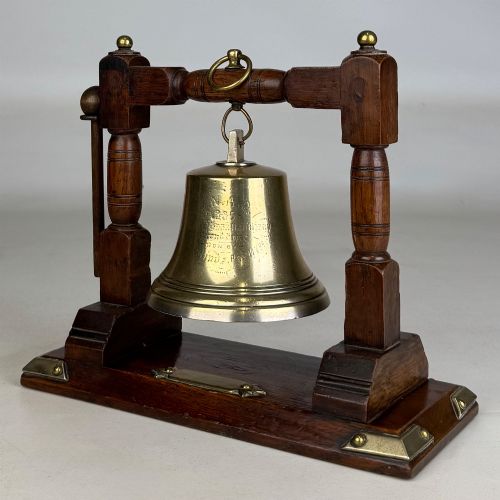
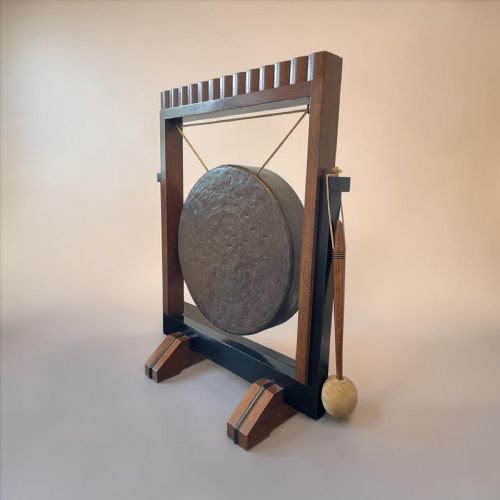
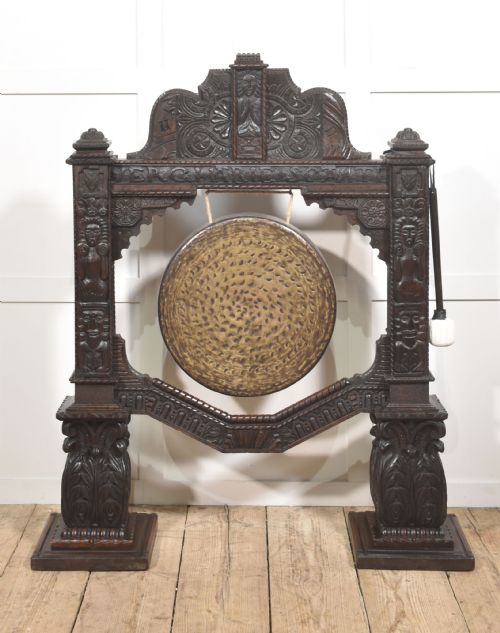


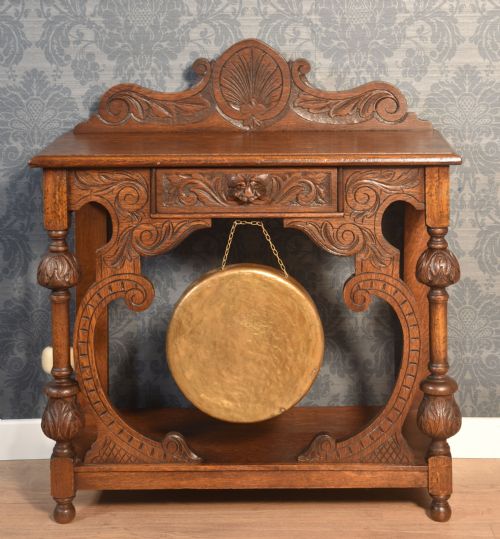

Oak Standing Gong
These oak standing gong pieces bring resonant Victorian and Edwardian summons to a hall or dining room.
Oak Standing Gong
An oak standing gong is a substantial household bell apparatus designed for domestic summons, most frequently encountered in floor-standing formats from the Victorian, Edwardian and Art Deco periods. You are looking at wooden framework structures built to suspend a resonant metal disc, paired with a striking mallet.
The pieces on this page span heavy Gothic Revival designs with carved details through to simpler Edwardian frames and later 1930s interpretations. Alongside traditional dinner gongs, the selection encompasses related hall furnishings and table bells sharing the same timber and metal construction.
Originating in large country houses where summoned announcements structured the daily routine, these standing gongs now function as striking architectural focal points in entrance halls. The typical survivor pairs a seasoned oak support with a cast brass or bronze disc, held by cord, rope or leather bindings.
How they were made
Makers built these frames primarily from solid oak, frequently turning, carving or joining the timber to support the weight of the suspended metal. Joinery techniques from the nineteenth and early twentieth centuries ensure the vertical standards and bases remain rigid under the repeated impact of a mallet strike.
The hanging mechanism relies on durable materials like cord, rope, leather or felt to suspend the gong disc without damping its acoustic vibration. Brass and bronze form the striking plates, shaped and hammered to achieve a clear, sustaining tone when hit.
Listings on this site feature oak standing gongs spanning the Victorian, Edwardian, and Art Deco periods, predominantly constructed from oak paired with brass or bronze.
What varies in quality
Quality in an oak standing gong rests upon the proportion and ambition of the timber framework, ranging from plain utility pieces to monumentally carved Gothic Revival structures. The depth and crispness of the woodwork carving, particularly on items featuring figural motifs like Green Men, distinguish finer examples from standard production.
Acoustic properties separate superior bronze or brass discs from simpler metal plates, dictating the resonance and clarity of the tone produced. The integrity of the original suspension materials, whether braided cord or leather straps, also influences the overall authenticity and finish of the piece.
The Oak Standing Gong Glossary
- Gothic Revival
- A nineteenth-century stylistic movement drawing inspiration from medieval architecture, visible in pointed arches, heavy tracery and dark carved timber. This style often manifests in ecclesiastical details applied to domestic furniture.
- Dinner Gong
- A suspended metal disc struck with a mallet to announce meals in large country houses. These domestic instruments became central pieces of hall furniture during the Victorian era.
- Green Man
- An architectural ornamentation depicting a human face disgorged from foliage, frequently encountered in carved woodwork from the Gothic Revival and Arts and Crafts periods. It adds a folkloric element to the wooden frame.
- Edwardian
- Pertaining to the reign of King Edward VII, spanning the early years of the twentieth century. Furniture from this period generally exhibits lighter proportions than heavy Victorian designs while retaining traditional craftsmanship.
- Bronze
- An alloy of copper and tin used for casting the resonant plates of high-status gongs. It produces a deeper and more sustained acoustic tone than standard brass.
Oak Standing Gong: Frequently Asked Questions
How do you clean an oak standing gong?
Dust the oak frame regularly with a dry cloth and apply occasional feeds of beeswax to maintain the timber's natural lustre.
Avoid using harsh chemical polishes on the brass or bronze disc, as gentle cleaning preserves the aged patina.
Where were standing gongs placed?
These pieces traditionally stood in entrance halls or large corridors so the sound carried effectively throughout the domestic interior.
Their substantial footprint makes them well-suited as focal points in modern hallways or open-plan living spaces.
How do you date an oak standing gong?
Examine the joinery methods, timber finishing and stylistic markers such as Gothic Revival tracery or Art Deco geometric lines.
Comparative details like the wear on the leather suspension straps and the casting characteristics of the metal help confirm the period.
Are the mallets usually original?
Original striking mallets often show distinct wear marks or matching timber handles from the period of manufacture.
Many surviving pieces retain either their original leather-headed or wooden strikers, though replacements are common due to heavy use.