
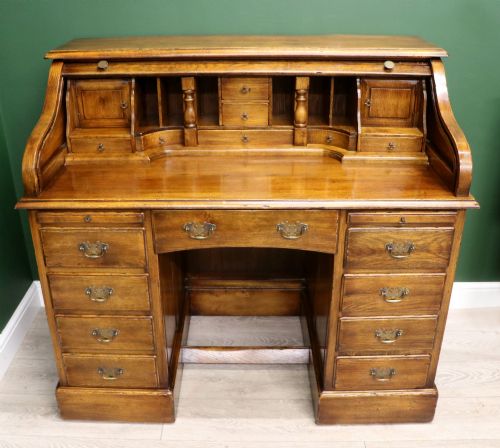
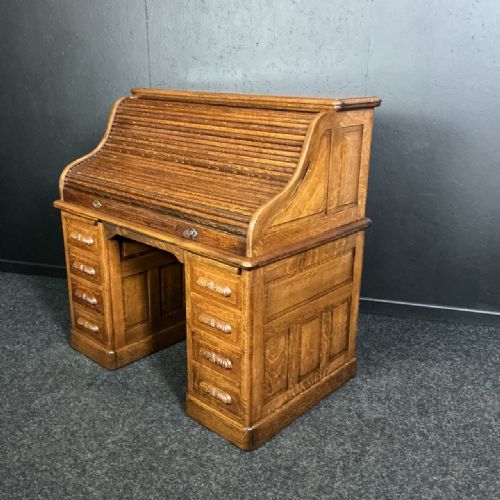


Oak Roll Top Bureau
These oak roll top bureau pieces offer enclosed working spaces and storage, drawing collectors who appreciate practical historical office furniture.
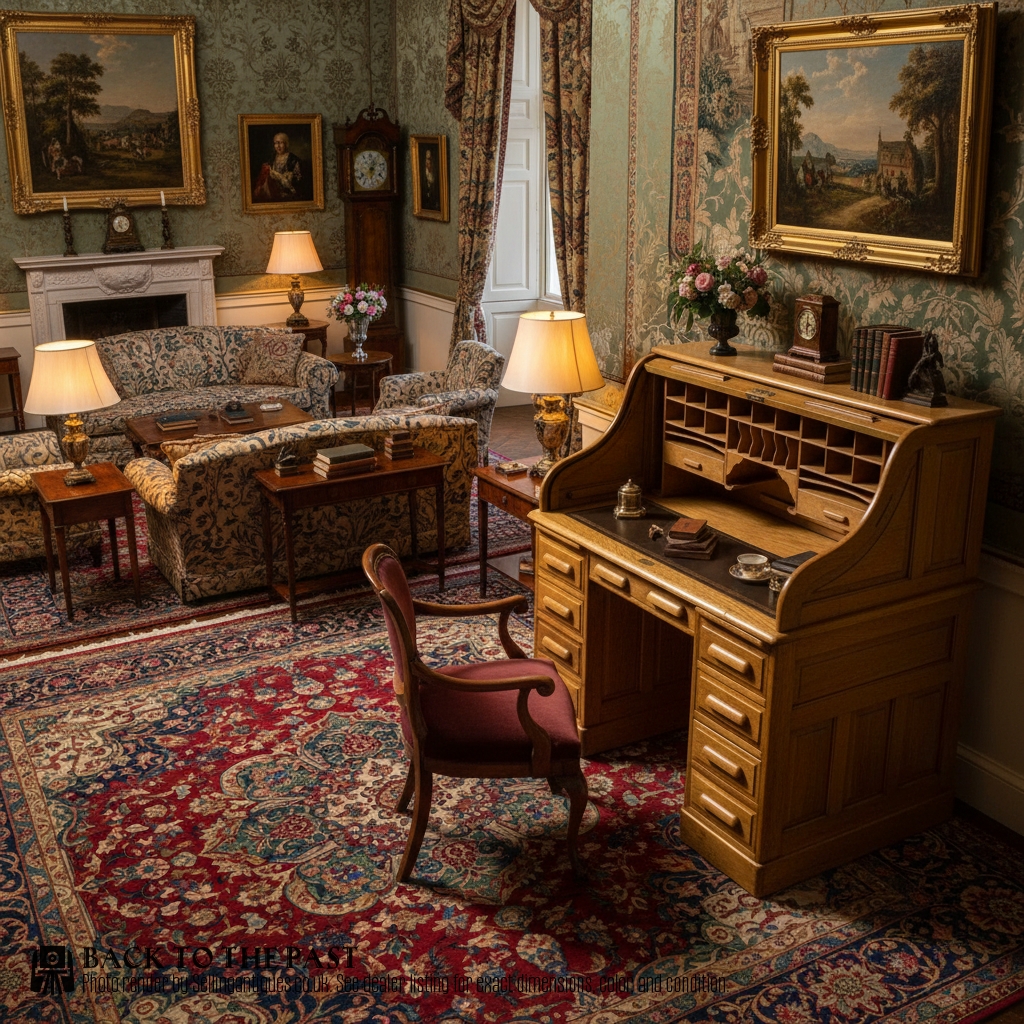
Oak Roll Top Bureau
An oak roll top bureau provides a dedicated writing space enclosed by a slatted tambour shutter that conceals the pigeonholes and small drawers within. These desks combine the function of a traditional bureau with the secure closure of a cylinder or roll top mechanism.
The versions met on this page span several decades, stretching from Victorian examples through Edwardian pieces and into the 1920s and 1930s. Buyers encounter forms ranging from standard pedestals to larger bureau bookcases that incorporate shelving above the writing surface.
Materials and construction methods
Makers built these pieces primarily using solid oak, sometimes referred to as golden oak, alongside American oak varieties. The timber provides a robust structure capable of supporting the internal partitions and the daily movement of the sliding tambour shutter.
Details such as brass handles and hardware appear alongside leather writing surfaces, glass panes in bookcase variations, and occasional lead details. The construction relies on panelled woodwork to form the pedestals and the curved track that guides the roll top.
Materials recorded across the inventory include solid oak, brass fittings, and leather writing inserts.
Separating grades of quality
Quality in these desks rests on the precision of the tambour mechanism and the condition of the slatted wooden tracks. Superior examples demonstrate smooth operation across the curved path without binding or looseness in the individual wooden strips.
The selection of timber grain, the solidity of the oak framing, and the integrity of internal fittings such as small drawers and pigeonholes distinguish finer pieces. The presence of integrated bookcases or maker signatures adds distinction to the construction.
Maples of London and Paris·Globe Wernicke
The Oak Roll Top Bureau Glossary
- Tambour
- A flexible shutter made of narrow strips of wood glued to canvas or fabric backing. This material allows the roll top to curve smoothly around a track and conceal the desk interior.
- Pedestal desk
- A form of furniture supported by two pillars of drawers or cupboards with a central space for the user. Many roll top desks utilise this twin-pedestal layout.
- Bureau bookcase
- A combined piece featuring a writing desk below and glazed shelving above for books. These taller items expand the storage capacity of the standard desk.
- Cylinder top
- A solid curved wooden shutter that slides back into the body of the desk rather than using flexible slats. This mechanism performs a similar function to the roll top.
Oak Roll Top Bureau: Frequently Asked Questions
What is an oak roll top bureau?
An oak roll top bureau is a writing desk featuring a slatted wooden shutter that pulls down to cover the work surface and internal pigeonholes. These pieces combine secure enclosed storage with a practical writing ledge.
They appear in various proportions, from compact slim-line models to large pedestal desks and combined bookcase variants.
How do you operate the roll top?
The roll top moves along a curved track cut into the sides of the desk framework. The slats are attached to a flexible backing canvas that allows the shutter to bend around the radius.
Lifting the handle guides the tambour upward into the upper cavity of the desk body to reveal the interior.
Which periods do these desks come from?
The listings include examples from the Victorian era, through Edwardian production, and into the interwar years of the 1920s and 1930s. Edwardian pieces form a large portion of the available items.
Design details and hardware often reflect the manufacturing standards of these specific decades.
How should I care for the oak wood?
Oak furniture benefits from stable indoor humidity levels away from direct heat sources and strong sunlight. Regular dusting with a dry cloth helps maintain the finish of the timber.
Leather writing surfaces require occasional specialist conditioning to prevent drying and cracking over time.