


Vintage Oak Rolltop Desk
These vintage oak rolltop desks bring practical workspace and traditional character into a room.
Vintage Oak Rolltop Desk
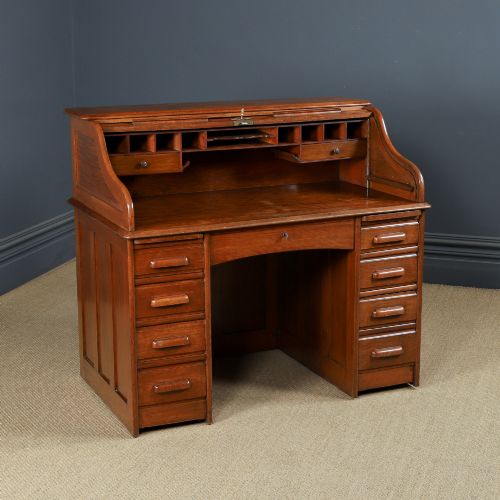
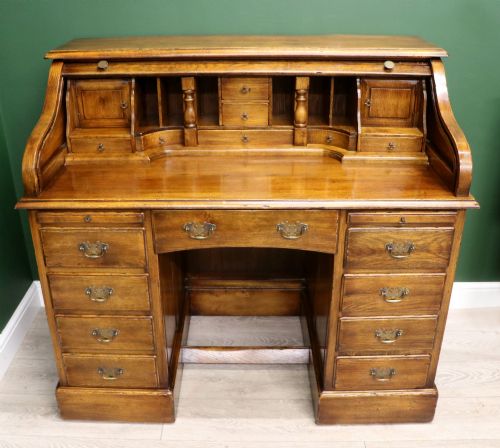
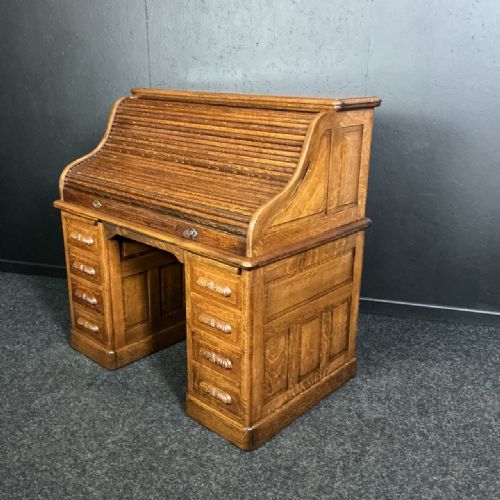
A vintage oak rolltop desk provides a practical workspace enclosed by a slatted tambour shutter that conceals papers and pigeonholes when closed. Buyers searching for a vintage oak rolltop desk typically find substantial pedestal forms originating from the Edwardian and Victorian eras.
The most common examples on this page are Edwardian pedestal desks built from solid oak with mechanical rolltop closures. These pieces often feature interior pigeonholes and small drawers designed for office organisation.
The selection ranges from standard office desks to larger bureau bookcases and specialised typewriter desks. Each piece demonstrates the heavy timber construction typical of early twentieth-century workspace furniture.
Materials and construction
Makers construct these desks primarily from solid oak, utilising brass handles, hinges, and drawer pulls for functional hardware. Glass and lead appear in associated bookcase sections, whilst leather surfaces occasionally line writing areas.
The defining mechanical feature relies on flexible tambour slats mounted on canvas backing to glide smoothly around a curved track. This slatted system requires precise joinery to ensure the rolltop operates without jamming.
Listings feature pieces spanning the Victorian, Edwardian, and interwar periods, built primarily in solid oak with brass and leather details.
Assessing quality
Quality in these desks rests upon the weight of the timber and the smoothness of the tambour mechanism. Solid oak construction throughout indicates a higher standard than pieces utilising secondary veneers on softwood carcasses.
The internal arrangement of drawers and pigeonholes reveals the attention given by the maker. Superior examples maintain precise alignment in the slatted shutter and solid brass fittings rather than plated base metals.
Maples of London and Paris
The Vintage Oak Rolltop Desk Glossary
- Tambour
- A flexible shutter made from narrow strips of wood glued to canvas or fabric backing. This allows the sliding top to curve around the desk mechanism.
- Pedestal desk
- A freestanding desk supported by two banks of drawers rather than simple legs. This layout provides substantial storage beneath the main writing surface.
- Bureau bookcase
- A combination furniture piece featuring a writing desk section below enclosed shelving. Glass doors frequently protect the upper bookcase compartments.
- Edwardian
- A stylistic period spanning from nineteen hundred to nineteen ten, following the Victorian era. Furniture from this time often shows lighter proportions whilst retaining solid timber construction.
Vintage Oak Rolltop Desk: Frequently Asked Questions
How do I operate the rolltop mechanism?
The slatted tambour runs within side tracks activated by lifting or pulling the central handle. When pulled down fully, the mechanism often engages an automatic locking device for the pedestal drawers.
Regular use benefits from occasional light lubrication of the wooden tracks to maintain smooth sliding action across the canvas backing.
What periods do these desks cover?
The pieces span from the Victorian era through the Edwardian period and into the nineteen twenties and thirties. Edwardian examples dominate the selection currently available.
Stylistic shifts appear in the hardware and proportions, moving from heavier Victorian cylinder forms to lighter Edwardian office formats.
How do I care for solid oak surfaces?
Solid oak requires simple dusting and occasional waxing to preserve the natural grain and finish. Avoid placing timber furniture in direct sunlight or near heat sources to prevent wood splitting.
Leather writing inserts benefit from specialised leather creams to prevent drying and cracking over time.
Are these desks suitable for daily office use?
These pieces were originally built for heavy administrative work and offer robust workspace surfaces. Modern users frequently adapt the internal pigeonholes for contemporary stationery and technology.
Checking dimensions ensures the kneehole space accommodates modern seating comfortably.