
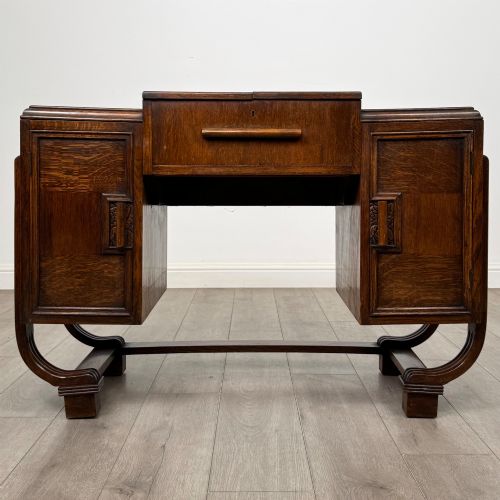
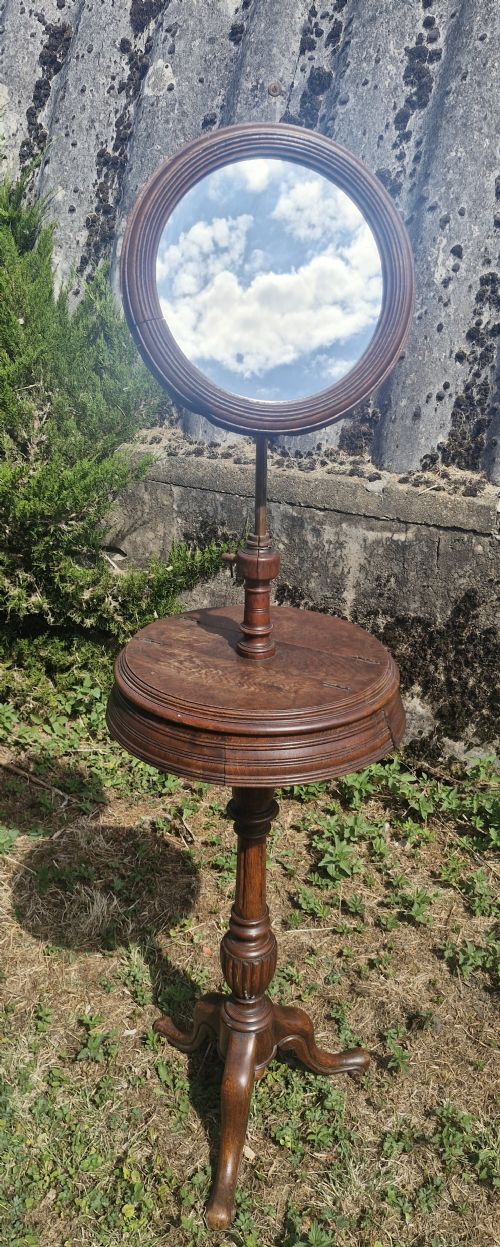
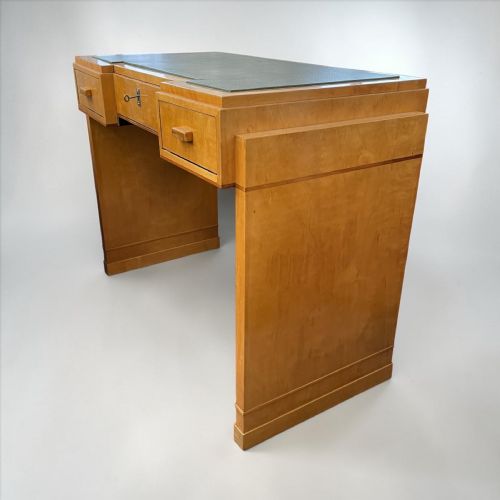
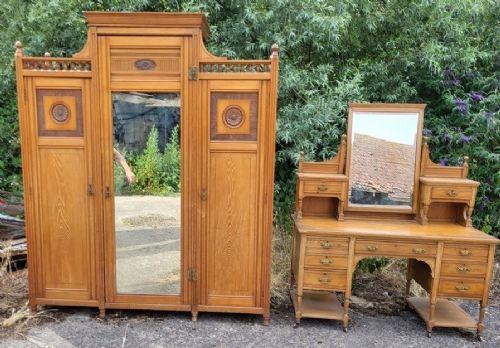


Oak Pedestal Dressing Table
An oak pedestal dressing table is a sturdy bedroom piece combining deep storage drawers with a central mirror, built to last for generations.
Oak Pedestal Dressing Table
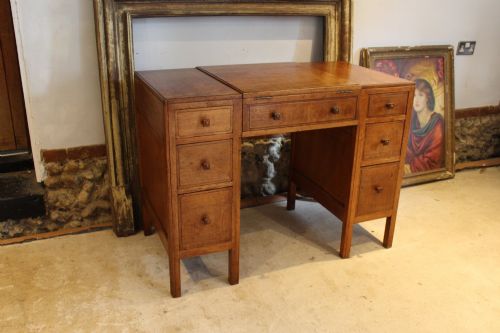
An oak pedestal dressing table provides a solid timber surface for morning routines, flanked by banks of vertical drawers that form the twin pedestals. These pieces draw on centuries of cabinet-making traditions, appearing in styles that range from the heavy proportions of the Victorian era to the cleaner lines of the Edwardian period and the 1930s.
Most examples found here reflect domestic British bedroom furniture from the late nineteenth and early twentieth centuries, though earlier Georgian formats also emerge. Buyers encounter everything from simple Edwardian dressing chests to elaborate Arts and Crafts interpretations featuring built-in mirrors and designated compartments for personal items.
Materials and construction
Cabinet-makers relied on solid oak for the primary carcass and drawer frames, often pairing it with contrasting secondary timbers such as walnut, ash, or mahogany for decorative banding. Drawer construction typically involved hand-cut dovetail joints designed to withstand daily pulling and loading.
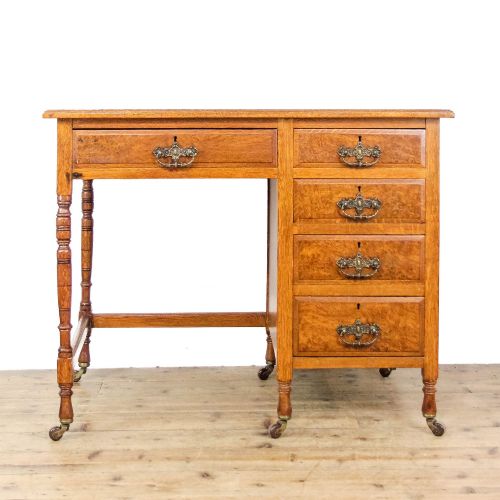
Fittings such as drop handles and key escutcheons were cast in brass, while working locks often secured the top central drawer. Mirrors, where present, were fixed to pivoting side arms above the main top surface, allowing the user to adjust the angle of the glass.
Listings feature oak alongside walnut, ash, and mahogany, spanning periods from early Georgian times through to the 1930s.
Distinctions in quality
The division between standard workshop production and fine cabinet-making lies in the selection of the timber and the precision of the joinery. Superior examples display carefully matched grain patterns across the drawer fronts and employ thick oak linings rather than thin plywood substitutes.
Makers of note integrated thoughtful proportions and robust hardware that remained secure over decades of use. Quality is further evident in the retention of original brass fittings, working locks with keys, and uncompromised structural stability in the pedestal bases.
Shapland & Petter·Heal & Sons·James Shoolbred·Maple & Co
The Oak Pedestal Dressing Table Glossary
- Pedestal
- A structural column or vertical bank of drawers supporting one side of the top surface. These twin supports create the central kneehole space.
- Kneehole
- The recessed space in the centre of a desk or dressing table designed to accommodate the user's legs while sitting.
- Dovetail
- A traditional interlocking joint used to join the sides of a drawer to the front and back. Its interlocking wedge shape provides high tensile strength.
- Escutcheon
- A protective plate surrounding a keyhole, usually cast in brass to prevent the wood from splitting around the lock.
Oak Pedestal Dressing Table: Frequently Asked Questions
How do I date an oak dressing table?
Dating relies on examining the timber preparation, handle styles, and construction methods. Machine-sawn boards and standardised screws generally point toward the Victorian and Edwardian periods.
Earlier pieces from the eighteenth century show hand- pit-sawn marks, irregular drawer linings, and older fixing methods like hand-forged iron nails or early brass screws.
Can these be used as regular desks?
Many pedestal dressing tables share dimensions with writing desks, making them adaptable for modern study use. The kneehole space provides adequate legroom for seating.
Buyers should check the kneehole clearance height, as older vanity tables were often built lower to accommodate the chairs of the period.
Are the mirrors removable?
Mirrors attached to dressing tables are typically mounted on upright supports secured with pivot screws. These can usually be detached for easier transport or placement.
Removing the mirror superstructure converts the visual weight of the piece, allowing it to function primarily as a flat-topped writing table or chest.
How should I care for oak furniture?
Solid oak benefits from application of traditional beeswax rather than modern silicone-based polishes. This feeds the timber and maintains a natural protective barrier against moisture.
Keep pieces away from direct heat sources and radiators to prevent the solid wood panels from drying out and splitting over time.