



Oak Fold Down Table
An oak fold down table offers sturdy timber utility and practical folding leaves, serving homes that need surface space to vanish in a moment.

Oak Fold Down Table
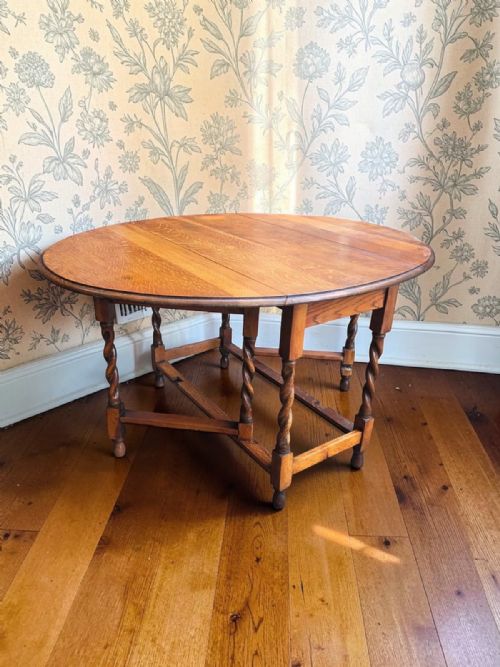
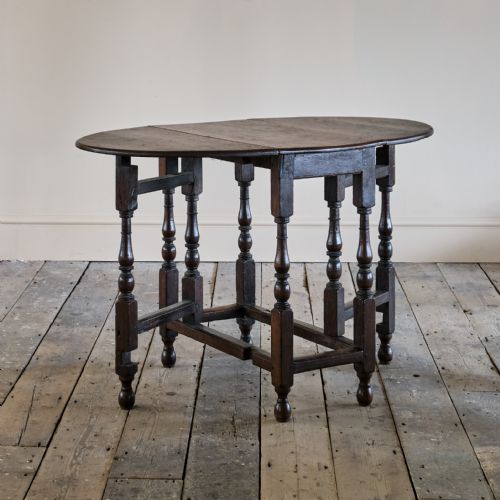
An oak fold down table appears across multiple centuries, ranging from late seventeenth-century vernacular pieces to early twentieth-century revivals. Buyers searching this phrase most frequently encounter gateleg and drop leaf dining or occasional tables designed with hinged leaves.
The physical forms include oval top dining tables with barley twist legs alongside smaller coffee and occasional tables. Origins span seventeenth-century English workshops up to the nineteen-twenties and nineteen-thirties revival periods.
How they were made
Makers utilised solid oak timber for the primary structure, building tops with drop leaves supported by swinging legs or folding mechanisms. Iron and brass hardware appeared on hinges and mechanical elements where necessary.
Turned legs, such as barley twist designs, feature prominently on seventeenth-century and later revival examples, providing structural support alongside aesthetic detail.
Oak Fold Down Table Retail Price Guide 2026
Typical asking prices for oak fold down table among the pieces listed under this phrase on Sellingantiques today, from the lower quarter to the upper quarter. They describe what is for sale here now, not the wider market.
The listings here span six distinct periods, moving from seventeenth-century vernacular oak up to nineteen-thirties occasional tables.
What varies in quality
The distinction between top examples and simpler pieces lies in the age of the timber and the sophistication of the turning. Early seventeenth-century vernacular work displays hand-shaped joinery that differs fundamentally from twentieth-century revival production.
Proportion and scale also separate standard utility items from grander dining pieces built to seat six, where the timber selection and stability of the folding mechanism dictate the overall standard.
The Oak Fold Down Table Glossary
- Gateleg table
- A table with hinged leaves supported by legs that swing outward like a gate. This form provides a large surface area when extended and folds compactly.
- Drop leaf table
- A table featuring a fixed central section and one or more hinged flaps that drop down. These leaves are supported by brackets or swinging legs.
- Barley twist
- A spiral turning technique resembling a twisted rope, carved or lathed into table legs. This decorative feature appears frequently on seventeenth-century and revival pieces.
- Vernacular
- Everyday objects made by regional craftsmen for local use rather than high-style court designers. These pieces reflect traditional local construction methods.
- Metamorphic
- Furniture designed to transform from one object type into another, such as a cupboard converting into a table. These pieces showcase ingenious historical mechanics.
Oak Fold Down Table: Frequently Asked Questions
How do I date an oak drop leaf table?
Dating relies on examining the joinery methods, timber characteristics, and leg turning styles present in the piece. Seventeenth-century examples display hand-tooled surfaces, whereas nineteen-twenties revivals show more uniform machine turning.
Hardware types and structural wear further help differentiate authentic early periods from later reproductions.
Were these tables used for dining?
Larger gateleg and drop leaf formats served primarily as dining tables in historical homes. Their folding leaves allowed households to clear floor space between meals.
Smaller occasional and coffee table variants emerged in later periods to suit compact modern rooms.
How do I maintain an antique oak surface?
Solid oak timber requires regular dusting with a dry cloth and occasional treatment with appropriate traditional waxes. Avoiding excessive moisture and direct heat protects the historical finish.
Gentle care preserves the natural grain and colour developed over centuries.
What is the difference between gateleg and dropleaf?
All gateleg tables are a type of drop leaf table, but not all drop leaf tables use a swinging gateleg mechanism. Gatelegs utilise pivoting support legs, whereas simpler drop leaf designs may use fixed brackets or pull-out struts.
This structural difference affects how much weight the extended leaves can safely bear.