


Oak Cylinder Desk
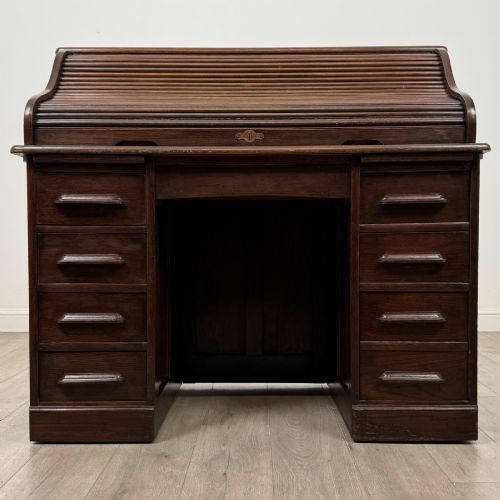
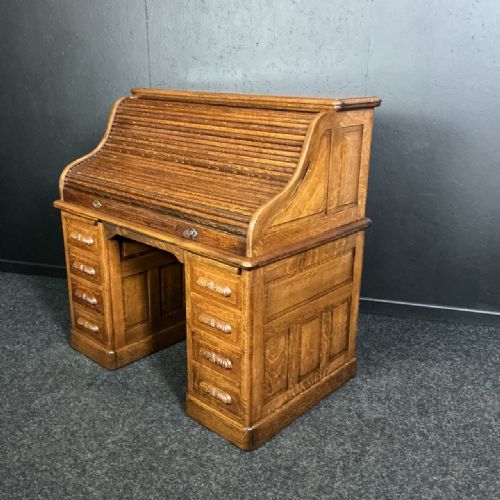
These substantial oak cylinder desk pieces offer a secure workspace with a curved tambour lid, combining practical storage with period craftsmanship.

Oak Cylinder Desk
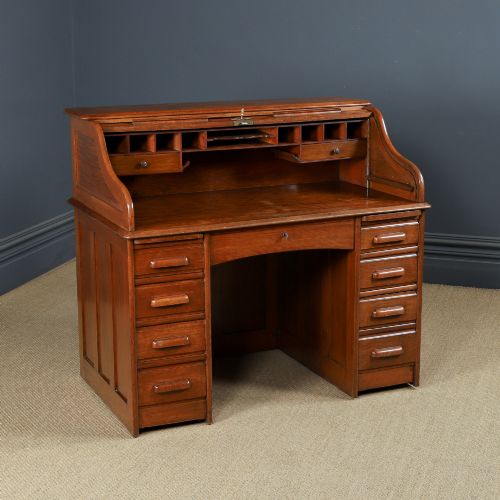
When you search for an oak cylinder desk, you are looking at substantial writing furniture featuring a curved wooden shutter that rolls back to reveal fitted interior compartments and a pull-out writing surface. These pieces emerge primarily from the Victorian and Edwardian eras, running through the 1910s and 1920s.
The versions you are most likely to meet on this page take the form of large pedestal writing desks or office variants. They appear in solid oak and golden oak, often incorporating brass hardware and occasionally canvas components.
How they were made
Construction relies heavily on solid oak timbers shaped into pedestal forms and large writing tables. The distinctive cylinder or roll top utilises tracked slats fixed to canvas backings, allowing the curved shutter to glide smoothly over the desk interior.
Hardware details such as brass handles and pulls complete the construction of these office and pedestal desks. Cabinetmakers built these pieces to withstand heavy administrative use while housing complex banks of internal drawers and pigeonholes.
Some Edwardian models arrived with specialised pull-out trays specifically designed to hold early office typewriters safely mid-clatter.
What varies in quality
Quality in these desks rests upon the selection of timber and the precision of the cylinder mechanism. Pieces fashioned from solid oak or figured golden oak with smooth-operating tambour shutters represent the upper tier of production.
The interior arrangement also dictates worth, as finer examples feature elaborately fitted stationery compartments and secondary drawers rather than basic utility spaces. The integration of robust pedestal configurations ensures structural stability across the range.
Carter of London
The Oak Cylinder Desk Glossary
- Cylinder desk
- A writing table featuring a curved, quarter-circle wooden shutter that encloses the desktop when closed. This design protects confidential papers and writing implements while offering a neat appearance.
- Tambour
- A flexible sliding shutter made of narrow vertical strips of wood glued to a canvas backing. It runs in concealed grooves to follow the curve of the cylinder top.
- Pedestal desk
- A heavy freestanding writing table supported by two separate stacks of drawers or cupboards. The central user sits in the kneehole space positioned between these pedestals.
- Golden oak
- A bright, warm timber finish applied to oak furniture popular during the late nineteenth and early twentieth centuries. It highlights the natural grain pattern of the wood.
Oak Cylinder Desk: Frequently Asked Questions
How do I operate the cylinder top?
The curved wooden shutter slides along grooved tracks embedded in the desk frame. Pulling the handle downwards reveals the writing surface and internal compartments.
Pushing the shutter back into the body of the desk exposes the full interior. The mechanism relies on flexible slats attached to a canvas backing to bend around the curve.
Were these desks used in offices?
Many examples served as executive or clerical furniture in commercial offices and administrative buildings. Their large pedestal designs provided ample storage for ledgers and correspondence.
Typewriter variants also appeared to accommodate early office machinery. They combined heavy oak construction with practical compartments for daily business.
How do I date an oak desk?
Dating relies on stylistic clues and construction methods associated with Victorian and Edwardian periods. Pieces from the 1880s often display darker finishes and elaborate pediments.
Later Edwardian and 1920s variants tend toward simpler oak surfaces and specific hardware. The presence of typewriter attachments points directly to early twentieth-century manufacture.