
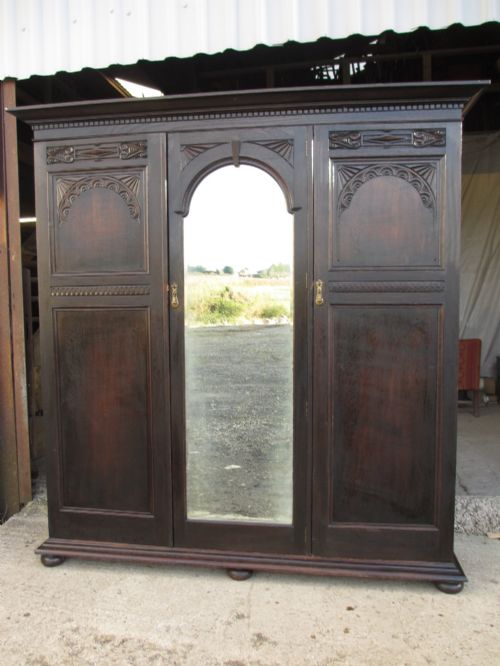
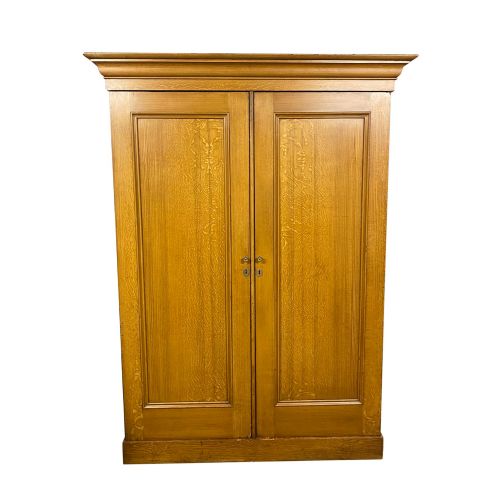
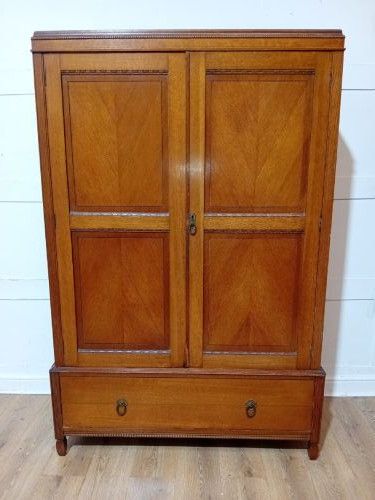
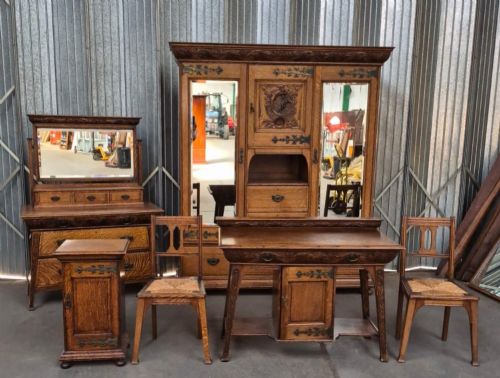
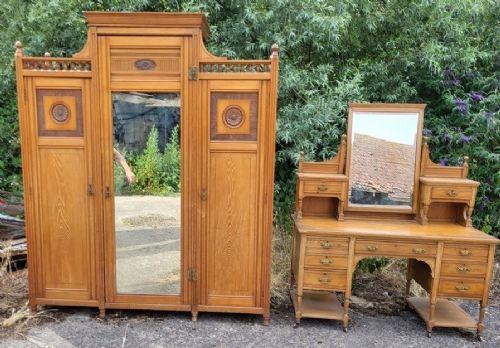


Oak Compactum Wardrobe
An oak compactum wardrobe provides fitted hanging space and drawer storage within one heavy piece, built to last a lifetime.
Oak Compactum Wardrobe
An oak compactum wardrobe combines hanging compartments with internal drawers, shelves, and linen presses to solve bedroom storage in a single piece. The pieces listed span the Victorian and Edwardian eras, alongside robust Arts and Crafts iterations.
Most examples meet on this page hail from the late nineteenth and early twentieth centuries, constructed in substantial timber with mirror doors or carved panels. Compactum designs vary from double configurations to large triple wardrobes and breakfront layouts.
Timber and Construction Methods
Carpenters utilised solid oak alongside ash and pollard oak veneers, frequently incorporating brass handles, iron fittings, and glass mirror panels into the doors. Scumble paint also appears on nineteenth-century surfaces to imitate fine grain.
Joinery methods rely on sturdy panelled construction, dovetail joints for internal drawers, and carved ornamentation characteristic of the Arts and Crafts movement or Gothic revivals.
Some miniature oak compactum wardrobes were made as apprentice pieces or salesmen's samples to demonstrate cabinet-making skill at small scale.
Distinctions in Execution and Maker Attribution
The standard of an oak compactum wardrobe rests on the selection of timber, the crispness of hand-carved details, and the integrity of internal fittings such as sliding linen trays and original brass locks. Finer items exhibit integrated marquetry inlay or specialised limed finishes.
Attribution to documented workshops like Heals, Liberty, or Gillows elevates a piece, as does bespoke labelling from prominent retailers and makers of the period.
Harris Lebus·Shapland and Petter·Maple and Co·Heals of London·Gillows of Lancaster·Arnott and Co·Liberty and Co·Kean and Scott·Waring and Gillow·Blyth and Sons
The Oak Compactum Wardrobe Glossary
- Compactum
- A multi-functional wardrobe that integrates hanging space, shelving, and internal drawers into a single unit. This layout maximises storage capacity within bedroom furniture.
- Scumble paint
- A translucent decorative glaze applied over a base coat to simulate the appearance of natural timber grain. It occurs on nineteenth-century pieces.
- Pollard oak
- Timber sourced from trees that have been pollarded, producing dense wood with highly decorative knot clusters. Cabinet makers utilised veneers of this material for striking visual effect.
- Marquetry
- The art of applying small pieces of veneer to a structure to form decorative patterns and pictures. Makers employed this technique on select panels.
- Breakfront
- A piece of furniture featuring a central section that projects forward from the flanking wings. This architectural arrangement creates depth and shadow.
Oak Compactum Wardrobe: Frequently Asked Questions
What is an oak compactum wardrobe?
An oak compactum wardrobe is a large fitted bedroom piece that combines hanging space with banks of internal drawers and shelves. It offers a complete storage solution in one heavy cabinet.
These pieces typically date from the Victorian and Edwardian eras, frequently incorporating mirror doors and specialised internal trays for garments and linen.
How do I date an oak wardrobe?
Dating relies on stylistic clues, construction methods, and hardware styles. Victorian examples often display heavier carving and dark finishes, while Edwardian and Arts and Crafts pieces lean towards golden oak or limed surfaces.
Maker labels pasted inside drawers or stamped on hinges provide the most precise indication of origin and date of manufacture.
Can these wardrobes be dismantled?
Many large compactums and triple wardrobes were built to dismantle into modular sections, including a cornice, a base, and separate side or centre carcases, to allow for transport and placement in rooms.
Checking the internal bolts and tongue-and-groove joints reveals whether a specific piece was constructed for assembly on site.
What is a gentleman's wardrobe?
A gentleman's wardrobe is a compactum variant featuring specific internal compartments tailored for men's attire, such as sliding trouser racks, tie rails, and shallow shirt drawers.
These functional internal layouts distinguish them from standard hanging wardrobes designed primarily for dresses and coats.