



Norwich School Artwork
Norwich school artwork brings the distinct light and flat horizons of Norfolk into domestic spaces through the output of Britain's first provincial art movement.
Norwich School Artwork
Norwich school artwork comprises paintings and drawings created by regional artists working in Norfolk during the nineteenth century. These pieces capture local topography, including rivers, windmills, cottages, and flatland English landscapes.
Buyers frequently encounter works executed in oil on canvas or wood panel, alongside delicate watercolours on paper. The examples span the late eighteenth century through the Victorian period, reflecting the changing tastes of the era.
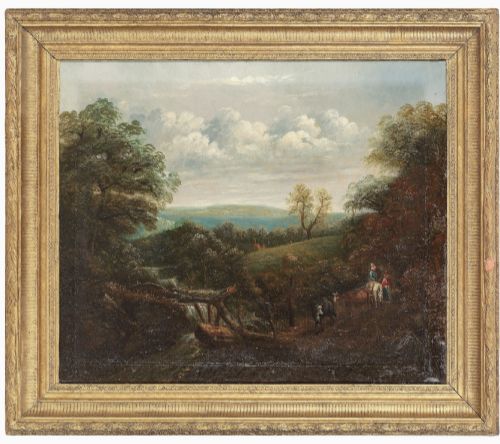
Represented subjects range from quiet rural paths with figures to bustling river scenes and ruined castles. Many pieces retain their period gilt wood frames, completing the traditional aesthetic of these regional landscapes.
How they were made
Artists utilised traditional media such as oil paint applied to canvas or wood panel, alongside watercolour pigments and graphite on paper. These materials allowed practitioners to capture both atmospheric weather effects and precise architectural details.
Works on paper often involved watercolour washes combined with graphite sketching to map out river views and church structures. Oil paintings on wood panel provided a stable surface for detailed depictions of windmills and rural figures.
Listings feature works spanning the nineteenth century, utilising watercolour pigments, graphite, and oil on wood panel or canvas.
What varies in quality
Quality rests upon the handling of light and the atmospheric depth achieved within the flat Norfolk landscape. Stronger works demonstrate confident brushwork and a clear sense of place, whether depicting a quiet country path or a busy staithe.
The preservation of the original surface and the condition of the pigments dictate the visual impact of each piece. Surviving period frames in gilt wood further enhance the presentation and integrity of the artwork.
Thomas Lound·John Joseph Cotman·Henry Bright·John Thirttle·Joseph Paul
The Norwich School Artwork Glossary
- Norwich School
- A regional movement of painters active in Norfolk from the early nineteenth century onwards. They focused primarily on local landscapes and rural scenes.
- Wood Panel
- A rigid support used by artists before canvas became universal. It offers a smooth, stable surface for detailed oil painting.
- Gilt Wood
- Timber coated with a thin layer of gold leaf or gilt finish. Period frames of this type are commonly found surrounding nineteenth century paintings.
- Staithe
- A landing stage or wharf alongside a river. These locations frequently served as focal points for regional maritime and trading scenes.
- Watercolour Pigment
- Colour suspended in a water-soluble medium for application on paper. It allows for translucent washes and delicate atmospheric effects.
Norwich School Artwork: Frequently Asked Questions
What is Norwich school artwork?
Norwich school artwork encompasses paintings and drawings produced by a collective of artists centred in Norfolk during the nineteenth century. These works primarily document the local landscape, rivers, and architecture of East Anglia.
The movement represents Britain's earliest provincial art community, capturing everyday rural life and topography with distinct regional character.
How should I hang these watercolours?
Watercolours on paper require protection from direct sunlight to prevent the pigments from fading over time. Displaying them in a stable environment away from damp walls preserves the paper and the framing.
Using conservation-grade mounting materials during any reframing helps maintain the structural integrity of older drawings.
How do I identify the period?
Dating relies on the materials used, the framing style, and the recorded dates associated with the specific artist. Early nineteenth century pieces often feature softer watercolours, while Victorian works can include heavier oil applications.
Examining the reverse of wood panels or canvas stretcher bars frequently reveals period inscriptions or dealer marks.
Were these painted outdoors?
Artists of this period typically made preparatory sketches and watercolours outdoors to capture accurate topographical details of rivers and mills. The finished oil paintings were usually completed back in the studio using those field studies.
This method combined direct observation of Norfolk weather with the formal composition required for exhibition pieces.