

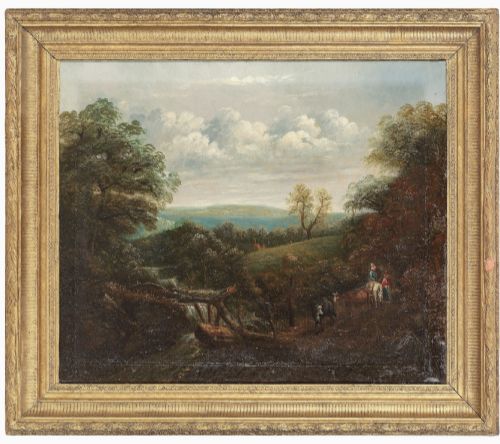


Country Path Oil Painting
These country path oil paintings capture quiet rural lanes and shaded tracks, offering a glimpse into pastoral life through period brushwork.
Country Path Oil Painting
A country path oil painting depicts rural lanes, woodland tracks, and village routes rendered in oil paint on canvas, spanning periods from the late eighteenth century into the twentieth century. These works frequently incorporate figures walking along the path or focus entirely on the natural canopy and surrounding foliage.
The selection encompasses British and French examples, drawing from regional movements such as the Norwich School as well as Victorian impressionism and post-impressionism. Pieces range from intimate wooded scenes to larger canvases detailing rural tracks.
Most examples appear within gilt wood frames featuring gesso ornamentation, preserving the original presentation of the artwork. The forms vary from straightforward landscape views to composed pastoral narratives involving human figures.
How they were made
These works utilise oil paint applied to stretched canvas, mounted within wooden frames that frequently employ gesso layers and gold leaf finishes. Painters built up the surface using varied brush techniques, from the tight detail of the nineteenth-century landscape tradition to the looser application seen in later impressionist and post-impressionist examples.
The framing methods rely on traditional joinery in wood, with moulded gesso providing decorative relief beneath gilt or gold leaf surfaces. This construction protects the canvas edges and maintains structural integrity across the centuries.
The listings span from the late 18th century through to the 1930s, utilising canvas, wood, gesso, and gold leaf.
What varies in quality
Quality rests in the handling of light, the depth of the perspective along the pathway, and the sensitivity of the brushwork in rendering foliage and atmospheric conditions. Stronger works demonstrate a confident command of tone and composition that draws the viewer along the route.
The execution of the surrounding frame also influences the overall character, where period gilt wood frames with intact gesso and gold leaf complement the depth and palette of the oil on canvas.
Abraham Hulk Jnr·Joseph Thors·Walter Emsley·William Greaves·Kershaw Schofield
The Country Path Oil Painting Glossary
- Gesso
- A plaster-like mixture applied to wooden frames as a base for gilding. It provides a smooth surface for intricate mouldings.
- Gilt Wood
- Wood treated with a thin layer of gold leaf or metallic paint. It frames the canvas and reflects ambient light.
- Norwich School
- A regional group of artists active in the nineteenth century inspired by local landscapes. Their work emphasises naturalistic observation.
- Post-Impressionism
- An art movement extending impressionist techniques with a greater emphasis on symbolic content and expressive brushwork. It appears in later twentieth-century pieces.
- Canvas
- A heavy woven fabric stretched across a wooden support to serve as the painting surface. Oil paint adheres directly to its primed texture.
Country Path Oil Painting: Frequently Asked Questions
How do I date a country path painting?
Dating relies on stylistic evidence, stretcher construction, and framing materials. Earlier nineteenth-century works often show tighter brushwork, while post-impressionist examples from the twentieth century employ looser paint application.
Signatures, artist records, and canvas stamps further clarify the period of creation and regional origin.
Are these paintings supplied in original frames?
Many examples retain their period gilt wood frames, complete with gesso mouldings and gold leaf finishes. These frames are selected to match the era of the canvas.
Original framing adds historical context and protects the edges of the oil on canvas structure.
Where were these landscape scenes painted?
The works depict rural locations across Britain and France, including Hertfordshire and regional village routes. Artists painted these scenes <em>en plein air</em> or developed them from field sketches.
Specific titles often reference local lanes, woodlands, and canals familiar to the artists.
How should I care for an antique oil painting?
Keep the canvas away from direct sunlight and dramatic shifts in temperature or humidity. Dust the surface gently with a soft, dry brush without applying pressure.
Avoid using water or chemical cleaners on either the oil paint or the gilt wood frame.