


Norfolk Coastal Painting
A norfolk coastal painting captures the flat horizons, marshes and tidal waters of East Anglia through the eyes of artists working from the nineteenth century onwards.
Norfolk Coastal Painting
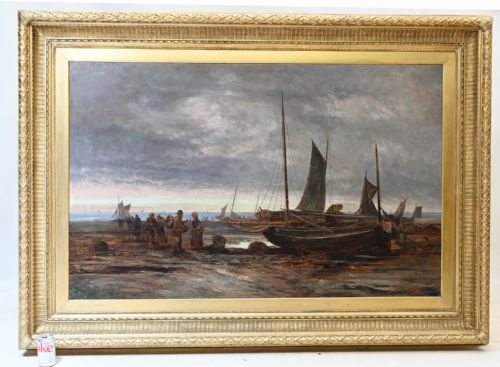
When you search for a norfolk coastal painting, you encounter works that record the beaches, harbours and broads of the county. These pieces range from expansive nineteenth-century maritime oils to smaller twentieth-century watercolours of coastal villages.
The most frequent examples on this page are watercolours on paper and oil paintings on canvas depicting specific locations such as Cromer, Brancaster and Gorleston. They vary from brisk plein-air sketches to large finished exhibition pieces.
Makers and artists represented span the Victorian period through to post-war Modern British Impressionism, offering a visual record of Norfolk's changing shorelines and waterways.
How they were made
These works rely on traditional painting materials, principally oil paint and watercolour pigment applied to paper, wood or stretched canvas. Artists balanced fluid washes for open skies with heavier impasto to render coastal water and mudflats.
Many historical pieces retain their original frames, including ornate giltwood settings that complement the scale and period of the canvas. The support structures utilise traditional wooden stretchers or paper mounted securely for transit.
Several pieces preserve the exact moment the tide went out at Heacham over a century ago.
What varies in quality
Quality rests upon the artist's command of light, atmosphere and local topography, separating competent topographical records from accomplished artistic interpretations of the Norfolk coast. The handling of watercolour pigment or oil paint shows confidence in capturing fleeting weather conditions and tidal movement.
Condition also dictates standing, with works preserved on stable paper or canvas without excessive fading or discoloration commanding greater attention. The presence of clear attribution to documented painters adds context to the execution.
Thomas Bush Hardy·Sir Thomas Newenham Dean·Edward Seago·Frederick William Hattersley·Leslie Rackham·H.E. Tidmarsh·Stephen John Batchelder·Henry Bright·Joseph West
The Norfolk Coastal Painting Glossary
- Watercolour
- A paint consisting of pigment suspended in a water-based solution, typically applied to paper to achieve translucent washes of colour.
- Giltwood
- Wood carved and coated with gold leaf or a metallic gilding powder, commonly found on traditional picture frames.
- Impasto
- Paint applied thickly to a canvas, standing out from the surface to give a sense of texture and three-dimensional form.
- Provenance
- The documented history of ownership of an artwork, establishing its authenticity and chain of custody over time.
- Plein-air
- Painting outdoors in direct contact with the subject, allowing the artist to capture immediate natural light and weather.
Norfolk Coastal Painting: Frequently Asked Questions
How do I date a norfolk coastal painting?
Dating relies on stylistic clues, framing materials, artist signatures and recorded exhibition dates. Victorian works often show tighter academic brushwork, whereas mid-century pieces lean towards impressionistic freedom.
Paper quality and backing materials also help place an unsigned watercolour within its correct nineteenth or twentieth-century period.
Where were these coastal scenes painted?
Artists focused on specific Norfolk locations including Cromer, Brancaster Staithe, Gorleston-on-Sea and the various broads and harbours.
Local landmarks, specific mudflats and named quaysides help identify the exact stretch of coastline depicted in the artwork.
How should I frame and display them?
Watercolours require conservation mounting behind glass to protect the paper from ultraviolet light and humidity. Oil paintings on canvas benefit from stable indoor environments away from direct heat sources.
Matching the frame to the period of the painting ensures the artwork is displayed as intended by the artist or original owner.
What is the difference between oil and watercolour here?
Oil paintings utilise oil-based pigments on canvas or wood panels, allowing for rich textures and deep colour layering. Watercolours employ water-soluble pigments on paper, offering a lighter and more luminous finish.
Both mediums were used extensively by artists recording the Norfolk landscape across different decades.