
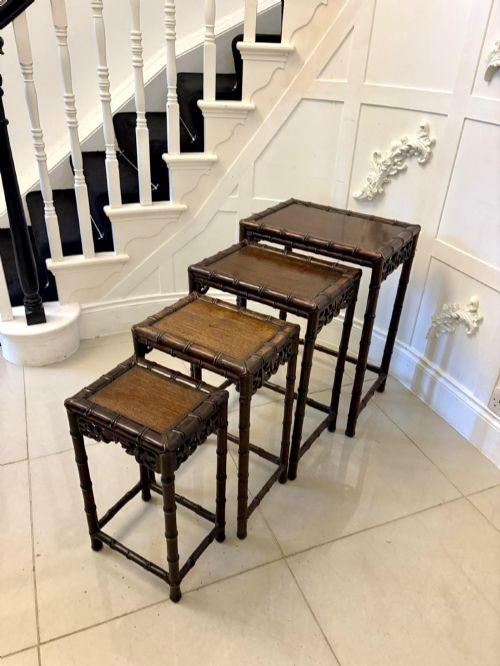
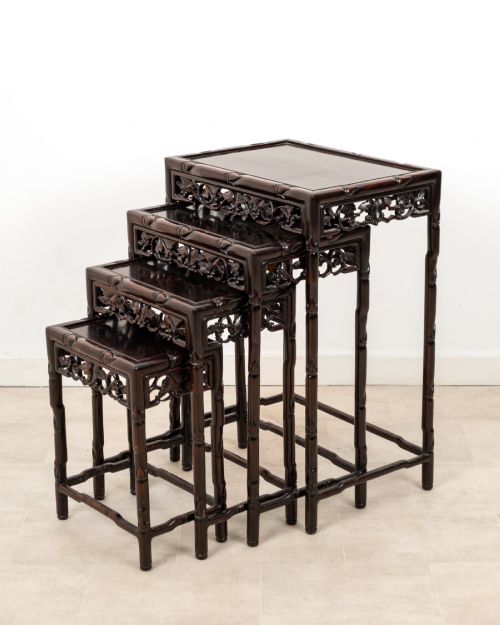
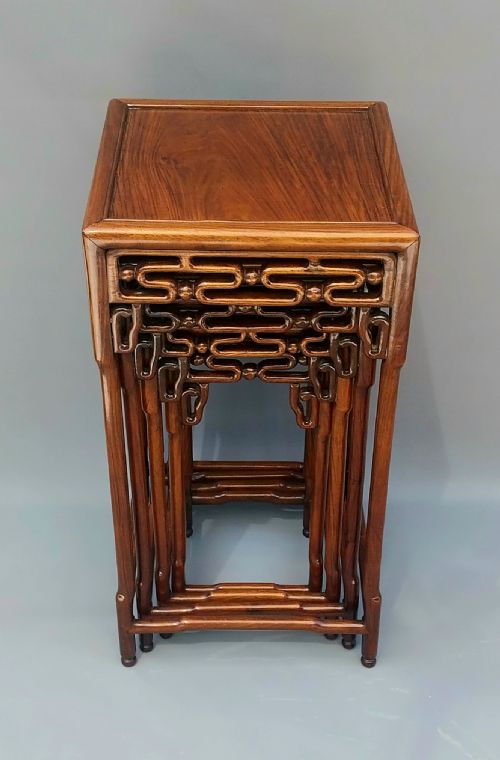
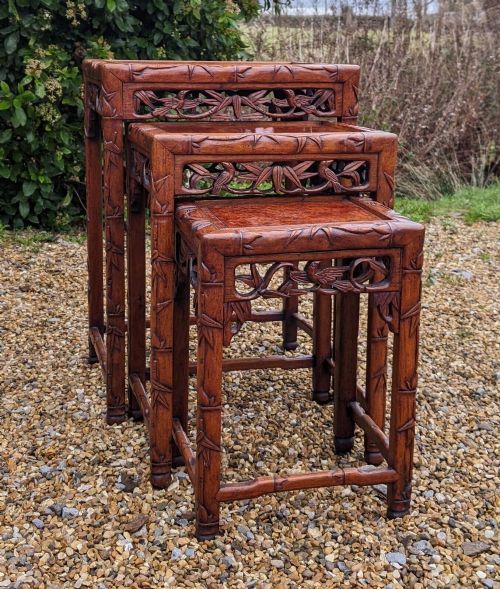


Nest of Tables Carved
When you search for a nest of tables carved, you are looking at sets of graduating surfaces designed to slide one beneath another.

Nest of Tables Carved
A nest of tables carved provides multiple surfaces that stack into the footprint of a single small table when not in use. These sets appear frequently in Chinese export, Qing Dynasty, and Edwardian styles, alongside various regional interpretations.
The format typically consists of three or four graduated pieces designed to slide neatly together. On this page, you will encounter examples ranging from nineteenth-century hardwood sets to early twentieth-century teak, rosewood, and mahogany designs.
Originating both in East Asian workshops and British cabinet-making traditions, these pieces served as versatile occasional furniture for drawing rooms and parlours. They allow a host to provide extra table space instantly without cluttering the floor.
Materials and construction
Cabinet-makers relied on dense tropical hardwoods such as hongmu, rosewood, and padouk, alongside domestic timbers like mahogany, walnut, and oak. These woods provided the structural stability required for slender legs and thin table tops.
Carving was executed in relief on the friezes and top panels, often depicting motifs such as dragons, foliage, or floral arrangements. Joinery methods included precise tongue-and-groove framing to ensure each table slid smoothly into the one above it without jamming.
Listings on this site range from nineteenth-century Chinese hardwood sets to early twentieth-century teak and burr walnut iterations.
Distinguishing quality
The precision of the graduation is equally telling, as top-tier sets slide together with uniform gaps and minimal friction. Finer examples exhibit meticulous joinery where the frames remain square and stable across all four surfaces over decades of use.
The Nest of Tables Carved Glossary
- Quartetto
- A set of four small tables designed to fit inside one another. This term appears frequently in nineteenth-century British and export contexts.
- Hongmu
- A traditional Chinese term for dense, reddish-brown hardwoods used in fine furniture production. It translates literally as red wood.
- Frieze
- The decorative horizontal band situated directly beneath the table top. Carved motifs often populate this area on export pieces.
- Graduated
- Describing tables of decreasing dimensions built to nest in sequence. Each smaller piece slides precisely beneath the preceding one.
- Chinoiserie
- European artistic styles reflecting Chinese motifs and techniques. These designs often feature relief carving and simulated oriental finishes.
Nest of Tables Carved: Frequently Asked Questions
What is a quartetto nest of tables?
A quartetto nest consists of four tables designed to slide together into a single stack. The format became popular during the nineteenth century for drawing room use.
Each table is fractionally smaller than the last, allowing the entire set to occupy the floor space of the largest piece.
How were carved nests of tables used?
These sets provided temporary surfaces for tea, writing, or displaying ornaments when entertaining guests. Servants or hosts could deploy the smaller tables individually around a room.
When the gathering concluded, the tables stacked back together to clear the floor.
How do I identify Chinese export sets?
Chinese export sets typically utilise dense hardwoods such as hongmu, rosewood, or padouk. They frequently feature deep relief carvings of dragons, foliage, or traditional landscapes.
The construction often employs traditional Asian joinery techniques distinct from standard British cabinet making of the same era.
Are Edwardian sets different from nineteenth-century ones?
Edwardian examples tend to utilise British timbers like mahogany or walnut, sometimes incorporating inlaid stringing or Edwardian stylistic cues. Nineteenth-century versions lean more heavily towards heavy carved hardwoods and Chinese export designs.
Both periods maintained the practical four-table graduation format.