


Neoclassical Round Table
When you seek a neoclassical round table, you are looking at circular centre and gueridon forms grounded in classical symmetry and proportion.
Neoclassical Round Table
A neoclassical round table encompasses circular side tables, centre tables, occasional tables, and gueridons originating mostly across the nineteenth and twentieth centuries. These pieces draw upon French Empire, Louis XVI, and Biedermeier revival styles, with French origin appearing frequently among the listings.
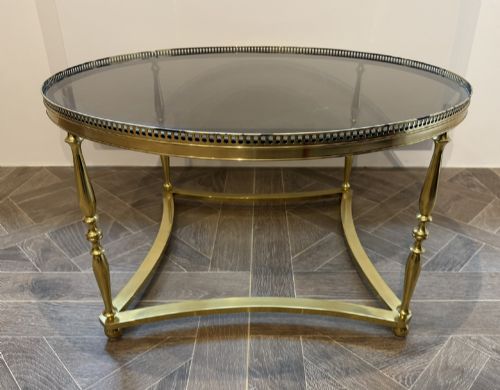
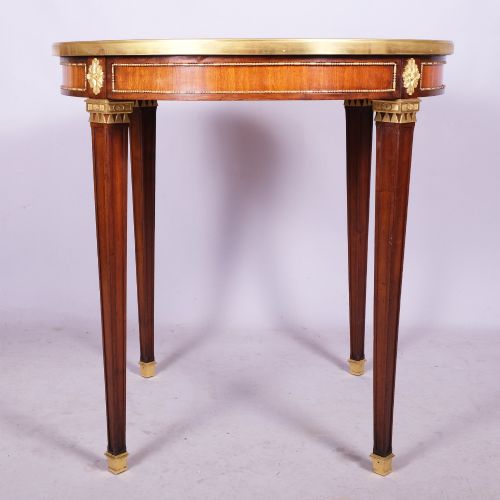
The buyer meets variations ranging from marble-topped bouillotte tables to mahogany gueridons fitted with columns and bronze or ormolu mounts. Such items serve practical functions as lamp or coffee tables while establishing a formal, architectural presence in a room.
Materials and Construction
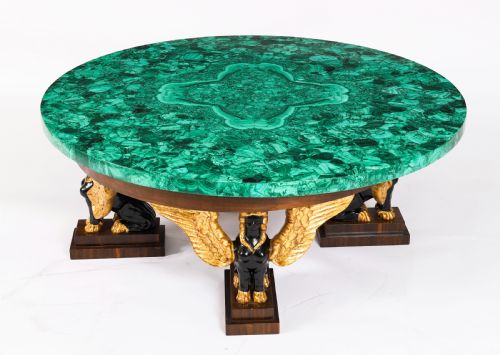
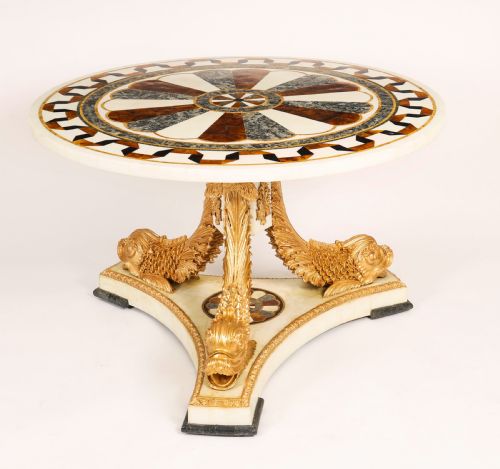
Carpenters utilised primary cabinet timbers including mahogany, walnut, satinwood, and ebonised wood, frequently pairing them with inlaid specimen woods or painted finishes. Tops in white or porphyry marble, onyx, and malachite provide heavy, contrasting surfaces supported by timber frames.
Decorative detailing relies upon cast brass and ormolu mounts, giltwood carvings, and applied motifs such as rams' heads, swans, and floral mouldings. These metal elements and carved wooden details anchor the classical vocabulary of the tables.
Listings feature mahogany, walnut, and satinwood alongside marble and onyx tops.
Markers of Quality
Quality differentiates itself through the crispness of cast ormolu and bronze ornaments, where sharply defined details reflect superior foundry work. The selection of timber, such as figured mahogany or intricate satinwood inlay, dictates the visual depth of the woodwork.
Structural refinement shows in the integration of heavy stone or marble tops with stable columnar or pillar supports. Pieces bearing distinct stylistic attribution or specific regional cabinet-making demonstrate higher execution levels than standard revival productions.
Pietro Ferrario
The Neoclassical Round Table Glossary
- Guéridon
- A small round table, often supported by a central column or pillar, originating in French furniture design. This form frequently incorporates marble tops and gilt mounts.
- Ormolu
- Gilt bronze ornamentation applied to furniture mounts and decorative details. The technique involves treating bronze with a gold amalgam to achieve a rich metallic lustre.
- Bouillotte table
- A small neoclassical circular card or occasional table featuring a raised gallery edge around the top. They are traditionally designed to hold candlesticks for card games.
- Porphyry
- An igneous rock with large crystals, valued for its purple or red coloration and hard texture. It appears as decorative table tops within classical designs.
- Specimen wood
- Small pieces of various decorative timbers arranged in geometric patterns or pictures on table tops. This technique highlights the natural colour variations of different woods.
Neoclassical Round Table: Frequently Asked Questions
What is a gueridon table?
A gueridon is a circular table supported by a central pillar or column, originating in seventeenth-century France and remaining popular through later revival periods.
These pieces function well as central display surfaces or lamp tables in a room layout.
How do I identify French Empire style?
French Empire furniture utilises dark mahogany timbers combined with classical bronze or ormolu mounts, featuring motifs like swans, columns, and rams' heads.
The aesthetic draws directly from ancient Roman and Greek design vocabulary translated through nineteenth-century workshops.
Where should I place a round table?
Circular tables suit entrance halls as centre pieces or function beside seating areas as occasional lamp tables.
Their curved profile softens linear architectural layouts and allows smooth circulation flow in a room.