
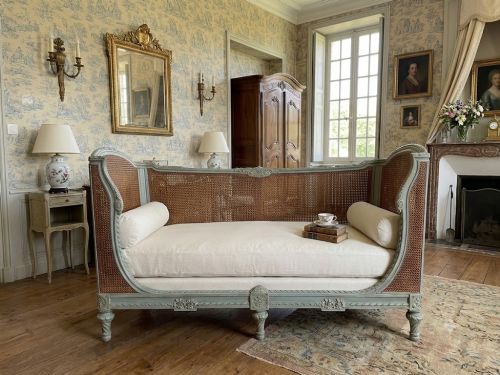
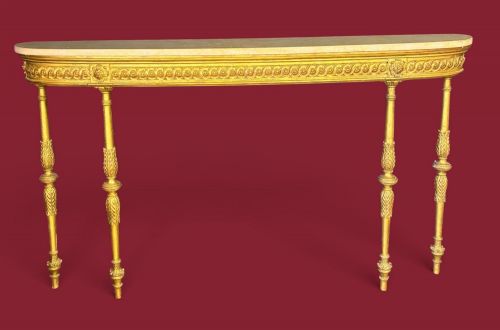


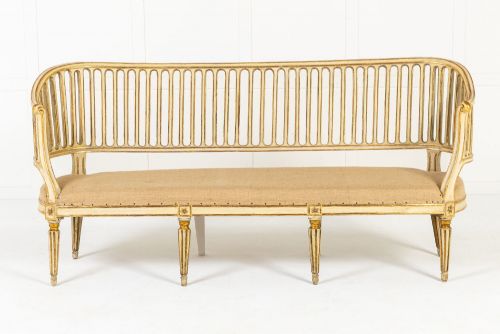


Neoclassical Carved Sofa
A neoclassical carved sofa brings structured symmetry and classical ornament into a room, spanning periods from the eighteenth century to the early twentieth.
Neoclassical Carved Sofa
A neoclassical carved sofa represents a lineage of seating that draws directly on classical antiquity, interpreted through Georgian, Regency, and continental European traditions. When you search for a neoclassical carved sofa, you encounter forms ranging from strict English mahogany frames to French giltwood settees and painted Swedish daybeds.
Makers and workshops across England, France, Sweden, and Italy contributed to this variety, employing styles such as Gustavian, Empire Revival, and George III. Forms extend from grand three seater settees and daybeds down to compact two seater salon seating.
How they were made
Frames are constructed primarily from timbers such as mahogany, walnut, birch, and satinwood, frequently paired with applied decorative finishes. Cabinetmakers carved structural elements directly into the wood, incorporating motifs drawn from classical architecture.
Surface treatments vary widely between natural polished woods, giltwood applications, and painted or cream finishes. Upholstery methods utilise traditional stuffing techniques paired with linen, cane panels, or patterned fabrics.
The inventory spans the eighteenth century, the Georgian period, the nineteenth century, and the early twentieth century.
What varies in quality
The refinement of the hand carving dictates much of the distinction between ordinary pieces and exceptional examples. Crisp execution of classical details such as fluting, paterae, and acanthus leaves shows the hand of a skilled artisan.
The choice and preparation of the primary timber also separate pieces within the range, particularly where figured mahogany or fire gilded gesso are employed. Structural integrity in the joinery of the frame underpins the longevity of every settee.
The Neoclassical Carved Sofa Glossary
- Neoclassical
- A style spanning the eighteenth and nineteenth centuries that revived the classical motifs of ancient Greece and Rome. It emphasises straight lines, symmetry, and architectural proportion.
- Giltwood
- Timber that has been coated with a thin layer of gold leaf or gold paint over a prepared gesso ground. This finish is frequently found on formal French and Regency frames.
- Gustavian
- The Swedish interpretation of neoclassical design, championed during the reign of Gustav III. It is characterised by lighter painted finishes and restrained classical carving.
- Cané
- Woven rattan or cane panels utilised for backrests and seats, offering a lighter visual weight. This technique appears frequently on French and Edwardian daybeds and settees.
- Serpentine
- A curved line that undulates inwards and outwards, commonly seen along the front rails of eighteenth and nineteenth century sofas.
Neoclassical Carved Sofa: Frequently Asked Questions
Where did neoclassical sofas originate?
Neoclassical design emerged across Europe during the mid-eighteenth century as archaeological discoveries in Pompeii and Herculaneum inspired a return to classical antiquity. Craftsmen in England, France, Sweden, and Italy adapted these ancient motifs for contemporary domestic seating.
French workshops favoured giltwood and painted frames in the Louis XVI style, while English makers turned to mahogany and satinwood under the influence of designers like Hepplewhite and Adam.
What is the difference between a settee and a sofa?
Historically, the term settee often denoted a wider wooden or upholstered seat for two or more people, sometimes sharing characteristics with large chairs. Sofas generally evolved to describe fully upholstered, larger pieces designed for lounging.
In antique listings, however, the terms are frequently used interchangeably to describe formal seating from the eighteenth century onwards.
Can I use an antique sofa every day?
Most antique frames are structurally robust, but their suitability for daily use depends on the condition of the internal webbing, springs, and upholstery. Frames built from solid mahogany or walnut handle regular seating well once properly restored.
Delicate giltwood or painted pieces from the nineteenth century require a more gentle approach to preserve their original surface finishes and applied decoration.