
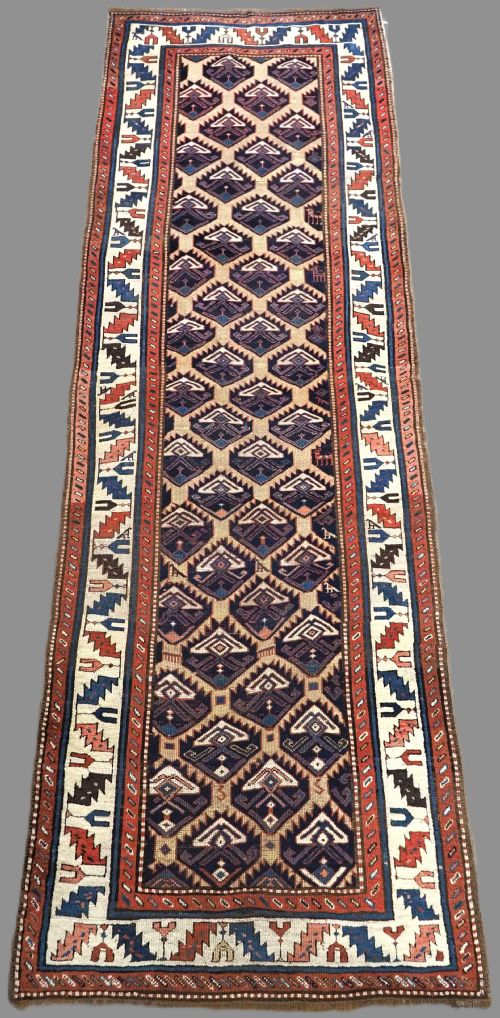



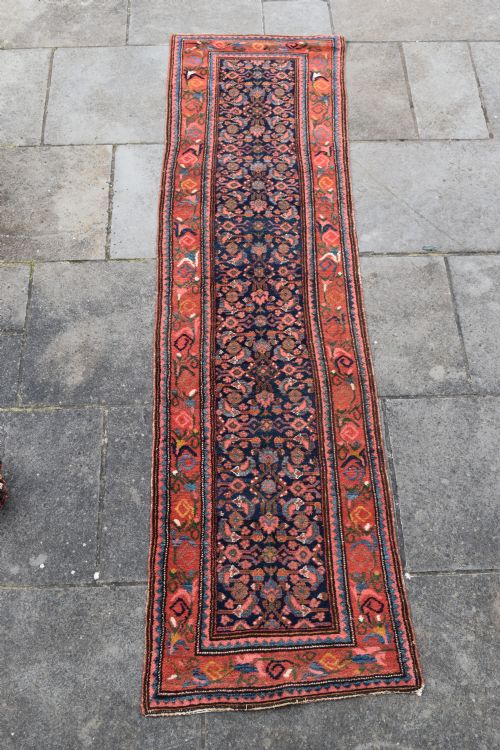


Navy Wool Hall Rug
A navy wool hall rug grounds a corridor with deep indigo tones and resilient village weaving.
Navy Wool Hall Rug
A navy wool hall rug is a long, narrow floor covering designed specifically for corridors and passage spaces, combining deep indigo fields with durable pile construction. These pieces stretch from shorter village formats to grand lengths exceeding four metres, serving areas that require both linear structure and warmth underfoot.
The selections available here span from the late nineteenth century into the early twentieth century, showing Persian tribal designs, Caucasian geometric patterns, and traditional village motifs. Buyers encountering this group will find runner rugs and hallway runners featuring distinctive lattice work, boteh motifs, and stylised floral arrangements.
Origins represented in this inventory point directly to traditional weaving regions including Persia, the Caucasus, and Turkey. These runners bring historical depth to modern interiors, offering narrow proportions suited to traditional hallways and extended landings.
What varies in quality
Quality in these runners rests on the density of the knotting and the crispness of the geometric or floral design execution. A finer weave allows intricate motifs like lattice work and boteh patterns to maintain sharp outlines along the narrow field.
The depth and stability of the natural dyes also distinguish finer examples, where rich indigo grounds hold their luminosity across long expanses. Variations in wool quality dictate how resilient the pile remains under sustained foot traffic in a corridor.
The inventory records regional styles including Persian Tribal, Caucasian, Bakhtiari, Karaja, Sarouk, and Kurdish village traditions.
The Navy Wool Hall Rug Glossary
- Runner
- A long, narrow carpet format designed for hallways, corridors, and stairs. These pieces measure significantly longer than they are wide to fit linear architectural spaces.
- Boteh
- A stylised teardrop or almond-shaped motif representing a floral spray or cypress tree. This ancient design appears frequently in Persian and Caucasian village weaving.
- Natural Dyes
- Colourants derived from plant, insect, and mineral sources rather than synthetic chemicals. These dyes yield rich, complex tones that age with considerable depth.
- Warp
- The vertical threads stretched lengthwise on the loom that form the structural skeleton of the rug. Weft threads are interlaced across these to secure the knots.
- Lattice
- An open network pattern formed by intersecting diagonal bands that create repeating geometric compartments. This framework often encloses floral or abstract ornaments.
Navy Wool Hall Rug: Frequently Asked Questions
Where should I place a long runner?
These narrow formats suit entrance halls, extended corridors, and galley spaces where linear flooring softens hard surfaces. Their proportions guide movement through the home while protecting high-traffic wooden floors.
Ensure the chosen length leaves appropriate margins of exposed floor around the edges for a balanced look. Measuring the clearance for doors to swing freely over the pile is essential before placement.
How do I care for antique wool runners?
Regular gentle vacuuming without a rotating brush roll prevents dust from settling deep into the wool pile. Professional cleaning suited to antique textiles preserves the natural lanolin and dye stability.
Using a quality underlay prevents slipping and cushions the foundation against hard subfloors. Rotating the runner periodically distributes foot wear evenly along its length.
What does a wool pile mean for durability?
Wool contains natural lanolin that resists stains and gives the fibre inherent elasticity under foot traffic. This natural resilience allows the pile to bounce back after compression in busy hallways.
Hand-spun wool variations add subtle texture and tonal shifts across the dark navy fields. This material ages gracefully, developing a soft patina through decades of use.