
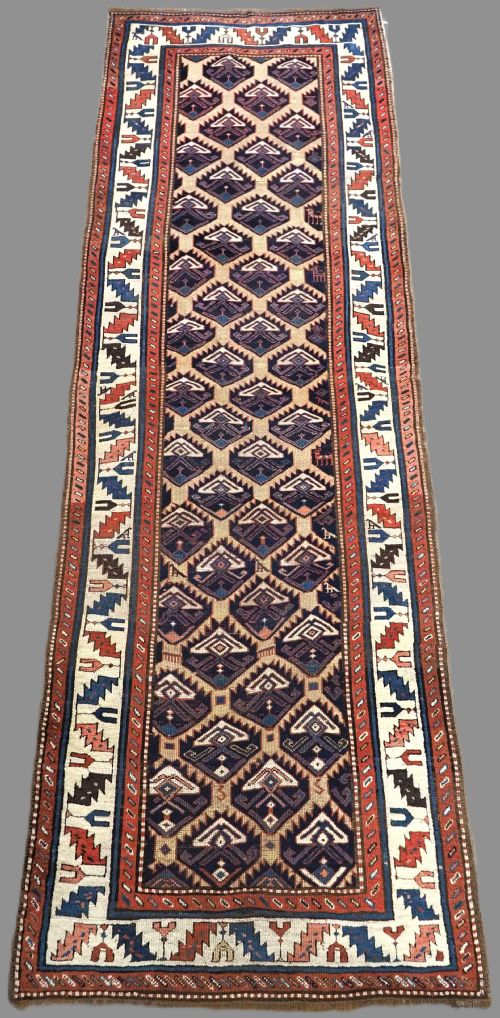
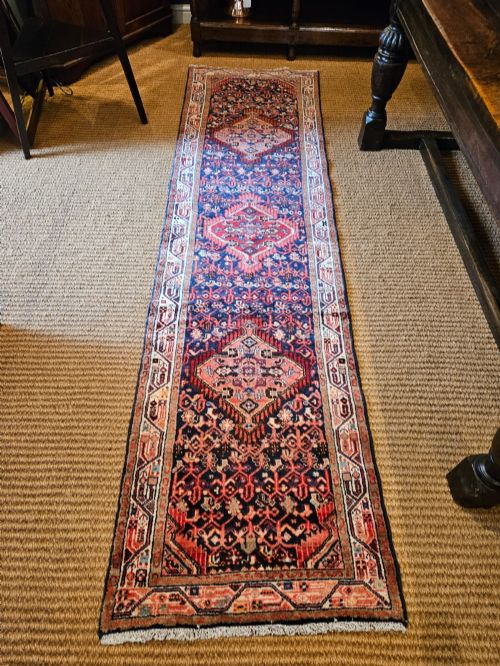

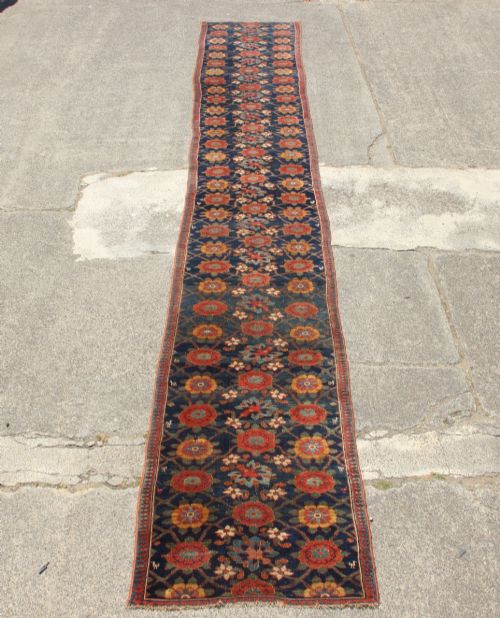
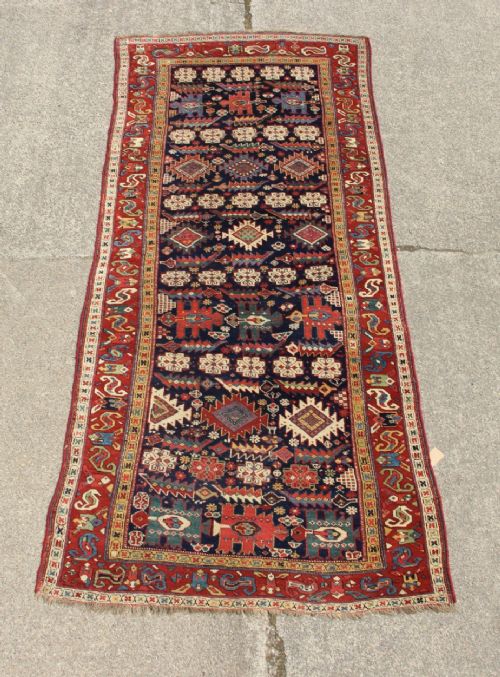
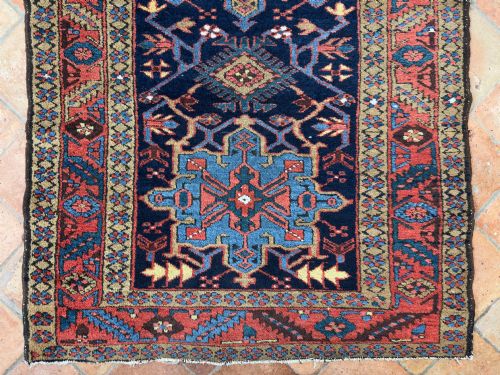


Navy Oriental Hallway Runner
When you search for a navy oriental hallway runner, you seek a long, narrow carpet woven in wool using traditional Persian and Caucasian designs.
Navy Oriental Hallway Runner
A navy oriental hallway runner is a narrow, elongated textile designed specifically for corridors and narrow spaces in a home. The pieces found here span production dates from the eighteen-sixties through to the nineteen-thirties, reflecting decades of traditional weaving practices.
Most examples originate from Persian and Caucasian regions, encompassing traditional styles such as Heriz, Hamadan, Kurdish Tribal, and Shahsavan. Buyers searching for a navy oriental hallway runner will frequently encounter these regional variations in formats including long runners, gallery carpets, and narrow rug formats.
How they were made
These floor coverings utilise wool and hand-spun wool for the pile and foundation, providing a durable surface suited to heavy foot traffic in corridors. Cotton also appears in the structural foundations of many examples to impart stability.
Makers employed natural dyes to colour the wool, creating deep navy grounds and contrasting motifs. Artisans knotted the fibres by hand, developing dense foundations and intricate geometric or floral patterns.
Listings span production dates from eighteen-sixty to nineteen-thirty, focusing on Persian and Caucasian traditions utilising wool and natural dyes.
What varies in quality
The fineness of the knotting and the density of the weave set the baseline for quality across these long formats. Tighter structures yield sharper detail in lattice, medallion, and boteh motifs.
The purity and richness of the natural dyes influence the visual depth of the navy field over time. Greater precision in regional design attribution and wool quality separate standard utility carpets from finer tribal and village works.
Persian Tribal·Caucasian·Persian Heriz·Kurdish Tribal·Persian Bakhtiari
The Navy Oriental Hallway Runner Glossary
- Runner
- A long, narrow carpet format intended for corridors, staircases, and hallways. These pieces typically measure significantly greater in length than in width.
- Boteh
- A stylised floral or almond-shaped motif commonly found in Persian and Caucasian textile design. This ancient symbol represents a cypress tree or a flower cluster.
- Natural Dyes
- Colourants derived from plant, insect, and mineral sources rather than synthetic chemicals. These dyes produce complex, muted tones that mature gracefully.
- Knot
- An individual loop of wool tied around the warp threads to form the pile of a carpet. Higher knot counts generally allow for greater intricacy in pattern work.
- Warp
- The stationary vertical threads stretched on a loom that form the structural foundation of the textile. Weft threads are interlaced across these warp threads during construction.
Navy Oriental Hallway Runner: Frequently Asked Questions
What rooms suit a hallway runner?
These narrow textiles fit well in corridors, entryways, and narrow passageways where floor protection is needed.
They also serve effectively in kitchens and galley spaces to add warmth underfoot.
How do I identify a Heriz runner?
Heriz runners typically feature bold geometric medallions and substantial corner spandrels woven in structured village designs.
They use durable wool and distinct navy or rich red primary tones.
Are these runners made of pure wool?
The listings show construction using wool, hand-spun wool, and cotton foundations.
Natural dyes provide the coloration across the pile.
How do I date an antique runner?
Dating relies on stylistic markers, weave structure, and the specific natural dye palette typical of periods from the mid-nineteenth century onward.
Regional characteristics often indicate the era of production.