
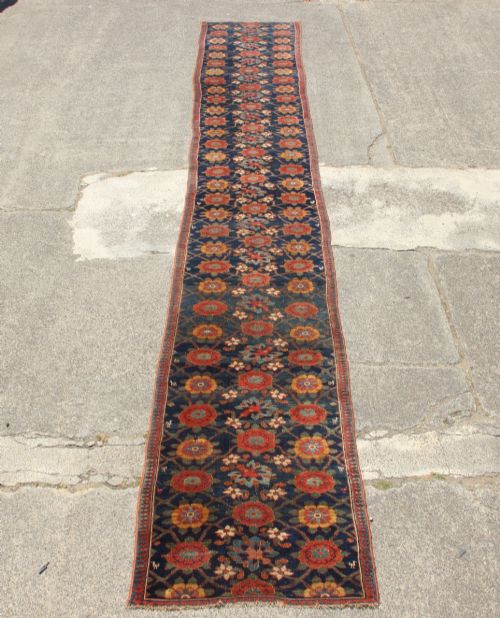
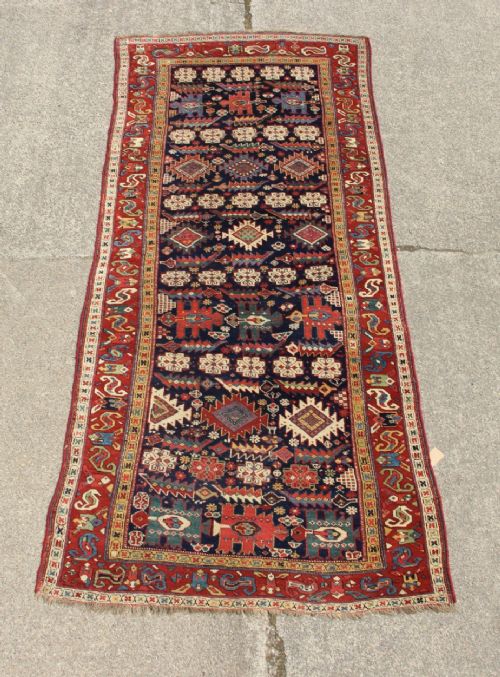
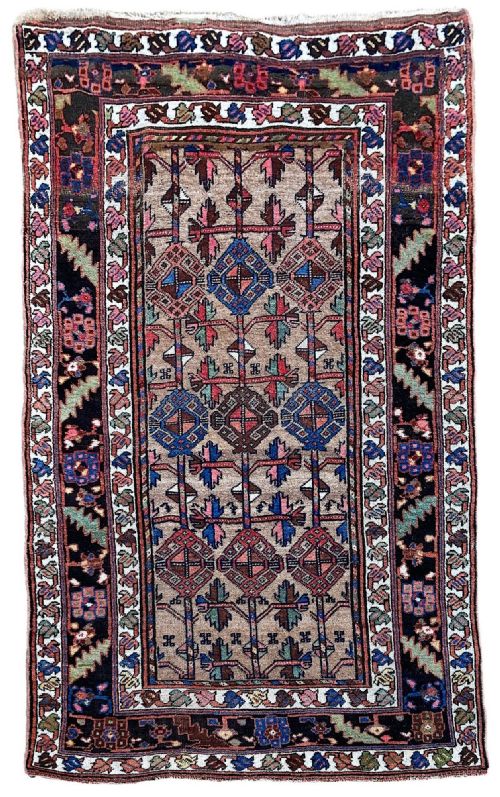


Navy Kurdish Runner Rug
A navy kurdish runner rug brings geometric tribal motifs and deep indigo wool to long hallways and narrow spaces.
Navy Kurdish Runner Rug
A navy kurdish runner rug is a long, narrow tribal weaving created by village weavers in Western Persia. These pieces serve practical purposes in corridors and hallways while displaying traditional village motifs.
Most examples found here date from the late nineteenth century through to the early decades of the twentieth century. They encompass specific regional subtypes including Senneh, Bidjar, Hamadan and Jaf village productions.
Makers utilise format proportions suited to narrow domestic spaces, pairing elongated formats with repeating geometric medallions, boteh motifs or all-over shrub designs.
Differences in quality
Quality rests in the fineness of the knotting density and the crispness of the geometric design work. Tighter foundations allow intricate motifs like Mina Khani patterns or Memlinc guls to remain sharp and well-defined.
The handling of natural dye palettes distinguishes superior examples, where varied indigo tones and rich secondary shades maintain depth across the pile.
The Navy Kurdish Runner Rug Glossary
- Kelleh
- A large room-sized carpet format, often intermediate in proportion between standard rugs and full runners. These pieces share the dense wool construction typical of village workshops.
- Boteh
- A stylised floral or almond-shaped motif representing a shrub or palm leaf. This recurrent design appears frequently across tribal room rugs and corridor runners.
- Mina Khani
- A repeating symmetrical floral pattern arranged in an all-over grid. This classical Persian layout translates into geometric village interpretations.
- Gul
- A medallion or repeating octagonal stamp used in tribal design traditions. These graphic elements identify specific regional weaving groups.
Navy Kurdish Runner Rug: Frequently Asked Questions
Where should I place a runner rug?
These narrow formats suit hallways, corridors and bedside spaces where linear proportions work best. Their durable wool pile handles high foot traffic effectively.
Position them clear of doorways to allow smooth clearance while accentuating architectural length.
How do I identify a Kurdish village rug?
Look for dense wool construction, saturated indigo grounds and geometric tribal motifs such as boteh or stylized shrubs. Village pieces often display spontaneous variations in border arrangements.
Regional sub-types like Senneh or Bidjar reveal specific structural tightness and distinct regional palettes.
Are these rugs made with natural dyes?
Nineteenth and early twentieth-century village pieces frequently incorporate traditional natural dye sources, producing rich variations in navy and red tones. Hand-spun wool absorbs these colour materials with subtle tonal shifts.
Close inspection of the pile reveals the characteristic mellowing associated with age and traditional dyeing methods.
How do I care for antique wool runners?
Vacuum gently using suction attachments without rotating brush bars to protect the hand-knotted pile. Rotate the piece periodically to ensure even exposure to light and wear.
Professional rug cleaning preserves the integrity of the cotton foundations and dyed wool fibres.