



Navy Afghan Carpet
A navy afghan carpet brings rich, tribal warmth to a floor, rooted in the weaving traditions of the nineteenth and early twentieth centuries.
Navy Afghan Carpet
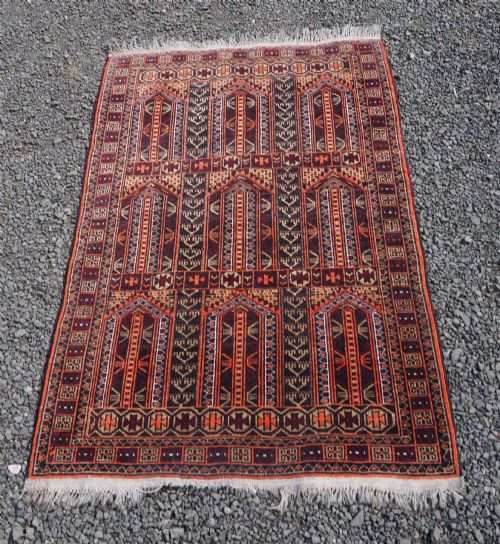
When you examine a navy afghan carpet, you are looking at hand-woven textiles originating from nineteenth-century and early twentieth-century Afghanistan and neighbouring regions. These pieces frequently incorporate tribal motifs, prayer formats with double or multiple mihrabs, and distinctive regional designs.
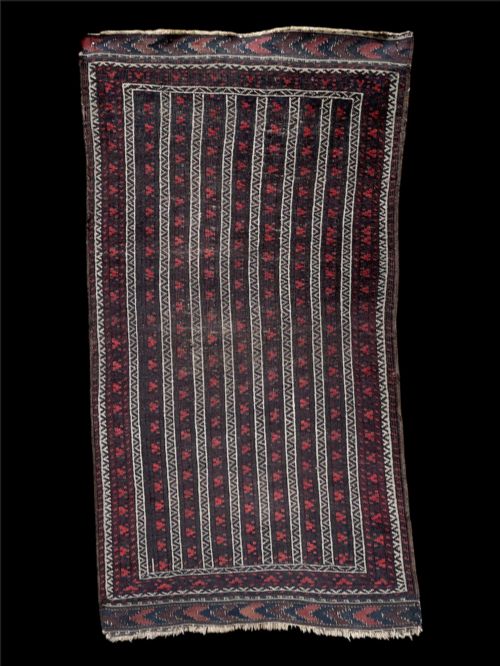
The selections available range from compact prayer rugs and kilims to larger village carpets. You will frequently encounter Baluch, Timuri, Ersari and Taimani variations among the pieces offered on this page.
Tribal weavers produced these items for domestic use and local trade, employing traditional patterns handed down through generations. Their enduring appeal lies in this authentic, utilitarian heritage rather than formal court manufacture.
Assessing quality and character
Quality rests in the fineness of the weave, the clarity of the tribal motifs, and the depth of the dye work. Tighter knotting and well-balanced proportions elevate a piece above standard domestic output.
Condition and integrity dictate the standing of individual rugs. Pieces retaining their original borders and robust wool foundations command greater appreciation among collectors.
Listings span from the nineteenth century through the 1930s, featuring wool and cotton materials across tribal village styles.
The Navy Afghan Carpet Glossary
- Mihrab
- A niche design symbolising the direction of prayer, frequently seen duplicated in tribal prayer rugs. It organises the central field of the textile.
- Kilim
- A flatweave textile produced without a pile by tightly interweaving warp and weft threads. These items offer geometric patterns and a lighter structure.
- Timuri
- A regional weaving attribution associated with tribal groups of western Afghanistan. These pieces share stylistic traits with neighbouring Baluch output.
- Ersari
- A Turkmen tribal grouping recognised for producing large carpets with characteristic guls and geometric motifs. Their work displays generous proportions and soft colouration.
Navy Afghan Carpet: Frequently Asked Questions
How do I identify a prayer rug?
Prayer rugs feature one or more arched mihrab niches designed to direct the placement of the textile during daily devotion.
These formats remain compact and intimate compared to room-sized floor coverings.
Where were these carpets woven?
Production centred on villages and nomadic encampments across Afghanistan, particularly in western regions near the borders.
Local tribal groups such as the Baluch, Timuri and Ersari maintained distinct design vocabularies.
What materials are used?
Weavers relied primarily on locally sourced wool for the pile, foundations and surface texture.
Cotton also appears in the structural warps and wefts of certain village productions.
How do I care for my rug?
Protect the wool textile by placing it in low-traffic areas and using a suitable underlay to prevent sliding.
Vacuum gently without a rotating brush roll and consult a specialist for professional cleaning.