
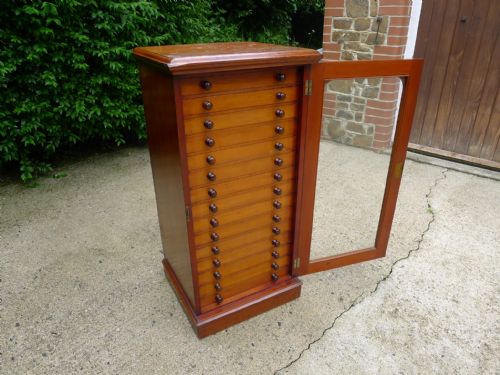


Natural History Chest
A natural history chest is a multi-drawer cabinet designed to house scientific specimens, sought after for disciplined storage and fine timber construction.
Natural History Chest
A natural history chest serves as a specialised storage unit for specimens, featuring numerous shallow drawers designed to protect delicate collections of insects, eggs, and ornithological items. These pieces appear in forms such as collectors cabinets and specimen cabinets, spanning periods from the Georgian era through the Victorian period up to 1930.
The versions most commonly met on this page include mahogany and pitch pine constructions, varying in scale from compact five-drawer table examples up to substantial forty-drawer upright cases. Styles represented across these pieces encompass Georgian, Regency, William IV, and Victorian designs, reflecting the methodical collecting habits of their original owners.
How they were made
Makers constructed these cabinets predominantly using solid mahogany, flame mahogany veneer, and pitch pine, selecting dense timbers to ensure stability and protect contents from atmospheric changes. Brass hardware appears frequently for handles, locking mechanisms, and drawer pulls, offering both durability and functional restraint.
Listings for a natural history chest span from 1781 to 1930, utilising mahogany, pitch pine, and brass.
What varies in quality
The standard of timber selection and veneer matching defines the visual merit of the cabinet, particularly where figured pitch pine or flame mahogany veneer covers large expanses. Superior examples exhibit continuous grain patterns and meticulous timber preparation across numerous drawer fronts.
The complexity and scale of the drawer arrangement dictate the internal execution, ranging from modest five-drawer units to forty-drawer architectural monuments by known makers. Precision in the drawer construction ensures an airtight fit, which separates utilitarian storage from exceptional workshop production.
Messrs Watkins & Doncaster·J.T.Crockett·Standish
The Natural History Chest Glossary
- Specimen cabinet
- A piece of furniture fitted with multiple shallow drawers intended for housing natural history collections. These cabinets often feature locking panel doors to secure the contents.
- Flame mahogany veneer
- A decorative wood slicing applied to a base timber to create a distinctive, flickering flame pattern. This technique enhances the visual richness of Victorian and Georgian case furniture.
- Pitch pine
- A durable softwood with prominent grain patterns utilised for cabinet construction during the latter half of the nineteenth century. It provides a robust alternative to hardwoods while accepting a fine finish.
- Carcase
- The main structural body or shell of a cabinet before the addition of drawers, doors, and feet. The quality of its framing dictates the long-term alignment of the internal drawers.
Natural History Chest: Frequently Asked Questions
What fits inside a natural history chest?
These cabinets were originally built to house scientific collections including insects, bird eggs, and ornithological specimens within their shallow drawers.
Today, the partitioned and dust-proof drawers suit the storage of small collectibles, coins, geological samples, or jewellery.
How do I date a specimen cabinet?
Dating relies upon examining the timber species, construction methods, and architectural style visible in the piece. Georgian and Regency pieces display different proportions and mouldings compared to Victorian mahogany or pitch pine examples.
Maker signatures, stamped drawer numbers, or historical provenance labels often provide precise decade markers.
Where should I place a cabinet?
Position the piece away from direct sunlight and strong heat sources to protect the polished wood surfaces and delicate veneers from splitting.
Ensure the floor surface is level so that the numerous drawers align properly within the main carcase.
Are all drawers glass-topped?
Drawer construction varies according to the specific purpose of the cabinet and the preferences of the original maker or owner. Some examples feature glazed inner frames designed for viewing, while others utilise solid timber bases.