

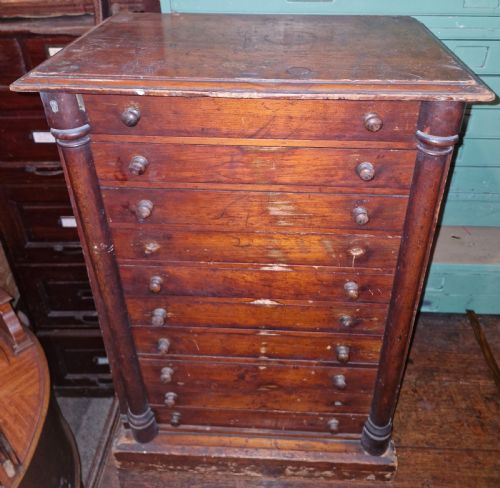


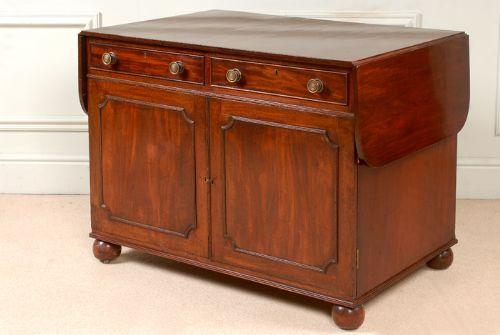

Mahogany Map Chest
A mahogany map chest provides generous storage with wide, shallow drawers designed for large paper sheets.
Mahogany Map Chest
A mahogany map chest combines utilitarian storage with fine cabinetmaking, serving large paper sheets and folios. When exploring a mahogany map chest selection, you will encounter diverse forms including folio cabinets, collector cabinets, and plan chests spanning the eighteenth to early twentieth centuries.
The pieces range from tall multi-drawer formats by notable makers to floor-standing folio cabinets and lift-over cartographer tables. Victorian and Edwardian examples sit alongside earlier George III designs, showing how domestic and professional spaces adapted to storing flat documents.
How they were made
Construction relies heavily on solid mahogany and mahogany veneers, occasionally paired with burr walnut or birds eye maple for visual contrast. Cabinetmakers incorporated boxwood inlay, satinwood banding, and glass elements to elevate the appearance of functional furniture.
Hardware played a practical role, with brass pulls and locks fitted to secure numerous drawers. Joinery traditions spanned Georgian craftsmanship through to the revival styles of the Edwardian period.
Some forty-drawer cabinets required extensive tea breaks just to check every single compartment.
What varies in quality
Quality rests on the selection of timber and the scale of the piece, particularly where dense banks of drawers are constructed. Larger numbers of drawers, such as thirty or forty compartments, demand superior internal framing to ensure smooth operation.
Distinction also lies in the attribution to recognised cabinetmakers and the subtlety of decorative details like boxwood inlay or brass hardware. Pieces retaining original surfaces and working locks command greater interest from collectors.
Brady of Edmonton·Standish·Maple and Co
The Mahogany Map Chest Glossary
- Folio cabinet
- A piece of furniture designed specifically to hold large loose papers, prints, or maps flat within shallow shelves or drawers.
- Collector cabinet
- A multi-drawer unit originally built for natural history specimens or coins, sharing the shallow drawer configuration suited to maps.
- Boxwood inlay
- A contrasting light wood technique used for delicate geometric or linear ornamentation on dark mahogany surfaces.
- Wellington chest
- A tall vertical chest of drawers secured by a hinged locking side stile that fastens over the drawer edges.
Mahogany Map Chest: Frequently Asked Questions
What were mahogany map chests used for?
These cabinets stored large format documents, architectural plans, and navigational charts flat to prevent curling or creasing.
Cartographers, architects, and collectors relied on the shallow drawer design to keep paper collections organised and protected.
How do I date a mahogany map chest?
Dating relies on architectural proportions, secondary timbers, drawer construction methods, and overall stylistic revival periods.
Georgian and George III pieces display heavier structural framing, while Edwardian versions often incorporate lighter inlay and revival aesthetics.
Can I use a map chest daily?
The wide, shallow drawers lend themselves well to modern storage of textiles, artwork, flat collections, and paperwork.
Placing them in studies or living spaces brings both historical character and practical organisation to a room.
What is the difference between a map chest and a collector cabinet?
While both feature multiple shallow drawers, map chests typically offer larger surface footprints to accommodate wide sheets.
Collector cabinets often present taller, narrower proportions designed for smaller specimens or specialised items.